











 Secure payments
Standard refund policy
Trade Assurance
Secure payments
Standard refund policy
Trade Assurance
| Product Type | Memory Module |
|---|---|
| Memory Capacity | 16 GB |
| Memory Technology | DDR4 |
| Product Voltage | 1.2V |
| RAM Speed | 2133MHz |
| RAM Standard | DDR4-2133/PC4-17000 |
| Error Identifying | ECC |
| Signal Type | Registered |
| Column Access Strobe (CAS) | CL15 |
| Rank | Dual Rank x4 |
| Quantity of Pins | 288-pin |
| RAM Genre | RDIMM |
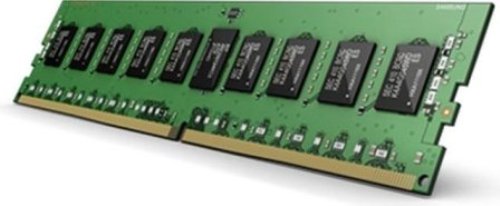
This Samsung DDR4-2133 16GB RDIMM (M393A2G40DB0-CPB2C) is a server-class memory module built for virtualization clusters and in-memory databases where data integrity and uptime are critical. Its registered ECC architecture with dual-rank x4 organization provides stable signal integrity under heavy load and delivers automatic single-bit error correction while leveraging interleaved bank accesses for sustained throughput.
1. ECC protection proactively corrects single-bit errors, eliminating silent data corruption that could compromise transactional integrity in critical database and virtualization environments.
2. Registered DIMM architecture buffers command and address signals, preserving signal integrity across high-capacity memory configurations essential for large-scale in-memory computing.
3. Dual Rank x4 organization interleaves bank accesses to keep memory channels fully saturated, delivering consistent bandwidth for smooth operation of mixed enterprise workloads.
4. 16 GB module capacity raises the memory ceiling per host, enabling higher virtual machine density and larger in-memory caches in software-defined data centers.
5. 1.2V low voltage reduces overall rack power draw and thermal output, shrinking operational expenses and cooling demands in hyperscale deployments.
The Samsung M393A2G40DB0-CPB2C is a server-class DDR4 RDIMM engineered for data centers where every transaction and virtual machine depends on unwavering memory integrity. Its four essential characteristics—ECC error correction, registered signal buffering, a dual-rank architecture, and 1.2V low-voltage operation—directly answer the real-world pain points of IT infrastructure. In a dense virtualization cluster hosting dozens of VMs per server, a single bit flip from background radiation can silently corrupt a database page or crash multiple tenants. The module’s ECC engine continuously detects and corrects single-bit errors, preserving transactional consistency without performance penalty, while the registered clock driver buffers command and address signals, maintaining crisp signal integrity across fully populated memory channels. This eliminates the intermittent boot failures and instability that plague unbuffered designs at scale. For an in-memory database like Redis or SAP HANA, latency and throughput are non-negotiable. The dual-rank organization enables rank interleaving, overlapping data bursts to boost effective bandwidth and absorb heavy read/write storms so response times stay flat under load. Meanwhile, the 1.2V power envelope curbs energy consumption, and across a rack of servers this directly lowers cooling demands and operational costs, turning a specification choice into a measurable reduction in total cost of ownership.
General Virtualization
This 16GB DDR4-2133 RDIMM is designed for virtualized server environments. For typical hypervisor hosts, populate at least four to eight identical modules across all memory channels to ensure balanced capacity and optimal memory bandwidth. A configuration of four modules (64GB total) supports moderate VM densities, while scaling to eight modules (128GB) comfortably handles heavier consolidation workloads.
In-Memory Database
For in-memory databases like Redis or SAP HANA, low latency trumps raw frequency; the CL15 timing and registered ECC of this module provide the reliability needed. Deploy multiple DIMMs per processor, populating all channels equally to maximize throughput and capacity. Aim for 128GB and above across the system, using eight or more of these 16GB sticks to keep large datasets entirely in RAM without swap penalties.
High-Performance Computing
HPC workloads benefit from the registered ECC stability of this 2133MHz RDIMM under sustained compute loads. Use a fully balanced memory population—one DIMM per channel across every memory controller—to unlock maximum memory bandwidth for parallel MPI or simulation codes. Depending on node design, 128GB (eight modules) or 256GB (sixteen modules) configurations keep high-thread-count cores fed while guarding against silent data corruption with ECC.
Rigorously tested for server compatibility: compatible with Dell PowerEdge R740, HPE DL380 Gen10, Lenovo ThinkSystem SR650.
Q: Can I mix this M393A2G40DB0-CPB2C with other memory modules of different brands or speeds?
A: Mixing RDIMMs of different brands or speeds is strongly discouraged. It may cause stability issues, force all modules to the lowest speed, or prevent boot. Identical modules are recommended for validated reliability.
Q: Is this memory compatible with my Intel or AMD server platform?
A: It is compatible with platforms supporting DDR4-2133 Registered ECC memory, such as Intel Xeon E5-2600 v3/v4 and select AMD EPYC 7001 series. Always consult your server motherboard's Qualified Vendor List to confirm support.
Q: What is the recommended DIMM population order for optimal performance?
A: For this dual‑rank RDIMM, balance channels by installing matching modules in sets. Start with the first slot of each memory channel (often indicated by blue or white tabs), then fill the second slots per your server manual.
Q: Does this module support overclocking or XMP profiles?
A: No. As an enterprise Registered ECC module, it strictly follows JEDEC DDR4-2133 specifications for maximum data integrity. Overclocking and XMP profiles are not supported and would contradict its reliability purpose.
Q: What warranty and typical failure rate can I expect?
A: The module is covered by a 1‑year warranty. Enterprise RDIMMs exhibit very low annualized failure rates, typically below 0.2% under proper thermal and operating conditions, owing to rigorous screening and error correction.