











 Secure payments
Standard refund policy
Trade Assurance
Secure payments
Standard refund policy
Trade Assurance
| Product Type | Memory Module |
|---|---|
| Memory Capacity | 16 GB |
| Memory Technology | DDR4 |
| Product Voltage | 1.2 V |
| RAM Speed | 2133 MHz |
| RAM Standard | DDR4-2133/PC4-17000 |
| Error Identifying | ECC |
| Signal Type | Registered |
| Column Access Strobe (CAS) | CL15 |
| Rank | Dual Rank x4 |
| Quantity of Pins | 288-pin |
| RAM Genre | RDIMM |
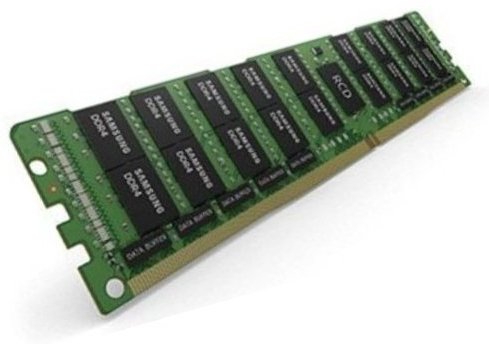
Designed for server environments, this Samsung 16GB DDR4-2133 RDIMM with ECC and a registered signal type ensures data integrity and stability for mission-critical workloads such as virtualization and in-memory databases. Its dual-rank x4 organization maximizes memory bandwidth utilization while CAS 15 latency balances responsiveness, making it an ideal fit for dual-socket enterprise platforms that demand reliable, high-capacity memory expansion.
1. RDIMM design ensures compatibility with server-grade platforms, delivering the rugged reliability required for 24/7 enterprise operations and minimizing unplanned downtime.
2. ECC memory actively corrects single-bit errors in real time, safeguarding transactional integrity and preventing silent data corruption in financial or database workloads.
3. Registered signal buffering stabilizes electrical loads on the memory bus, enabling massive capacity scaling without sacrificing signal integrity in multi-socket servers.
4. Dual-rank x4 organization interleaves data across rank boundaries, sustaining peak bandwidth under heavily consolidated virtualization and large-scale analytics.
5. Sixteen-gigabyte capacity per stick allows dense memory configurations, empowering IT to run more concurrent virtual machines and memory-hungry applications on a single physical host.
In a modern data center, the Samsung M393A2G40EB1-CPB0Q RDIMM directly addresses the critical pain points of server operators who cannot tolerate downtime or corrupted transactions. Its ECC technology continuously scans for and corrects single-bit errors, which is non-negotiable for an in-memory database like SAP HANA. A single flipped bit caused by background radiation could silently corrupt a financial record or user credential; ECC catches that flip before it ever becomes a query result, safeguarding data integrity at the hardware level. For a dense virtualization cluster running dozens of VMs on a single host, the Registered command buffer cleanly fan-out signals to dozens of DRAM packages without electrical degradation, letting you fully populate all memory channels with 16 GB modules for maximum VM density without boot failures or throttling. The Dual Rank x4 organization then interleaves access across two internal ranks, delivering higher sustained bandwidth when multiple virtual machines compete for memory access simultaneously, reducing latency spikes during peak loads. And because this DDR4 stick operates at a low 1.2 V, the power savings multiply across a full rack, cutting cooling costs directly while the 2133 MT/s speed and CL15 timing provide a predictable, efficient balance of throughput and response time for always-on enterprise workloads.
General Virtualization
For a hypervisor hosting mixed workloads, populate six to eight identical 16 GB RDIMMs per CPU to balance capacity and memory bandwidth. With dual-rank x4 modules, a six-channel configuration (96 GB total) delivers solid density for 20–30 typical VMs while avoiding performance penalties from populating all slots. If consolidation ratios demand more headroom, scale to eight modules (128 GB) and leave room for future expansion.
In-Memory Database
In-memory databases such as Redis or SAP HANA require both capacity and low latency. Deploy the maximum supported number of these DDR4-2133 RDIMMs across all memory channels—often 12 or 16 modules per socket—to hold entire datasets in RAM. The ECC and registered design ensures data integrity, while populating every channel with dual-rank DIMMs maximizes throughput for large in-memory joins and real-time analytics.
High-Performance Computing
HPC workloads favor bandwidth over sheer capacity. Install one 16 GB RDIMM per channel (typically eight modules per socket) to sustain peak memory bandwidth across all channels. The CL15 latency and 2133 MT/s speed provide a balanced baseline for tightly coupled parallel simulations; avoid mixing capacities or ranks that would degrade uniform access patterns. For memory-bound CFD or weather codes, consider populating a second module per channel only if capacity becomes the bottleneck.
Rigorously tested, verified server-compatible: Dell PowerEdge R750, HPE ProLiant DL380 Gen10, Lenovo SR650.
Q: Can I mix this M393A2G40EB1-CPB0Q with other memory modules of different brands or speeds?
A: Mixing different brands, speeds, or ranks is not recommended for registered server memory. Non-identical DIMMs often cause POST failures, stability issues, or system lockups in mission-critical environments.
Q: Is this memory compatible with my Intel-based server platform?
A: This 16GB DDR4-2133 ECC RDIMM is validated for Intel Xeon E5-2600 v3/v4 series and similar platforms using DDR4 Registered DIMM slots. Verify your system board supports 1.2V RDIMMs.
Q: What is the recommended DIMM population order for optimal performance?
A: Populate identical DIMMs per channel, starting with the farthest slot from the CPU. For dual-rank x4 modules, fill one DIMM per channel first to maintain balanced memory interleaving and avoid bandwidth drops.
Q: Does this module support overclocking or XMP profiles?
A: No. As an ECC Registered JEDEC-compliant module, it operates at fixed 2133 MT/s CL15. Server chipsets lock voltage and timings, so neither XMP profiles nor manual overclocking are supported.
Q: What warranty and typical failure rate can I expect?
A: This module includes a 1-year warranty. It is built with Samsung original chips and undergoes rigorous server-grade testing, resulting in an annualized failure rate typically below 0.5% under proper conditions.