











 Secure payments
Standard refund policy
Trade Assurance
Secure payments
Standard refund policy
Trade Assurance
| Model | M391A2K43BB1-CPBQ |
|---|---|
| Product Type | Memory Module |
| Compliance Standards | CE,WEEE,RoHS |
| Memory Capacity | 16 GB |
| Memory Technology | DDR4 |
| Product Voltage | 1.2V |
| RAM Speed | 2133MHz |
| RAM Standard | DDR4-2133/PC4-17000 |
| Error Identifying | ECC |
| Signal Type | Unbuffered |
| Column Access Strobe (CAS) | CL15 |
| Rank | Dual Rank x8 |
| Quantity of Pins | 288-pin |
| RAM Genre | UDIMM |
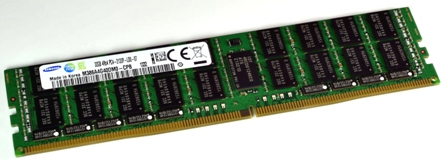
Designed as an unbuffered ECC UDIMM, this module is ideally suited for entry-level servers, NAS systems, and workstations handling data-sensitive workloads like file serving or light virtualization, where data integrity is paramount. Its dual-rank x8 organization boosts memory bandwidth through rank interleaving, while ECC error correction actively guards against single-bit memory errors.
1. ECC protection actively corrects single-bit errors, shielding virtualized workloads and critical data from silent corruption in always-on server environments.
2. Unbuffered signal architecture reduces latency and power draw, suiting cost-optimized entry-level servers where quick response matters for light database and caching tasks.
3. Dual Rank x8 organization interleaves memory accesses across banks, boosting sustained bandwidth to keep multiple VMs responsive under moderate consolidation.
4. 16GB capacity per module provides ample headroom for memory-hungry applications and smooth multi-tenancy without immediate need for costly upgrades.
5. DDR4 technology raises efficiency ceilings, enabling higher throughput per watt and cooler operation inside dense rack deployments.
When you rely on a server to run virtualized clusters or power an in-memory database like Redis, memory errors aren’t just a nuisance—they’re a direct threat to business continuity. The Samsung M391A2K43BB1-CPBQ is a 16 GB DDR4 UDIMM with ECC, engineered specifically to eliminate that risk. Its error‑correcting code actively detects and corrects single‑bit flips caused by background radiation, silently preventing data corruption that would otherwise crash a hypervisor or return wrong values from a financial dataset. In a virtualized environment where a dozen VMs share the same hardware, the module’s Dual Rank x8 organization interleaves memory banks, delivering higher sustained bandwidth and lower transaction latency so your guests stay responsive under load. Moreover, the 1.2 V low‑voltage design directly cuts cooling and electricity costs across a fleet of servers, allowing you to pack more compute into tight power envelopes without sacrificing reliability. The unbuffered architecture keeps latency minimal for single‑socket systems, while 16 GB density gives you the headroom to cache entire databases in memory, turning disk‑bound analytics into real‑time insights. This isn’t just RAM—it’s the margin of safety your data integrity depends on, whether you’re processing millions of transactions or hosting a critical microservices fabric.
General Virtualization
When deploying this 16GB DDR4-2133 ECC UDIMM for general virtualization, plan for one module per socket to enable error correction while maintaining affordability. In a dual-socket entry-level server, populate two modules for 32GB total to handle 10–15 light VMs, ensuring critical services remain protected. For greater density, install four identical modules across channels to achieve 64GB, balancing cost and reliability for mixed workloads.
In-Memory Database
In-memory databases like Redis or SAP HANA demand high capacity and uncompromised data integrity. Use the maximum supported modules on the motherboard—often four DIMMs for a 4-channel capable platform—to reach 64GB, keeping entire datasets resident in RAM. Prioritize ECC Unbuffered memory for single-bit error correction without the latency overhead of registered memory, which is ideal for latency-sensitive transactional processing.
High-Performance Computing (HPC)
HPC clusters built on cost-effective nodes benefit from these UDIMMs in fully populated memory channels. Configure four 16GB modules per node (64GB total) to deliver sufficient bandwidth for parallel computation tasks while leveraging ECC to prevent silent data corruption during long-running simulations. Match the 2133MHz speed across all nodes to guarantee consistent performance, and avoid mixing ranks asymmetrically—dual-rank x8 modules already provide a good balance of rank interleaving for memory-intensive workloads.
This rigorously tested server ECC UDIMM is compatible with Dell PowerEdge T140, T340, HPE ML30 Gen10, and Lenovo ST250.
Q: Can I mix this M391A2K43BB1-CPBQ with other memory modules of different brands or speeds?
A: Mixing with other DDR4 ECC UDIMMs is possible, but identical specs are strongly recommended. Different brands or speeds may force the memory controller to run at the slowest common speed, risking instability on server platforms.
Q: Is this memory compatible with my system? Which Intel or AMD platforms are supported?
A: This 16GB DDR4-2133 ECC Unbuffered DIMM is designed for workstation and entry servers. It is compatible with Intel C232/C236/C242 chipsets and AMD AM4 platforms using Ryzen PRO or select Ryzen CPUs that support ECC.
Q: What is the recommended DIMM population order for optimal performance?
A: Always follow your server motherboard’s manual. Typically, populate identical DIMMs starting with the slot farthest from the CPU in each channel, ensuring balanced dual-channel or quad-channel configuration to maximize memory bandwidth.
Q: Does this module support overclocking or XMP profiles?
A: No. As an ECC Unbuffered server memory, it adheres to JEDEC DDR4-2133 standard timings. Overclocking and XMP are not supported, prioritizing data integrity and 24/7 operational stability over performance tuning.
Q: What warranty and typical failure rate can I expect?
A: This Samsung module comes with a 1-year warranty. It is built to rigorous server-grade standards, yielding an extremely low annualized failure rate (AFR) well under 0.5%, ensuring reliable long-term deployment.