











 Secure payments
Standard refund policy
Trade Assurance
Secure payments
Standard refund policy
Trade Assurance
| Product Type | Memory Module |
|---|---|
| Compliance Standards | EU RoHS,FCC |
| Memory Capacity | 16 GB |
| Memory Technology | DDR4 |
| Product Voltage | 1.2 V |
| RAM Speed | 2400 MHz |
| RAM Standard | DDR4-2400/PC4-19200 |
| Error Identifying | ECC |
| Signal Type | Registered |
| Column Access Strobe (CAS) | CL17 |
| Rank | Single Rank x4 |
| Quantity of Pins | 288-pin |
| RAM Genre | RDIMM |
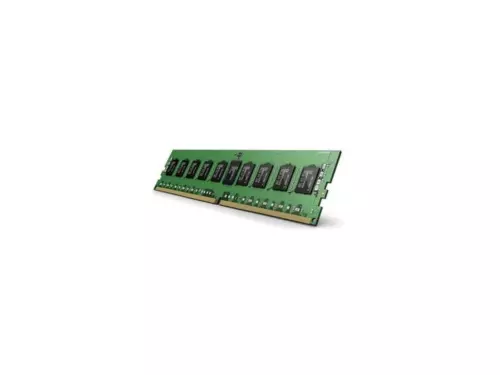
This 16GB DDR4-2400 RDIMM with ECC is purpose-built for enterprise server platforms, ideally suited for virtualization clusters and in-memory database workloads that demand continuous data integrity. Its registered signal architecture stabilizes command and address lines under heavy load, while the single-rank x4 organization minimizes bus loading to deliver consistent 2400MT/s throughput at CL17 latency.
1. ECC error correction silently detects and corrects single-bit data corruption in real time, safeguarding transactional integrity for virtualization and database workloads.
2. Registered signal buffering stabilizes command and address lines across heavily loaded memory channels, essential for maintaining uptime in multi-DIMM server configurations.
3. Sixteen-gigabyte module density packs more active VMs per server node, directly boosting consolidation ratios in virtualized infrastructure without sacrificing DIMM slot availability.
4. 1.2V low-power operation trims overall server energy consumption and thermal output, lowering cooling overhead in dense rack and blade deployments.
5. Single-rank x4 organization reduces per-channel electrical loading, helping sustain high transfer speeds for memory-throughput-hungry analytics and HPC environments.
The M393A2K40CB1-CRC4Q is a server-grade DDR4 Registered DIMM, engineered for the unwavering reliability that mission-critical workloads demand. Its ECC protection automatically detects and corrects single-bit memory errors, a non-negotiable safeguard in virtualization clusters where a flipped bit in a hypervisor can silently corrupt multiple guest operating systems and trigger cascading failures. The registered signal buffer enables stable operation when populating all 24 DIMM slots in a 2U rack server, letting you scale to terabyte-class memory without signal degradation—exactly what dense VDI or container hosts require to avoid unexpected reboots. At 16 GB per module with a single-rank x4 organization, this RDIMM balances bandwidth and latency for in-memory databases like SAP HANA; it delivers the rapid column access and sustained 19.2 GB/s throughput that let analytical queries scan billions of rows without stalling. Finally, the 1.2 V operating voltage and DDR4-2400 speed cut total power consumption across a fleet by up to 20% compared to earlier generations, reducing both electricity costs and cooling overhead in colocation environments while still meeting EU RoHS and FCC compliance for global deployment.
General Virtualization
For moderate consolidation (10–15 VMs per host), deploy six to eight of these 16 GB RDIMMs in a dual-socket server to provide 96–128 GB of registered ECC memory. Populate identical modules across all memory channels evenly to maintain balanced interleaving and avoid NUMA performance penalties.
In-Memory Database
Aim for maximum capacity within budgetary limits—install twelve or more modules across all available DIMM slots to reach 192 GB+ per node. Combine multiple 16 GB single-rank x4 RDIMMs per channel while strictly respecting the platform’s population order to preserve signal integrity at 2400 MT/s.
High-Performance Computing
Fill all memory channels symmetrically with one module per channel to maximize bandwidth for compute-bound workloads; a typical dual-socket node would use sixteen of these RDIMMs for 256 GB total. Stick to identical single-rank registered modules to keep latency predictable and avoid clock cycle penalties during tightly coupled parallel jobs.
Rigorously tested, compatible with Dell PowerEdge R740, HPE ProLiant DL380 Gen10, Lenovo ThinkSystem SR650, and Supermicro X11 series.
Q: Can I mix this M393A2K40CB1-CRC4Q with other memory modules of different brands or speeds?
A: Mixing is strongly discouraged for server environments. To maintain stable ECC operation and signal integrity, populate all channels with identical M393A2K40CB1-CRC4Q modules. Mismatched DIMMs often default to the lowest common speed and can cause parity errors.
Q: Is this RDIMM compatible with my Intel Xeon or AMD EPYC server platform?
A: Yes, this 16GB DDR4-2400 ECC Registered DIMM is compatible with Intel Xeon E5-2600 v3/v4 and Xeon Scalable platforms, as well as AMD EPYC 7000 series. Always confirm that your specific server motherboard lists this part in its Qualified Vendor List.
Q: What is the recommended DIMM population order for optimal performance?
A: For optimal interleaved performance, install identical modules in sets that match your memory channels. Typically, populate the slots farthest from the CPU first (e.g., DIMM A1, B1). Always follow your server board’s specific population guide to maximize bandwidth.
Q: Does this module support overclocking or XMP profiles?
A: No. As a server-grade JEDEC-compliant DDR4-2400 RDIMM, this module does not support overclocking or XMP profiles. It is engineered for maximum stability, data integrity, and continuous 24/7 operation, strictly running at its specified timings.
Q: What warranty and typical failure rate can I expect?
A: This Samsung RDIMM includes a 1-year warranty. Enterprise memory like this typically demonstrates an annualized failure rate (AFR) well below 0.5% under proper thermal and environmental conditions, reflecting its high reliability for critical workloads.