











 Secure payments
Standard refund policy
Trade Assurance
Secure payments
Standard refund policy
Trade Assurance
| Product Type | Memory Module |
|---|---|
| Memory Capacity | 16 GB |
| Memory Technology | DDR4 |
| Product Voltage | 1.2 V |
| RAM Speed | 2400 MHz |
| RAM Standard | DDR4-2400/PC4-19200 |
| Error Identifying | ECC |
| Signal Type | Registered |
| Column Access Strobe (CAS) | CL17 |
| Rank | Single Rank x4 |
| Quantity of Pins | 288-pin |
| RAM Genre | RDIMM |
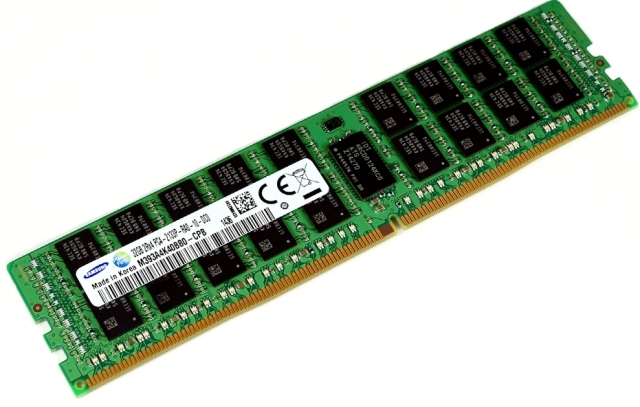
This 16GB DDR4-2400 Registered ECC module, built with a single-rank x4 organization and a CAS latency of 17, is engineered for enterprise servers powering virtualization and in-memory database workloads where uncompromising data integrity and low bus loading are essential. Its 1.2 V registered design provides stable signal buffering for dense multi-DIMM configurations, while the integrated ECC actively corrects single-bit errors to ensure continuous, corruption-free operation.
1. ECC error correction safeguards data integrity, essential for preventing silent data corruption in mission-critical enterprise databases.
2. Registered signal buffering stabilizes high-capacity memory configurations, enabling seamless scaling to support large virtualized workloads without compromising signal integrity.
3. 16GB per module strikes the ideal balance for dense cloud servers, maximizing VM density per rack unit while maintaining a low cost per gigabyte.
4. 2400 MT/s throughput delivers consistent memory bandwidth, accelerating in-memory analytics and real-time processing in always-on enterprise applications.
5. Single Rank x4 organization reduces electrical loading on the memory bus, allowing fully populated server boards to sustain higher clock frequencies for predictable performance.
The Samsung M393A2K40BB1-CRC4Q is a DDR4-2400 Registered DIMM with ECC, purpose-built for server environments where uptime and data fidelity are non-negotiable. Its four defining characteristics translate directly into operational resilience. Electronic noise or cosmic radiation can silently flip a memory bit; the integrated ECC engine detects and corrects these errors in real time, preventing database corruption that could cascade into billing inaccuracies or inventory mismatches in transactional systems. The Registered signal buffer re-drives address and command lines, enabling a single server to populate all memory channels with 16 GB RDIMMs without signal degradation. For a virtualized cluster running dozens of VMs on one node, this means you can provision large, stable memory pools without unexpected hypervisor crashes. The Single Rank x4 organization balances latency and bandwidth, delivering consistent CL17 access times crucial for in-memory databases like Redis or SAP HANA—every nanosecond saved in query response directly accelerates user-facing analytics or financial trades. Finally, the 1.2 V operating voltage reduces thermal load across dense rack deployments, shrinking cooling costs and extending the service life of adjacent components in a 24/7 data center.
General Virtualization
For balanced density and cost, populate one 16GB RDIMM per channel across all available memory channels. In a dual-socket server with six channels per CPU, this yields 192 GB using twelve modules—ideal for running dozens of VMs without sacrificing the native 2400 MT/s speed. The single-rank x4 design maintains low latency under mixed workload pressure.
In-Memory Database
Maximize capacity by installing two DIMMs per channel (2DPC), reaching 384 GB in the same dual-socket platform. Although 2DPC may invoke a minor speed step-down, the registered ECC integrity and 2400 base rate still deliver the large, reliable footprint required by Redis or SAP HANA. Use identical Samsung modules to guarantee consistent timing and error protection.
High-Performance Computing
Achieve peak memory bandwidth by sticking to one DIMM per channel, keeping all modules at the full 2400 MT/s. The single-rank RDIMM’s reduced electrical loading improves command scheduling, directly benefiting MPI or simulation codes. A symmetric 96–192 GB configuration across all channels eliminates NUMA bottlenecks and sustains line-speed data delivery for compute-bound workloads.
Rigorously tested for servers. Compatible with Dell PowerEdge R740, HPE DL380 Gen10, Lenovo SR650, and more.
Q: Can I mix this M393A2K40BB1-CRC4Q with other memory modules of different brands or speeds?
A: Mixing different brands or speeds is not recommended for this Registered ECC server memory. It may cause instability or failure to POST. For reliable operation, always install identical modules with the same part number, rank, and timings.
Q: Is this memory compatible with my system?
A: This is a DDR4-2400 Registered ECC RDIMM designed for server platforms using Intel Xeon E5-2600 v3/v4 or AMD EPYC 7001 series processors. Verify your server board supports 288-pin RDIMMs and ECC before purchasing.
Q: What is the recommended DIMM population order for optimal performance?
A: Follow your server motherboard manual for optimal channel population. Typically, populate identical modules in sets of four or eight, balancing capacity per channel. For single-rank x4 DIMMs like this, fill blue slots first on dual-processor boards.
Q: Does this module support overclocking or XMP profiles?
A: No. This is a server-grade Registered ECC DIMM running at JEDEC standard DDR4-2400 CL17. It does not support XMP or overclocking, as stability and data integrity are prioritized in enterprise environments.
Q: Can I install this RDIMM in a standard desktop PC or laptop?
A: No. Registered ECC memory is electrically incompatible with consumer desktop and laptop motherboards, which require unbuffered non-ECC DIMMs or SO-DIMMs. Using this module in such systems will prevent booting.