











 Secure payments
Standard refund policy
Trade Assurance
Secure payments
Standard refund policy
Trade Assurance
| Product Type | Memory Module |
|---|---|
| Memory Capacity | 16 GB |
| Memory Technology | DDR4 |
| Product Voltage | 1.2 V |
| RAM Speed | 2400 MHz |
| RAM Standard | DDR4-2400/PC4-19200 |
| Error Identifying | ECC |
| Signal Type | Registered |
| Column Access Strobe (CAS) | CL17 |
| Rank | Dual Rank x8 |
| Quantity of Pins | 288-pin |
| RAM Genre | RDIMM |
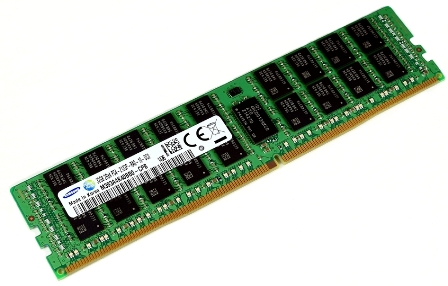
This is a server-class DDR4-2400 Registered ECC DIMM (RDIMM), ideally suited for virtualization hosts, in-memory databases, and other enterprise workloads where data integrity and high memory density are critical. Its dual-rank x8 organization and registered signaling ensure robust signal integrity and stable operation in multi-DIMM configurations, while ECC provides single-bit error correction to prevent silent data corruption.
1. ECC protection corrects single-bit errors and detects multi-bit faults in real time, safeguarding transactional data integrity for mission-critical enterprise applications.
2. Registered signal buffering stabilizes high-density memory channels, allowing dense server configurations to scale without compromising command bus reliability.
3. Dual Rank x8 organization interleaves memory accesses across multiple banks, boosting effective bandwidth for virtualized environments handling varied workloads simultaneously.
4. The 16-gigabyte module capacity strikes a balance between footprint and compute density, ideal for building cost-effective virtualization nodes with plenty of headroom per guest.
5. DDR4-2400 speed provides steady, validated throughput that aligns with conservative server refresh cycles, ensuring broad platform compatibility without unexpected tuning.
In the relentless environment of data center operations, the Samsung M393A2K43CB1-CRC0Q is not just a memory module; it is a strategic asset. As a registered DDR4-2400 RDIMM with ECC, its 16 GB capacity on a dual-rank x8 design directly addresses the critical vulnerabilities that keep IT managers awake at night.
When you are orchestrating a dense virtualization cluster hosting dozens of virtual machines per node, memory errors are silent killers. The integrated ECC technology actively detects and corrects single-bit flips caused by background radiation, preventing a flipped bit from silently corrupting a transactional database or crashing an entire VM guest that your business depends on. Without ECC, that undetected error could cascade into data loss or hours of painful forensic diagnostics. Simultaneously, the registered architecture buffers the command and address signals, dramatically reducing the electrical load on the memory controller. This allows you to fully populate all banks in a multi-socket server with rock-solid stability, enabling massive in-memory caching for real-time analytics or Redis clusters where every microsecond of latency counts. The dual-rank configuration further boosts performance through rank interleaving, allowing the memory controller to begin a read on one rank while another completes a write, effectively saturating bandwidth during burst-heavy workloads. This means a more responsive database, smoother live migration of VMs, and uncompromised data integrity under continuous, heavy load—turning your memory from a basic component into a foundation of enterprise reliability.
General Virtualization
For a hypervisor hosting multiple VMs, density is key. Populate all available channels with 16GB RDIMMs to maximize total capacity while maintaining balanced memory interleaving. A dual-socket server with 12 DIMM slots per CPU can deliver 384GB using 24 modules, comfortably supporting 50+ light-to-medium virtual machines.
In-Memory Database
In-memory databases like Redis or SAP HANA demand both capacity and fault tolerance. Deploy six or more identical 16GB RDIMMs per memory controller to sustain high throughput under heavy OLTP workloads. Always configure memory mirroring or sparing in the BIOS when data integrity is critical, and use identical dual-rank x8 DIMMs to avoid rank contention.
High-Performance Computing
HPC clusters benefit from the bandwidth of fully populated memory channels. Install one 16GB RDIMM per channel (typically eight DIMMs per socket) to achieve peak memory bandwidth for MPI workloads. Registered ECC operation ensures reliable scaling across hundreds of nodes during week-long simulation runs without silent data corruption.
Rigorously tested server memory. Compatible with Dell PowerEdge R760, HPE ProLiant DL380 Gen10, Lenovo ThinkSystem SR650.
Q: Can I mix this M393A2K43CB1-CRC0Q with other memory modules of different brands or speeds?
A: Mixing is strongly discouraged. Registered ECC RDIMMs require identical ranks, latency, and speed for stable multi-channel operation. Mismatched modules may cause POST failures or data corruption in server environments.
Q: Is this memory compatible with my system?
A: This 16GB DDR4-2400 ECC RDIMM is designed for server platforms such as Intel Xeon E5 v3/v4 or AMD EPYC 7001 series. Verify your motherboard supports 288-pin Registered DIMMs and 1.2V operation.
Q: What is the recommended DIMM population order for optimal performance?
A: Follow your server board's manual. Typically, populate identical DIMMs per channel starting from the farthest slot from the CPU. Balanced loading across all memory channels ensures maximum bandwidth and interleaving efficiency.
Q: Does this module support overclocking or XMP profiles?
A: No. Server-class Registered ECC memory adheres strictly to JEDEC standards for maximum reliability. It does not support overclocking or XMP profiles, as data integrity takes precedence over speed.
Q: What warranty and typical failure rate can I expect?
A: This product includes a one-year warranty. As an enterprise-grade Samsung RDIMM with full component screening, it exhibits an extremely low annualized failure rate, typically below 0.1% under rated conditions.