











 Secure payments
Standard refund policy
Trade Assurance
Secure payments
Standard refund policy
Trade Assurance
| Product Type | Memory Module |
|---|---|
| Memory Capacity | 16 GB |
| Memory Technology | DDR4 |
| Product Voltage | 1.2V |
| RAM Standard | DDR4-2400/PC4-19200 |
| Error Identifying | ECC |
| Signal Type | Registered |
| Column Access Strobe (CAS) | CL17 |
| Rank | Single Rank |
| Quantity of Pins | 288-pin |
| RAM Genre | RDIMM |
Designed for server environments, this 16GB DDR4-2400 RDIMM leverages Registered logic and ECC to ensure signal integrity and data reliability in high-density deployments. It is best suited for virtualization clusters and memory-intensive databases where Single Rank configuration at CL17 reduces load on the memory controller, enabling stable operation across 24/7 enterprise workloads.
1. ECC error correction safeguards data integrity in memory, virtually eliminating silent data corruption for mission-critical enterprise workloads.
2. Registered signal buffering stabilizes high-capacity deployments, enabling reliable operation across fully populated server memory channels.
3. Sixteen-gigabyte capacity per module delivers the density needed to consolidate more virtual machines per host without sacrificing performance.
4. DDR4-2400 throughput balances bandwidth and power, sustaining consistent application performance in scale-out data center environments.
5. Single Rank construction reduces electrical load on the memory bus, allowing servers to maintain rated speeds even with all DIMM slots filled.
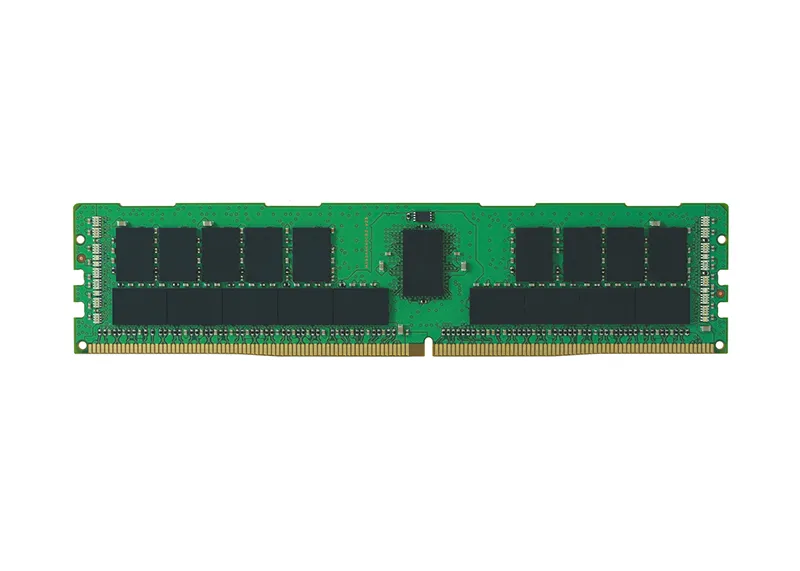
Meet the Samsung M393A2K40BB1, a 16GB DDR4-2400 RDIMM purpose-built for enterprise servers. In a virtualized cluster hosting dozens of VMs, even a single uncorrected memory bit flip can silently corrupt a financial database or bring down a critical node. This module’s ECC engine detects and corrects those errors on the fly, transforming a potential outage into a non-event. Its registered clock driver buffers command and address signals, preserving crisp signal integrity when you fully populate all memory channels in a dense dual-socket system—a necessity when scaling to hundreds of gigabytes for an in-memory analytics engine like SAP HANA or a high-throughput Redis cache, where every microsecond of latency impacts user experience. The single-rank design minimizes electrical loading, enabling stable operation at DDR4-2400 CL17 while improving rank interleaving efficiency across channels, which directly accelerates query throughput on large tables. With a low 1.2V power envelope, it also reduces thermal stress and cooling costs during 24/7 operation, delivering the reliability and consistent performance your data center demands.
General Virtualization
For general virtualization hosts running multiple VMs, density per channel is critical. Deploy this 16GB RDIMM in a balanced configuration, typically populating at least one DIMM per memory channel (e.g., 8 modules in a dual-socket system for 128GB total) to maintain bandwidth while providing sufficient capacity for moderate consolidation ratios. Stick to identical single-rank DIMMs to avoid performance penalties from mixed-rank configurations.
In-Memory Database
In-memory databases like SAP HANA or Redis demand maximum capacity and reliability. Use as many 16GB registered ECC modules as your platform supports, ideally filling all channels with multiple DIMMs per channel (2DPC) to reach 256GB or more per socket. The single-rank design at DDR4-2400 helps balance latency and density, and ECC is non-negotiable for data integrity.
High-Performance Computing
For HPC workloads sensitive to memory bandwidth, populate all memory channels symmetrically, one single-rank DIMM per channel initially. Start with 8 or 12 identical 16GB RDIMMs to achieve peak theoretical bandwidth while keeping total capacity adequate for most simulation and modeling jobs. If more capacity is needed, move to two DIMMs per channel but stay within the same rank type to preserve clock speeds.
Rigorously validated for server use with Dell PowerEdge R760, HPE ProLiant DL380 Gen10, Lenovo ThinkSystem SR650, Supermicro SYS-620P-TR.
Q: Can I mix this M393A2K40BB1 with other memory modules of different brands or speeds?
A: Mixing different brands or speeds is not recommended for servers, as it may cause instability. For optimal reliability, use identical modules with the same rank, CAS latency, and part number in all channels.
Q: Is this memory compatible with my system?
A: This RDIMM is compatible with select Intel Xeon E5 v4/v3 and AMD EPYC 7001 series platforms using DDR4-2400. Please consult your server’s memory QVL to confirm platform support.
Q: What is the recommended DIMM population order for optimal performance?
A: For optimal performance, populate DIMMs in identical sets per memory channel, starting with the blue or farthest slots. Follow your server manual’s balancing guidelines for symmetric channel loading.
Q: Does this module support overclocking or XMP profiles?
A: No, this is a server-grade Registered DIMM running at standard JEDEC speeds (DDR4-2400, CL17). It does not support XMP or overclocking, as stability and data integrity are paramount in server environments.
Q: What warranty and typical failure rate can I expect?
A: This module is backed by a 1-year warranty covering defects. Server memory typically exhibits a very low annualized failure rate (AFR) of approximately 0.2–0.5% under normal operating conditions.