











 Secure payments
Standard refund policy
Trade Assurance
Secure payments
Standard refund policy
Trade Assurance
| Product Type | Memory Module |
|---|---|
| Memory Capacity | 16 GB |
| Memory Technology | DDR4 |
| Product Voltage | 1.2V |
| RAM Speed | 2400MHz |
| RAM Standard | DDR4-2400/PC4-19200 |
| Error Identifying | ECC |
| Signal Type | Registered |
| Column Access Strobe (CAS) | CL17 |
| Rank | Single Rank x4 |
| Quantity of Pins | 288-pin |
| RAM Genre | RDIMM |
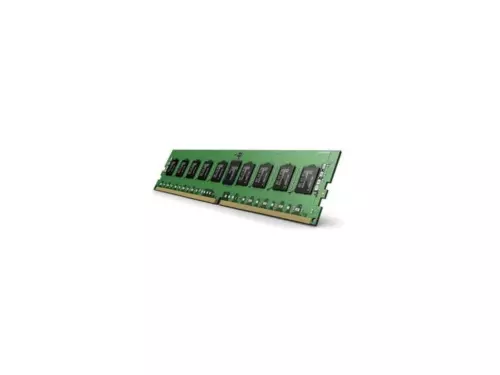
This 16GB DDR4-2400 ECC Registered DIMM (RDIMM) with a Single Rank x4 configuration delivers optimized memory bus efficiency and low CL17 latency, making it ideal for virtualization and in-memory database servers where data integrity is paramount. Its registered signal technology and hardware error correction ensure superior platform stability across large-scale, mission-critical deployments by buffering address and command signals to reduce electrical loading on the memory controller.
1. ECC error correction silently catches and repairs single-bit flips, preserving data integrity for always-on transactional databases where even one corrupted bit can crash a financial application.
2. Registered signal buffering decouples the memory controller from the DRAM load, enabling a server to fully populate all channels and scale to terabytes of RAM for dense virtualized clusters.
3. Sixteen gigabytes per module provides an optimal building block that balances per-VM memory allocation and total node capacity, maximizing instance density in private cloud hosts.
4. Steady 2400MT/s throughput ensures each of the many cores in a dual-socket server receives a non-stop data stream, preventing starvation under heavy concurrent query processing.
5. A 1.2-volt operating rail cuts per-DIMM power draw and rack-level cooling overhead, directly translating to lower energy bills for hyperscale and colocation data centers.
The M393A2K40CB1-CRC0Y is a 16GB DDR4-2400 Registered ECC DIMM purpose-built for enterprise servers, where its four core attributes directly strengthen your critical operations. ECC actively corrects single-bit memory errors on the fly. In an in-memory database processing financial transactions, an undetected bit flip can silently corrupt data and trigger costly failures—this module eliminates that risk, preserving transactional integrity without performance trade-offs. The Registered buffer isolates the memory controller from electrical loading when all 24 DIMM slots are populated, allowing virtualization clusters to safely achieve maximum RAM capacity. Your hypervisor hosts can run dozens more virtual machines with unwavering signal stability, avoiding blue-screen cascades under multitenant pressure. The single-rank x4 configuration and CL17 latency yield balanced bandwidth and rapid access, giving simultaneous VMs and containerized analytics the predictable responsiveness they demand. Finally, the 1.2V operating voltage reduces thermal output in dense racks, cutting cooling expenses and extending component life. For a VMware farm or a Redis cluster, that means proven uptime, denser workload consolidation, and a lower total cost of ownership—not just specifications, but hardened business continuity.
General Virtualization
For general virtualization, density per host is critical. Populate at least four of these 16GB RDIMMs (64GB total) across dual channels to balance cost and VM density. Use dual-processor servers and distribute identical modules symmetrically for NUMA-aware performance, leaving expansion slots free for future growth.
In-Memory Database
In-memory databases demand both capacity and memory bandwidth. Configure six or eight identical 16GB RDIMMs (96–128GB) in a balanced multi-channel layout, typically one DIMM per channel, to maximize throughput. Maintain a uniform single-rank x4 population to keep latency low and avoid performance cliffs under heavy OLAP or caching workloads.
High-Performance Computing (HPC)
HPC nodes benefit from maximum memory channels. Install eight modules (128GB total) across all available channels, using one DIMM per channel for optimal speed. The registered ECC design ensures data integrity during long-running simulations, and the 1.2V low-voltage operation helps manage power density in dense cluster deployments.
Rigorously tested server memory. Compatible with Dell PowerEdge R760, HPE ProLiant DL380 Gen10, Lenovo ThinkSystem SR650, and more.
Q: Can I mix this M393A2K40CB1-CRC0Y with other memory modules of different brands or speeds?
A: Mixing different brands or speeds in a server DDR4 ECC RDIMM configuration is not recommended. The system will downclock to the slowest module, potentially causing stability issues. Use identical modules for validated reliability and consistent performance.
Q: Is this memory compatible with my system?
A: This DDR4-2400 ECC Registered DIMM is designed for Intel Xeon E5-2600 v3/v4 and AMD EPYC platforms. Please check your server or motherboard Qualified Vendor List (QVL) to confirm compatibility with your specific platform.
Q: What is the recommended DIMM population order for optimal performance?
A: For dual-socket servers, populate identical DIMMs in sets per channel, typically starting with slots A1/B1, then A2/B2. Always follow the population guidelines in your server motherboard manual to maximize memory bandwidth and interleaving.
Q: Does this module support overclocking or XMP profiles?
A: No, this ECC Registered server memory does not support overclocking or XMP profiles. It operates strictly at JEDEC standard DDR4-2400 with CL17 to ensure data integrity and long-term stability in mission-critical environments.
Q: What warranty and typical failure rate can I expect?
A: This module includes a 1-year warranty. Server-grade RDIMMs like this typically exhibit an annualized failure rate (AFR) below 0.5% under 24/7 operation, reflecting the high reliability required for enterprise workloads.