











 Secure payments
Standard refund policy
Trade Assurance
Secure payments
Standard refund policy
Trade Assurance
| Product Type | Memory Module |
|---|---|
| Compliance Standards | CE,WEEE,RoHS |
| Memory Capacity | 16 GB |
| Memory Technology | DDR4 |
| Product Voltage | 1.2V |
| RAM Speed | 2400MHz |
| RAM Standard | DDR4-2400/PC4-19200 |
| Error Identifying | Non-ECC |
| Signal Type | Unbuffered |
| Column Access Strobe (CAS) | CL17 |
| Rank | Dual Rank x8 |
| Quantity of Pins | 288-pin |
| RAM Genre | UDIMM |
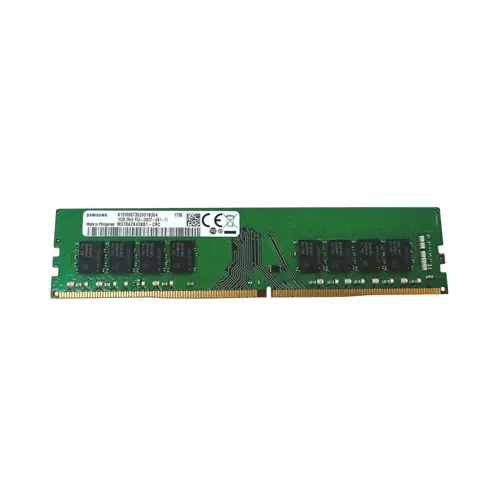
This 16GB DDR4-2400 UDIMM leverages a dual-rank x8 organization to enable memory interleaving, which boosts bandwidth efficiency for demanding desktop multitasking. Its unbuffered, non-ECC architecture and JEDEC-compliant CL17 latency at 1.2 V deliver predictable, reliable performance ideally suited for gaming rigs and content creation workstations.
1. 16GB capacity lets creators edit high-resolution footage and run multiple design tools simultaneously without triggering memory-compromised slowdowns.
2. 2400MHz clock speed delivers consistent frame delivery in modern games, preventing micro-stutters when streaming or recording gameplay in the background.
3. CL17 latency tightens command response, giving competitive gamers faster input-to-display reaction during high-refresh-rate matches.
4. Dual Rank x8 organization boosts interleaved bandwidth, noticeably shortening render-export times for 3D modeling and video post-production.
5. DDR4 technology ensures drop-in compatibility across mainstream Intel and AMD desktop platforms, enabling a hassle-free build or upgrade.
When upgrading your desktop system, the Samsung M378A2K43BB1-CRC DDR4 UDIMM module directly addresses the real-world frustrations of stuttering and slowdown in demanding tasks. This 16GB, dual-rank x8 stick runs at 2400MHz with a CAS latency of just 17 cycles, which means in a triple-A game, the CPU spends less time waiting for level assets to stream, giving you smoother frame delivery and snappier texture pop-in during chaotic firefights. Because it is unbuffered and non-ECC, the memory controller talks straight to the DRAM without added latency from a register chip, a design that keeps the command path short and responsive precisely when every millisecond counts in a 4K video render or real-time 3D modeling. The 1.2V low-voltage operation reduces thermal buildup inside your case during multi-hour rendering sessions, helping maintain consistent boost clocks without throttling. Built to CE, WEEE, and RoHS standards, this 288-pin module drops into consumer boards easily, letting content creators and competitive players turn a spec bump into a tangible productivity and gaming advantage without complex tuning.
Gaming Build
For dual-channel gaming configurations, deploy a matched pair of these 16GB DDR4-2400 UDIMMs for a total of 32GB. While 2400MHz is modest, Dual Rank x8 modules can still deliver decent bandwidth in symmetric setups, and 32GB comfortably handles modern titles, streaming, and background tasks. For budget-focused 16GB kits, use two 8GB sticks instead—these 16GB modules are best reserved for capacity-oriented gamers.
Content Creation
Content creation workloads like 4K video editing and 3D rendering demand high capacity. Populate all four DIMM slots with these 16GB modules to reach 64GB, ensuring smooth timeline scrubbing and reduced swap usage. The unbuffered, Non-ECC design suits workstation-class desktop boards; just be aware that 2400MHz may be a slight bottleneck for memory-bandwidth-intensive effects, so prioritize capacity over raw speed here.
General Productivity
For office multitasking, web browsing, and light productivity, a single 16GB module offers the best price-to-performance starting point. Users can later add an identical second stick to enable dual-channel mode and double capacity to 32GB if needs grow. This approach keeps initial costs low while preserving a straightforward upgrade path on typical consumer desktop platforms.
Rigorously tested, compatible with desktops like Dell OptiPlex 7050, HP EliteDesk 800 G3, Lenovo ThinkCentre M710.
Q: Can I mix this M378A2K43BB1-CRC with other memory modules of different brands or speeds?
A: Mixing is possible, but not recommended. The system will default to the slowest module's speed and timings, which may cause instability. For optimal reliability, use identical modules.
Q: Is this memory compatible with my system? I'm using an Intel/AMD desktop platform.
A: It is compatible with desktops using DDR4 UDIMM slots. It supports Intel 100-series and newer, or AMD 300-series and newer chipsets. Always verify your motherboard's QVL list for specific compatibility.
Q: What is the recommended DIMM population order for optimal performance?
A: Install matching pairs in the same-colored slots (typically A2 and B2 first) to enable dual-channel mode. Consult your motherboard manual for the exact population order to maximize bandwidth.
Q: Does this module support overclocking or XMP profiles?
A: No, this is a standard JEDEC DDR4-2400 module without XMP. It operates at its rated 2400MHz speed with CL17 timings and does not support user overclocking. It will run at default JEDEC profiles.
Q: What warranty and typical failure rate can I expect?
A: This module includes a 1-year warranty. It is built to JEDEC standards with a very low annualized failure rate (AFR), typically under 0.5%, ensuring high reliability for mainstream desktop use.