











 Secure payments
Standard refund policy
Trade Assurance
Secure payments
Standard refund policy
Trade Assurance
| Model | M393A2K40BB2-CTD7Q |
|---|---|
| Product Type | Memory Module |
| Compliance Standards | EU RoHS,FCC |
| Memory Capacity | 16 GB |
| Memory Technology | DDR4 |
| Product Voltage | 1.2V |
| RAM Speed | 2666MHz |
| RAM Standard | DDR4-2666/PC4-21300 |
| Error Identifying | ECC |
| Signal Type | Registered |
| Column Access Strobe (CAS) | CL19 |
| Rank | Single Rank x4 |
| Quantity of Pins | 288-pin |
| RAM Genre | RDIMM |
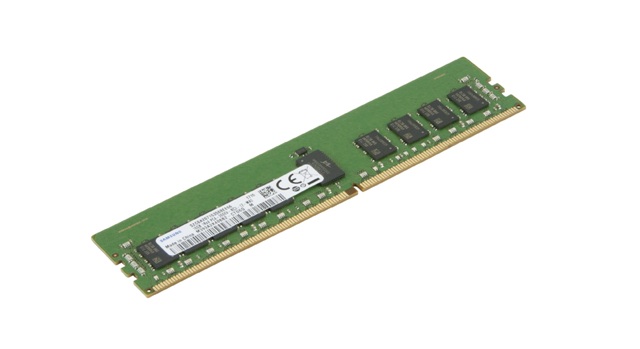
This Samsung 16GB DDR4-2666 RDIMM (M393A2K40BB2-CTD7Q) is engineered for enterprise servers, delivering registered ECC memory that ensures data integrity in virtualized environments, in-memory databases, and mission-critical workloads. Its Single Rank x4 organization and CL19 latency provide stable signal integrity and predictable performance when populating high-density server configurations.
1. ECC protection detects and corrects single-bit memory errors in real time, preventing silent data corruption in mission-critical database and financial transaction workloads.
2. Registered signal buffering stabilizes high-density memory configurations, allowing fully populated server nodes to sustain heavy virtualization without signal degradation.
3. 16 GB capacity per module strikes a balance between density and cost, enabling optimal VM packing for mid-scale private cloud deployments without overprovisioning.
4. 2666 MHz transfer speed delivers consistent per-channel bandwidth, keeping latency-sensitive enterprise applications responsive even under concurrent user spikes.
5. 1.2V ultra-low operating voltage reduces thermal dissipation across rack-scale deployments, directly lowering data center cooling overhead and energy costs.
Understanding that your infrastructure never sleeps, the Samsung M393A2K40BB2-CTD7Q RDIMM is engineered to eliminate the silent threats that undermine server reliability. Its ECC technology is non-negotiable—in a dense virtualization cluster hosting dozens of VMs, a single cosmic-ray-induced bit flip can corrupt a financial transaction or crash a tenant instance. ECC detects and corrects those errors in real time, preserving data integrity and preventing costly, erratic downtime. The Registered signal buffer is equally vital: it decouples the memory controller from the DRAM chips, allowing a single server to support massive 16GB DIMMs across numerous slots without destabilizing the command bus. For an in-memory database like SAP HANA or Redis, this means you can scale to terabytes of hot data while maintaining the clock-clean stability required for microsecond-sensitive queries. Operating at a cool 1.2V, the module draws less power per gigabyte, lowering cumulative thermal load inside a packed rack and reducing your energy budget. Finally, the Single Rank x4 organization ensures uniform, predictable bandwidth across channels, avoiding the inter-rank timing penalties that fragment throughput during sustained analytics workloads. This isn’t just memory; it’s a guarantee that your critical services remain consistent, responsive, and continuously available.
This Samsung M393A2K40BB2-CTD7Q is a 16GB DDR4-2666 ECC Registered DIMM designed for server platforms. Capacity planning for its typical workloads is as follows.
General Virtualization
Start by installing one DIMM per memory channel—for an 8-channel platform that means 8 modules (128 GB). This configuration balances capacity with full bandwidth and leaves slots free for future growth. When VM density demands more memory, add a second identical DIMM per channel to reach 256 GB while maintaining ECC integrity.
In-Memory Database
Maximize capacity by populating two DIMMs per channel; a dual-socket server with 12 channels per CPU yields 384 GB using 24 modules. Uniform modules ensure consistent rank and CAS latency (CL19), reducing the risk of memory errors in transaction-heavy environments.
High-Performance Computing (HPC)
HPC workloads crave memory bandwidth: populate exactly one DIMM per channel (8 modules for 128 GB) to sustain the full 2666 MT/s speed. Adding a second DIMM per channel often downgrades the speed to 2400 MT/s, which would bottleneck floating-point calculations. For a dual-socket system, 16 modules deliver 256 GB with no frequency penalty.
Tested server memory, compatible with Dell PowerEdge R760, HPE ProLiant DL380 Gen10, and Lenovo ThinkSystem SR650.
Q: Can I mix this M393A2K40BB2-CTD7Q with other memory modules of different brands or speeds?
A: Mixing RDIMMs of different brands or speeds is not recommended. It often causes system instability or boot failures. For guaranteed reliability, populate all channels with identical M393A2K40BB2-CTD7Q modules.
Q: Is this memory compatible with my system?
A: This DDR4-2666 Registered ECC module is compatible with servers featuring Intel Xeon Scalable or AMD EPYC processors. Please check your motherboard's qualified vendor list to confirm support for 16GB 2Rx4 RDIMMs.
Q: What is the recommended DIMM population order for optimal performance?
A: Follow your server board manual. Generally, populate the first slot of each memory channel with identical DIMMs, balancing total capacity across all channels to maximize interleaving and throughput.
Q: Does this module support overclocking or XMP profiles?
A: No. As a server-grade Registered ECC module, it adheres strictly to JEDEC DDR4-2666 standards. Overclocking and XMP profiles are not supported to ensure mission-critical stability.
Q: What warranty and typical failure rate can I expect?
A: This Samsung module comes with a 1-year warranty. It offers enterprise-class reliability with an annualized failure rate typically below 0.5%, ensuring dependable, long-term operation in data center environments.