











 Secure payments
Standard refund policy
Trade Assurance
Secure payments
Standard refund policy
Trade Assurance
| Product Type | Memory Module |
|---|---|
| Memory Capacity | 16 GB |
| Memory Technology | DDR4 |
| Product Voltage | 1.2V |
| RAM Speed | 2666MHz |
| RAM Standard | DDR4-2666/PC4-21300 |
| Error Identifying | ECC |
| Signal Type | Registered |
| Column Access Strobe (CAS) | CL19 |
| Rank | Single Rank x4 |
| Quantity of Pins | 288-pin |
| RAM Genre | RDIMM |
This DDR4-2666 Registered ECC RDIMM is engineered for enterprise server platforms, making it an ideal choice for virtualization clusters and in-memory database workloads where data integrity and uptime are mission-critical. Its registered signal buffering guarantees stable operation across fully populated memory channels, and the single-rank x4 configuration delivers consistent high throughput with minimal access contention under sustained load.
1. ECC protection detects and corrects single-bit errors in real time, preserving data integrity for financial transactions and virtualized database workloads where even minor corruption is unacceptable.
2. Registered signal type buffers the command and address buses, ensuring signal stability when populating high-density memory slots across multiple DIMMs in large-scale server deployments.
3. 16GB capacity per module strikes a balance between density and cost, enabling flexible memory provisioning for virtual machines and containerized applications without over-provisioning.
4. DDR4-2666 bandwidth sustains high throughput for concurrent data streams, reducing latency in caching layers and real-time analytics platforms that demand consistent memory access.
5. 1.2V low operating voltage cuts power draw and waste heat generation, directly improving energy efficiency and lowering cooling costs in densely packed rack environments.
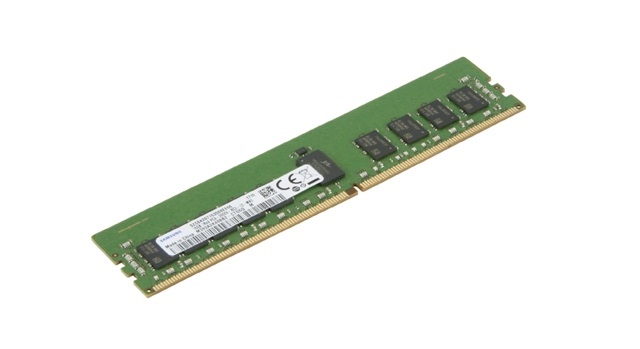
The M393A2K40BB2CTDDNA is a 16GB DDR4-2666 Registered DIMM with ECC, purpose-built for enterprise servers. Its significance becomes clear when you run demanding workloads like virtualization clusters or in-memory databases.
First, ECC actively corrects single-bit errors caused by background radiation or cosmic particles. In a 24/7 VMware cluster hosting dozens of virtual machines, a silent bit-flip in guest memory can corrupt transactional data or crash an entire node—ECC prevents this invisibly, protecting business continuity. Second, the Registered architecture buffers address and command signals, allowing the memory controller to drive many more DIMMs per channel without signal degradation. This lets you populate all 24 slots in a 2U server, reaching the hundreds of gigabytes that SAP HANA or large Redis instances require, without stability compromises. Third, the Single Rank x4 organization offers an optimal balance: the x4 DRAM width delivers strong burst performance for sequential database scans, while single rank minimizes electrical load to sustain low latency under high concurrency. Finally, operating at 1.2V and 2666MHz, this module reduces thermal stress and power draw across a rack of servers, directly lowering your cooling overhead and total operational cost without sacrificing the throughput demanded by NVMe storage arrays and 25GbE networking. In short, it is engineered to turn raw capacity into real, reliable performance where downtime is not an option.
General Virtualization
For a typical hypervisor hosting 10–15 light to moderate VMs, populate the server with six or eight identical 16 GB RDIMMs to enable balanced memory channels and a total of 96–128 GB. ECC support guards against bit-flip errors that could compromise multiple virtual machines simultaneously, while registered DIMMs provide the signal integrity needed for dense configurations.
In-Memory Database
Deploy a full set of 16 GB RDIMMs across all memory channels (often 12 or 16 modules in dual-socket servers) to reach 192–256 GB, ensuring the working set resides entirely in RAM for sub-millisecond latency. The 1.2 V DDR4-2666 operating voltage helps contain the thermal envelope, and ECC is non-negotiable for data integrity under constant, heavy write loads.
High-Performance Computing
Populate each memory channel with one single-rank 16 GB module to maximise bandwidth per core in compute nodes, giving a balanced 128 GB configuration on an eight-channel platform. Registered, CL19 single-rank x4 DIMMs deliver predictable latency and high throughput for tightly parallelised simulations, while ECC prevents silent data corruption during weeks-long calculation runs.
Rigorously tested server memory; compatible with Dell PowerEdge R740/R750, HPE ProLiant DL380 Gen10, Lenovo ThinkSystem SR650.
Q: Can I mix this M393A2K40BB2-CTD-DNA with other memory modules of different brands or speeds?
A: Mixing different brands or speeds is strongly discouraged in servers. This RDIMM adheres to strict JEDEC timings; mismatched modules may cause instability, POST failures, or degraded throughput. Use identical M393A2K40BB2-CTD-DNA kits for validated, reliable operation.
Q: Is this memory compatible with my system?
A: This DDR4-2666 ECC Registered DIMM is compatible with server platforms supporting RDIMM, such as Intel Xeon Scalable and AMD EPYC 7000 series. Please confirm your motherboard’s Qualified Vendor List and CPU support before purchasing.
Q: What is the recommended DIMM population order for optimal performance?
A: Populate matching DIMMs per memory channel, starting with the furthest slot from the CPU, typically slot 1 (blue). Balance ranks across channels and consult your server’s service manual for the exact population sequence to maximize bandwidth and interleaving.
Q: Does this module support overclocking or XMP profiles?
A: No. Server-grade registered DIMMs operate exclusively at JEDEC standard speeds and voltages to ensure 24/7 data integrity. Overclocking and XMP are not supported; these modules prioritize stability and error correction over variable frequencies.
Q: What warranty and typical failure rate can I expect?
A: This module includes a one-year warranty. Enterprise-class RDIMMs typically exhibit an annualized failure rate (AFR) below 0.5%, assuming proper thermal and electrical conditions, making them exceptionally reliable for mission-critical deployments.