











 Secure payments
Standard refund policy
Trade Assurance
Secure payments
Standard refund policy
Trade Assurance
| Product Type | Memory Module |
|---|---|
| Memory Capacity | 16 GB |
| Memory Technology | DDR4 |
| Product Voltage | 1.2 V |
| RAM Speed | 2666 MHz |
| RAM Standard | DDR4-2666/PC4-21300 |
| Error Identifying | ECC |
| Signal Type | Registered |
| Column Access Strobe (CAS) | CL19 |
| Rank | Dual Rank x8 |
| Quantity of Pins | 288-pin |
| RAM Genre | RDIMM |
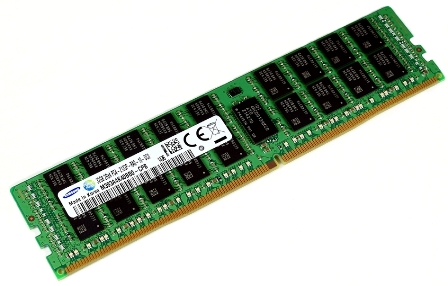
Specifically designed for enterprise servers, this Samsung 16GB DDR4-2666 Registered ECC module (M393A2K43CB2-CTD8Q) with dual-rank x8 organization ensures robust data integrity for virtualization, in-memory databases, and mission-critical workloads. The registered signal type and dual-rank configuration maximize signal stability and interleaved performance on high-density memory channels, making it ideal for scale-up virtual machine deployments where reliability under continuous operation is non-negotiable.
1. With ECC protection, silent memory errors are corrected in real time, safeguarding transactional databases and preventing mission-critical data corruption in always-on server environments.
2. The registered buffer decouples the memory controller from direct electrical loading, allowing dense DIMM populations to run stably across fully loaded 24/7 rack servers.
3. A dual rank x8 organization leverages interleaved access to keep data pipelines full, which sustains high IOPS and consistent response times under heavy virtualization workloads.
4. A 2666 MT/s transfer rate balances per-channel bandwidth and power efficiency, providing enough throughput for concurrent enterprise applications without overstepping thermal design limits.
5. The 16 GB capacity enables denser VM consolidation per node, granting headroom for additional containers or database caches without forcing early hardware refresh cycles.
The Samsung M393A2K43CB2-CTD8Q is a 16GB DDR4-2666 Registered ECC RDIMM purpose-built for enterprise servers, and four architectural highlights directly answer the real-world demands of modern data centers. First, ECC error correction acts as a shield against cosmic-ray-induced bit flips; for a virtualized financial database or Exchange server, it averts data corruption and costly downtime that could trigger compliance failures. Second, the registered buffer allows the memory controller to drive multiple DIMMs per channel without signal distortion, enabling dense VMware clusters running numerous VMs with rock‑solid stability even under full slot population. Third, the dual‑rank x8 organization uses rank interleaving to overlap data accesses, boosting effective bandwidth—critical when an in‑memory analytics platform like SAP HANA processes real‑time terabyte datasets and needs maximum throughput with minimal latency. Fourth, operating at 1.2V instead of 1.5V provides measurable power savings, lowering cooling costs and environmental impact while sustaining 21.3 GB/s throughput. In short, this module is a strategic asset that safeguards uptime, accelerates transactions, and lowers TCO.
This is a server-class DDR4-2666 Registered ECC memory module (16GB RDIMM). Capacity planning recommendations for typical server workloads are outlined below.
General Virtualization
Populate at least one 16GB dual‑rank RDIMM per memory channel. For a dual‑socket server with eight channels per socket, a minimal balanced configuration of one DIMM per channel provides 128 GB, which comfortably hosts 15–20 average VMs. For higher consolidation, install two identical DIMMs per channel to reach 256 GB while preserving NUMA symmetry and consistent latency.
In‑Memory Database
Maximize capacity by fully populating all channels with this module. Two DIMMs per channel in the same dual‑socket platform yield 512 GB, keeping entire datasets in DRAM and avoiding disk I/O. Always install matched pairs across sockets, and consider enabling memory sparing or mirroring to protect the large, mission‑critical memory array against uncorrectable errors.
High‑Performance Computing
Start with one 16 GB DIMM per channel (128 GB per socket) to sustain full 2666 MT/s speed and deliver high bandwidth. If capacity‑bound, add a second identical dual‑rank DIMM per channel for 256 GB, but verify the platform maintains the rated frequency at this population. Distribute modules equally across all memory controllers to guarantee optimal interleaving and throughput.
Professionally tested compatible with Dell PowerEdge R740/R760, HPE DL380 Gen10, Lenovo SR650 servers.
Q: Can I mix this M393A2K43CB2-CTD8Q with other memory modules of different brands or speeds?
A: Not recommended. Mixing modules may force the memory controller to run at the lowest common speed and can disable ECC. For guaranteed reliability, populate all channels with identical M393A2K43CB2-CTD8Q RDIMMs.
Q: Is this memory compatible with my system?
A: This 16GB DDR4-2666 Registered ECC RDIMM is designed for server platforms. Compatibility requires an Intel Xeon Scalable or AMD EPYC motherboard with 288-pin slots that explicitly supports PC4-21300 RDIMMs at 1.2V.
Q: What is the recommended DIMM population order for optimal performance?
A: Populate identical DIMMs per channel, starting with the slot farthest from the CPU. Balance memory across all memory channels and match Dual Rank x8 configurations to maximize throughput on your specific server motherboard.
Q: Does this module support overclocking or XMP profiles?
A: No. This is a JEDEC-compliant server Registered ECC DIMM. Overclocking and XMP are not supported, as the module is engineered for strict stability and data integrity at the standard DDR4-2666 CL19 specification.
Q: What warranty and typical failure rate can I expect?
A: This module is covered by a one-year warranty. Enterprise-grade Samsung RDIMMs like this exhibit very low annualized failure rates, typically under 0.5% in properly cooled and managed server environments.