











 Secure payments
Standard refund policy
Trade Assurance
Secure payments
Standard refund policy
Trade Assurance
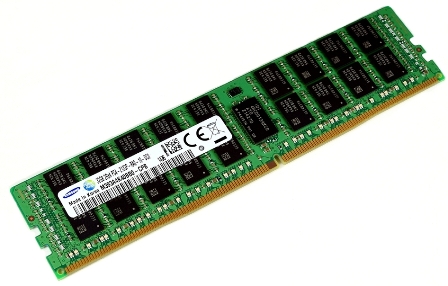
| Product Type | Memory Module |
|---|---|
| Memory Capacity | 16 GB |
| Memory Technology | DDR4 |
| Product Voltage | 1.2 V |
| RAM Speed | 2666 MHz |
| RAM Standard | DDR4-2666/PC4-21300 |
| Error Identifying | ECC |
| Signal Type | Registered |
| Column Access Strobe (CAS) | CL19 |
| Rank | Dual Rank x8 |
| Quantity of Pins | 288-pin |
| RAM Genre | RDIMM |
Designed for server platforms, this Samsung DDR4-2666 RDIMM combines ECC and registered signaling to ensure data integrity and signal stability under high-density deployments. Its dual-rank x8 configuration improves interleaving efficiency, making it ideal for virtualization and in-memory database workloads where reliable, sustained throughput is critical.
1. Registered signal buffering isolates the memory controller from heavy electrical loads, ensuring stable operation across fully populated server memory channels without signal degradation.
2. ECC memory detects and self-corrects single-bit errors in real time, preventing silent data corruption in transactional databases and long-running enterprise applications.
3. A 16GB module capacity right-sizes memory provisioning for dense virtualization hosts, allowing more active VMs per rack unit without over-allocating expensive resources.
4. DDR4-2666 throughput accelerates concurrent data streams, keeping latency-sensitive workloads like in-memory caching and real-time analytics responsive under peak load.
5. Dual Rank x8 organization enables rank interleaving that maximizes channel utilization, directly boosting aggregate bandwidth for heavily multi-threaded server processes.
The Samsung M393A2K43CB2-CTD7Q is a server-class DDR4 RDIMM engineered for mission-critical data center operations, where stability and accuracy directly impact business continuity. In dense virtualization clusters running dozens of VMs, its registered design with an on-DIMM clock buffer becomes essential. It cleans and re-drives signals, allowing you to fully populate every memory channel without electrical loading that could crash the hypervisor. This capability, combined with ECC error correction, eliminates the risk of silent data corruption. For an in-memory transactional database, a single flipped bit due to background radiation could mean a corrupted financial entry, but ECC detects and corrects those errors in real time, safeguarding your data integrity automatically. Moreover, the dual-rank x8 organization uses interleaving to feed the CPU with sustained bandwidth, which is critical for high-concurrency analytics, while the 1.2-volt operating voltage reduces power draw across racks of servers, lowering cooling costs significantly. Every attribute translates to fewer application stalls, continuous uptime, and uncompromised transactional accuracy in your infrastructure.
General Virtualization
Populate all memory channels symmetrically with these 16 GB dual‑rank RDIMMs to maximize interleaving and bandwidth. For a typical dual‑socket server with eight channels per CPU, installing one DIMM per channel yields 128 GB of ECC‑protected capacity – an ideal balance for running 20–30 light to medium VMs without overcommitting memory.
In‑Memory Database
Capacity is paramount for Redis, Memcached, or SAP HANA workloads. Fill every available DIMM slot with these registered 16 GB modules; on a 16‑slot board this provides 256 GB to keep entire datasets resident in memory. The ECC error correction ensures data integrity during continuous operation, while the dual‑rank design offers slightly better latency overlap at the cost of a small frequency trade‑off compared to single‑rank modules, which is acceptable for capacity‑bound scenarios.
High‑Performance Computing
HPC nodes demand consistent, low‑latency memory access. Configure one 16 GB DIMM per channel in a balanced layout (e.g., 8‑channel platform → 128 GB) to exploit full memory bandwidth and avoid NUMA imbalances. The registered ECC signaling stabilizes large‑scale clusters during week‑long simulation runs, and the 1.2 V DDR4‑2666 rating keeps power and thermals predictable in dense rack deployments, making this a cost‑effective building block for capacity‑aware HPC clusters.
Rigorously tested, compatible with servers including Dell PowerEdge R750, HPE ProLiant DL380 Gen10, Lenovo ThinkSystem SR650.
Q: Can I mix this M393A2K43CB2-CTD7Q with other memory modules of different brands or speeds?
A: Mixing is not recommended in server environments. For guaranteed stability, populate all channels with identical modules matching this RDIMM’s speed, rank, latency, and ECC registered specification.
Q: Is this memory compatible with my system?
A: This DDR4-2666 RDIMM is designed for Intel Xeon Scalable and AMD EPYC platforms. Confirm your server board supports 288-pin registered ECC memory and the specific 16GB dual-rank configuration.
Q: What is the recommended DIMM population order for optimal performance?
A: Follow your server motherboard manual. Typically, populate identical DIMMs per channel in a balanced configuration, filling slots farthest from the CPU first to enable optimal interleaving and bandwidth.
Q: Does this module support overclocking or XMP profiles?
A: No, this is a JEDEC-compliant server module. Overclocking and XMP are not supported. It runs strictly at its rated 2666 MHz with CL19 timing to ensure data integrity in ECC operations.
Q: What warranty and typical failure rate can I expect?
A: It includes a 1-year warranty. As a Samsung enterprise-grade RDIMM, the typical annualized failure rate is very low, generally below 0.5% under normal operating conditions with adequate cooling.