











 Secure payments
Standard refund policy
Trade Assurance
Secure payments
Standard refund policy
Trade Assurance
| Product Type | Memory Module |
|---|---|
| Memory Capacity | 16 GB |
| Memory Technology | DDR4 |
| Product Voltage | 1.2V |
| RAM Speed | 2666MHz |
| RAM Standard | DDR4-2666/PC4-21300 |
| Error Identifying | ECC |
| Signal Type | Registered |
| Column Access Strobe (CAS) | CL19 |
| Rank | Dual Rank x8 |
| Quantity of Pins | 288-pin |
| RAM Genre | RDIMM |
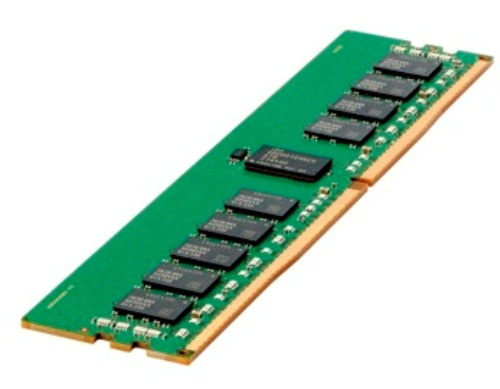
This registered ECC DDR4-2666 RDIMM is engineered for server platforms handling mission-critical workloads like virtualization and in-memory databases, where its dual-rank x8 organization boosts bandwidth through interleaving while ECC ensures end-to-end data integrity. The 1.2V low-power operation and registered signal buffering deliver rock-solid stability in dense, multi-DIMM configurations, making it ideal for scalable enterprise deployments.
1. Registered buffer technology stabilizes signal integrity across fully loaded memory channels, enabling seamless scaling to terabyte-class footprints in virtualized enterprise environments.
2. ECC protection silently corrects single-bit memory faults, preserving data accuracy for transactional databases and around-the-clock critical services.
3. A 16GB per-module density strikes an optimal balance for dense server nodes, increasing the number of VMs or containers per host without immediate capacity bottlenecks.
4. 2666MHz data rate delivers sufficient per-channel bandwidth to keep pace with multi-core Xeon-class processors, minimizing stall cycles during concurrent analytics queries.
5. Dual Rank x8 organization leverages bank interleaving to keep command pipelines saturated, which helps maintain consistent low-latency access under heavy consolidation workloads.
The M393A2K43DB2-CTD7 16GB DDR4-2666 RDIMM tackles server pain points through four key features: ECC, registered buffering, dual-rank design, and 1.2V operation. In a virtualized cluster, a single uncorrected bit-flip can crash multiple VMs; the ECC engine detects and corrects errors instantly, preserving hypervisor stability. Meanwhile, the registered clock driver buffers signals so you can populate all channels with dense memory to achieve 512GB or more per node for maximum consolidation. For in-memory databases like Redis or SAP HANA, the dual-rank x8 design interleaves bank accesses, boosting bandwidth under concurrent reads and writes without compromising latency. Added to this, the 1.2V low operating voltage reduces power draw per module, slashing cooling costs across your entire server fleet and contributing to a greener data center profile. This memory turns integrity, density, speed, and efficiency into tangible business continuity.
General Virtualization
Deploy this 16GB ECC RDIMM to build balanced virtualized nodes. Install one module per memory channel (e.g., eight modules for 128GB on an 8-channel CPU) to comfortably host dozens of VMs with full memory bandwidth. Scale to two DIMMs per channel (16 modules for 256GB) when density is critical, while ECC ensures continuous data integrity across your virtualized workloads.
In-Memory Database
For memory-resident platforms like SAP HANA or Redis, populate all channels with two of these dual-rank 16GB RDIMMs to create a robust 256GB+ footprint. The registered buffering and ECC maintain signal stability under heavy transactional loads, and dual-rank interleaving helps deliver the sustained throughput that real-time analytics demand.
High Performance Computing
HPC simulations prioritize consistent low latency and high bandwidth. Populate one 16GB DIMM per channel (128GB across eight channels) to sustain the full 2666MT/s speed without frequency penalties. The module’s CL19 latency and dual-rank design feed data efficiently to compute cores. If capacity becomes the bottleneck, carefully add a second DIMM per channel while accounting for potential speed trade-offs.
Rigorously tested server memory. Compatible with Dell PowerEdge R740, HPE DL380 Gen10, Lenovo SR650, Supermicro X11.
Q: Can I mix this M393A2K43DB2-CTD7 with other memory modules of different brands or speeds?
A: Mixing is strongly discouraged in server environments. Mismatched ranks, latencies or registers can cause signal integrity issues, ECC errors or system instability. Always use identical, validated modules.
Q: Is this memory compatible with my system?
A: It is compatible with servers supporting DDR4-2666 ECC Registered RDIMMs, such as Intel Xeon Scalable or AMD EPYC platforms. Please confirm your motherboard’s QVL and CPU memory support list.
Q: What is the recommended DIMM population order for optimal performance?
A: Refer to your server board manual. Typically, populate the farthest slot from the CPU per channel first (e.g., A1, B1, C1) and balance channels identically on dual-socket systems for optimal memory interleaving.
Q: Does this module support overclocking or XMP profiles?
A: No. As a registered server DIMM, it strictly adheres to JEDEC DDR4-2666 standards. It does not support overclocking, XMP or any non-standard voltage/timing profiles.
Q: What warranty and typical failure rate can I expect?
A: This module includes a 1-year warranty. Built to enterprise-grade standards, its typical annualized failure rate (AFR) is well under 0.1%, delivering exceptional long-term reliability.