











 Secure payments
Standard refund policy
Trade Assurance
Secure payments
Standard refund policy
Trade Assurance
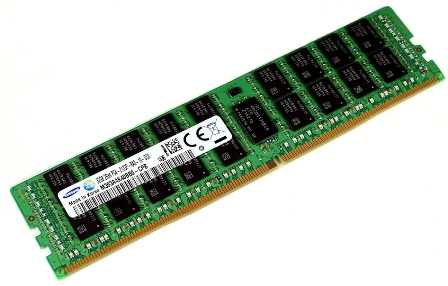
| Product Type | Memory Module |
|---|---|
| Compliance Standards | RoHS,WEEE |
| Memory Capacity | 16 GB |
| Memory Technology | DDR4 |
| Product Voltage | 1.2 V |
| RAM Speed | 2666 MHz |
| RAM Standard | DDR4-2666/PC4-21300 |
| Error Identifying | ECC |
| Signal Type | Registered |
| Column Access Strobe (CAS) | CL19 |
| Rank | Dual Rank x8 |
| Quantity of Pins | 288-pin |
| RAM Genre | RDIMM |
This DDR4-2666 RDIMM with ECC and a dual-rank x8 configuration is ideally suited for virtualization platforms and in-memory database workloads, ensuring robust data integrity and sustained performance under heavy concurrent access. The registered signal type stabilizes high-density memory configurations, while the dual-rank design enhances interleaving efficiency to maximize throughput in multi-DIMM servers.
1. ECC protection continuously corrects single-bit errors, safeguarding transactional integrity in financial databases and virtualized environments.
2. Registered DIMM buffering stabilizes command and address signals, allowing fully-populated server channels for maximum memory capacity and uptime.
3. Dual Rank x8 organization leverages interleaving to boost effective bandwidth, critical for consolidating high-density VMs without performance degradation.
4. DDR4-2666 speed provides 21.3 GB/s per channel, accelerating real-time analytics and reducing latency in scale-out storage clusters.
5. 1.2V ultra-low voltage drives down energy costs per DIMM, significantly improving power usage effectiveness in large-scale data centers.
As a server-grade RDIMM built for relentless datacenter workloads, the M393A2K43BB1-CTD transforms four critical design elements into tangible business resilience. Its ECC function actively detects and corrects single-bit memory errors—in a virtualized cluster running dozens of VMs, a cosmic ray-induced bit flip can silently corrupt transactional data or crash an entire hypervisor. ECC means that invisible threat is neutralized before it becomes a 3 a.m. alert. The Registered signal buffer cleanly decouples the command interface from the DRAM chips, allowing dense, fully populated server boards to maintain rock-solid signal integrity; for a SaaS provider scaling out, this is the difference between bumping up against capacity limits and confidently deploying 16 GB sticks across every slot without stability regressions. The dual-rank x8 organization unlocks interleaved access patterns that feed the memory controller more intelligently, directly accelerating in-memory databases like Redis or SAP HANA where microsecond-level responsiveness under simultaneous read/write pressure determines end-user experience. Woven through all this is the 1.2 V DDR4 power envelope—in a colocation rack with hundreds of such modules, the cumulative thermal and energy savings keep cooling costs predictable while sustaining the 2666 MT/s throughput and CL19 latency that keep bare-metal database instances running flat out during peak booking windows. For the infrastructure owner, this memory doesn’t just store bits; it converts engineering specifications into higher VM density, fewer production incidents, and lower total cost of ownership.
General Virtualization
For a typical hypervisor hosting multiple VMs, populate the server with at least six to eight of these 16GB RDIMMs symmetrically across memory channels to achieve 96–128GB. This balanced configuration maintains the interleaving benefit of the platform's memory architecture while delivering sufficient capacity for moderate overcommitment ratios. Always install identical modules in matched sets per memory channel to preserve Registered ECC reliability and avoid performance penalties from unbalanced NUMA domains.
In-Memory Database
In-memory workloads like Redis or SAP HANA demand large, contiguous capacity with the lowest latency the platform allows. Deploy the maximum supported number of these dual-rank 16GB DIMMs—commonly twelve or sixteen modules per socket—to reach 192–256GB, fully populating each channel for peak throughput. The CL19 latency and DDR4-2666 speed provide a solid baseline, but ensure the BIOS enforces 1.2V and disables any power-saving features that could introduce jitter.
High Performance Computing (HPC)
HPC clusters require both capacity and memory bandwidth per node, so install one DIMM per channel to maximize frequency and avoid rank multiplication slowdowns. Start with one 16GB RDIMM in each of the eight or twelve memory channels of a dual-socket server, yielding 128–192GB, and add a second identical DIMM per channel only if capacity exceeds bandwidth needs. The Registered ECC signaling is mandatory for data integrity in large-scale, long-running parallel jobs.
Rigorously tested, this server memory is compatible with Dell PowerEdge R760, HPE ProLiant DL380 Gen10, and Lenovo ThinkSystem SR650.
Q: Can I mix this M393A2K43BB1-CTD with other memory modules of different brands or speeds?
A: Mixing this RDIMM with modules of different brands or speeds is not advised. It risks instability, lowered performance, or ECC errors. For server reliability, populate all channels with identical, qualified DIMMs.
Q: Is this memory compatible with my system?
A: This DDR4-2666 ECC RDIMM fits server boards with DDR4 support, such as Intel Xeon Scalable (C621 chipset) or AMD EPYC 7001/7002 platforms. Always confirm against the motherboard's QVL for 288-pin registered memory.
Q: What is the recommended DIMM population order for optimal performance?
A: Install DIMMs starting from the furthest slot from the CPU in each channel. Follow the server board's population guide to balance channels and enable full ECC protection, typically filling blue slots first in multi-DIMM setups.
Q: Does this module support overclocking or XMP profiles?
A: No. This registered server memory operates at JEDEC standard DDR4-2666 CL19. It does not support overclocking or XMP, as stable, error-corrected operation is prioritized over speed for enterprise workloads.
Q: What warranty and typical failure rate can I expect?
A: This module includes a 1-year warranty. As high-grade server ECC RDIMM, the typical annualized failure rate is below 0.5% under normal conditions. We offer prompt replacement according to warranty terms.