











 Secure payments
Standard refund policy
Trade Assurance
Secure payments
Standard refund policy
Trade Assurance
| Product Type | Memory Module |
|---|---|
| Memory Capacity | 16 GB |
| Memory Technology | DDR4 |
| Product Voltage | 1.2V |
| RAM Speed | 2666MHz |
| RAM Standard | DDR4-2666/PC4-21300 |
| Error Identifying | ECC |
| Signal Type | Unbuffered |
| Column Access Strobe (CAS) | CL19 |
| Rank | Dual Rank x8 |
| Quantity of Pins | 288-pin |
| RAM Genre | UDIMM |
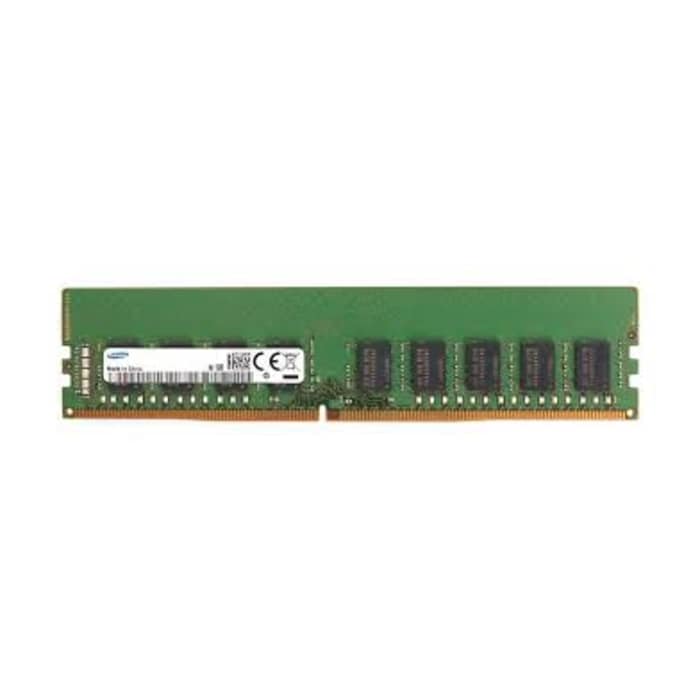
This unbuffered ECC UDIMM with a dual-rank x8 configuration is tailored for entry-level servers and workstations running data-critical workloads like virtualization and light in-memory databases, where 24/7 stability is essential. Its ECC error correction safeguards data integrity, while dual-rank interleaving enhances memory bandwidth for improved throughput under sustained load.
1. ECC error correction guards against in-memory bit flips, preserving data integrity for financial transactions or virtualized databases where undetected errors are unacceptable.
2. Unbuffered signal topology trims access latency, giving lightweight edge servers a responsiveness boost when processing time-sensitive telemetry streams.
3. Dual Rank x8 organization maximizes channel utilization during concurrent memory fetches, helping sustain throughput under dense container orchestration.
4. 16GB per module strikes a balance between capacity and cost, allowing operators to populate affordable yet sizable VM fleets on single-socket workstations.
5. DDR4-2666 bandwidth provides a dependable foundation for multi-tenant workloads, keeping page-load latency low without forcing aggressive cooling budgets.
Designed for entry-level servers and workstations, the Samsung M391A2K43BB1-CTDQ delivers uncompromising reliability as an Unbuffered ECC DDR4 module. Its four defining characteristics directly translate into tangible benefits for mission-critical workloads. The on‑die ECC corrects single‑bit errors in real time, effectively neutralizing the silent data corruption that can crash virtualized clusters or poison financial records overnight—meaning you avoid unexplained downtime and maintain transaction integrity. The dual‑rank x8 organization interleaves memory accesses across two internal ranks, boosting sustained bandwidth under heavy concurrent loads: when you run a dozen VMs on a hypervisor or an in‑memory database like Redis, the module keeps data flowing smoothly rather than stalling during simultaneous read/write bursts. Operating at a low 1.2 V, it measurably reduces power draw and thermal stress across a fleet of 24/7 nodes, shrinking cooling costs without sacrificing the 2666 MT/s speed. Finally, the Unbuffered architecture eliminates the register clock latency found in RDIMMs, delivering the slightly lower response times that latency‑sensitive edge computing and cached database lookups demand. Together, these features ensure that your virtual infrastructure and data‑centric applications stay ironclad, responsive, and energy‑efficient around the clock.
General Virtualization
For a hypervisor hosting multiple VMs, populate all available channels with identical 16 GB ECC UDIMMs to maximize memory bandwidth while retaining error correction. A typical dual-socket entry server with four channels per CPU benefits from eight modules (128 GB total), balancing density and cost for moderate consolidation ratios.
In-Memory Database
In-memory databases demand both capacity and data integrity, making ECC essential. Deploy six or eight 16 GB modules on a single-socket platform (96–128 GB) to keep the entire dataset resident in RAM. Dual-rank x8 DIMMs offer a slight latency advantage under heavy read/write loads, improving transaction throughput.
High-Performance Computing
HPC workloads favor balanced memory bandwidth across channels. Install one 16 GB DIMM per channel (e.g., four modules in a quad-channel board) to avoid bandwidth bottlenecks during large-scale simulations. Unbuffered ECC modules reduce cost and latency versus registered alternatives, suiting cluster nodes where node-level reliability is still required without the complexity of RDIMMs.
Validated for servers—rigorously tested, compatible with Dell PowerEdge T140, R240, HPE ProLiant DL20 Gen10, and more.
Q: Can I mix this M391A2K43BB1-CTDQ with other memory modules of different brands or speeds?
A: Mixing is not recommended. For ECC UDIMMs, all modules should match in speed, rank, and timings to ensure error correction functions correctly and avoid system instability.
Q: Is this memory compatible with my system?
A: It is compatible with Intel Xeon E-2100/E-2200 or AMD Ryzen PRO platforms using C246/X570 chipsets that explicitly support ECC UDIMMs. Verify motherboard ECC unbuffered support before purchase.
Q: What is the recommended DIMM population order for optimal performance?
A: Populate identical modules in matching slots across CPU memory channels, typically blue slots first. Consult your server motherboard manual for balanced channel interleaving to maximize bandwidth.
Q: Does this module support overclocking or XMP profiles?
A: No. This JEDEC-compliant server module does not support XMP or overclocking. It is engineered for rock-solid stability and data integrity at the rated 2666MHz CL19 timing.
Q: What warranty and typical failure rate can I expect?
A: This Samsung module includes a one-year warranty. Rigorous enterprise screening ensures an extremely low annualized failure rate, typically under 0.2%, delivering long-term reliability for critical workloads.