











 Secure payments
Standard refund policy
Trade Assurance
Secure payments
Standard refund policy
Trade Assurance
| Product Type | Memory Module |
|---|---|
| Compliance Standards | RoHS,WEEE |
| Memory Capacity | 16 GB |
| Memory Technology | DDR4 |
| Product Voltage | 1.2V |
| RAM Speed | 2666MHz |
| RAM Standard | DDR4-2666/PC4-21300 |
| Error Identifying | ECC |
| Signal Type | Registered |
| Column Access Strobe (CAS) | CL19 |
| Rank | Dual Rank x8 |
| Quantity of Pins | 288-pin |
| RAM Genre | RDIMM |
This 16GB DDR4-2666 Registered ECC module, organized as Dual Rank x8, is purpose-built for server platforms running virtualization, in-memory databases, or other mission-critical workloads where data integrity is paramount. Its registered architecture with ECC provides robust signal integrity and automatic single-bit error correction, while the dual-rank interleaving enhances memory bandwidth efficiency under heavy concurrent access.
1. Registered buffer technology isolates the memory controller from electrical loads, allowing fully loaded server platforms to maintain stable, error-free operation across dozens of modules.
2. Error-correcting code protection detects and corrects single-bit memory errors on the fly, safeguarding financial transactions and virtualization hosts from silent data corruption.
3. Dual-rank organization interleaves memory bank access to consistently saturate channel bandwidth, minimizing latency spikes for consolidated virtual machines during peak loads.
4. A generous per-module capacity enables dense memory configurations directly on the motherboard, maximizing the guest VM density each server socket can support.
5. The low-voltage DDR4 supply significantly cuts per-DIMM power consumption and thermal output, reducing cooling demands in large-scale data center deployments.
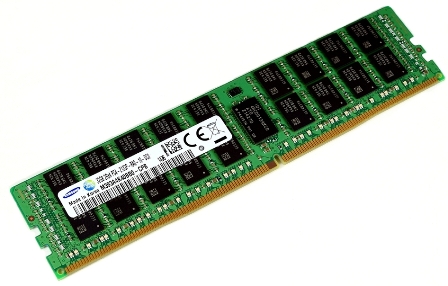
Designed for server environments, the Samsung M393A2K43BB1-CTD7Y DDR4-2666 RDIMM integrates four critical attributes that directly tackle your data center pain points. Its ECC technology actively detects and corrects single-bit memory errors, safeguarding data integrity for in-memory databases like SAP HANA where an undetected bit flip could corrupt financial transactions or analytical models—this means uncompromising accuracy and continuous uptime. The registered buffer isolates the memory bus electrically, enabling you to populate all channels with 16GB modules without signal degradation; in a virtualization cluster, this translates to higher VM density and stable consolidation of far more tenants per host, reducing your hardware footprint. The module’s Dual Rank x8 configuration leverages interleaving to hide row-access latencies, boosting effective bandwidth and delivering faster query responses and higher transaction throughput for your database. Finally, operating at an energy-efficient 1.2V, it slashes power draw and thermal output, directly lowering cooling costs and TCO in densely packed racks. This memory does not just store data—it accelerates your workloads while protecting your bottom line.
General Virtualization
For a typical dual-socket server, install at least one 16 GB RDIMM per memory channel to achieve balanced performance and avoid bandwidth bottlenecks. A configuration of 8 modules (128 GB) suits light to moderate VM density, while 16 modules (256 GB) handles larger consolidations. Uniformly populating all channels with these registered ECC DIMMs ensures reliable, responsive guest workloads.
In-Memory Database
Maximize capacity by filling each channel with two 16 GB RDIMMs where the platform allows (2DPC), targeting 256 GB to 512 GB total for small to mid-scale datasets. Although the speed may step down from 2666 MHz, Dual Rank x8 modules maintain good signal quality. For latency-sensitive in-memory engines, prioritize uniform population across all memory controllers and consider leaving one slot per channel empty if top frequency is critical.
High Performance Computing
Populate exactly one 16 GB RDIMM per channel to run at the native 2666 MHz and deliver the lowest latency. This 1DPC configuration preserves full memory bandwidth for bandwidth-hungry codes. Typical dual-socket systems with 8 to 12 channels yield 128 GB to 192 GB, sufficient for many HPC jobs; scale to additional nodes if capacity demands grow beyond a single server’s balanced limit.
Rigorously tested server memory, compatible with Dell PowerEdge R740, HPE DL380 Gen10, Lenovo SR650 and similar systems.
Q: Can I mix this M393A2K43BB1-CTD7Y with other memory modules of different brands or speeds?
A: Mixing RDIMMs of different brands, speeds, or ranks is strongly discouraged. It can lead to BIOS errors, signal integrity issues, and unpredictable system instability. Always populate identical, validated modules in server environments for reliable operation.
Q: Is this memory compatible with my system?
A: This DDR4-2666 ECC Registered DIMM is engineered for Intel Xeon Scalable and AMD EPYC platforms using C620 or SP3 sockets. Always consult your motherboard or server manufacturer’s Qualified Vendor List to confirm exact compatibility.
Q: What is the recommended DIMM population order for optimal performance?
A: Install identical DIMMs evenly across all memory channels per CPU, filling the first slot of each channel (often white or blue) before adding the second. This ensures balanced interleaving and maximum throughput as per your server manual.
Q: Does this module support overclocking or XMP profiles?
A: No, this Samsung RDIMM strictly follows JEDEC DDR4-2666 standards. It does not support XMP profiles or overclocking, as it is purpose-built for deterministic, error-corrected stability in mission-critical server workloads.
Q: What warranty and typical failure rate can I expect?
A: It is covered by a 1-year warranty. Samsung enterprise RDIMMs typically achieve an annualized failure rate below 0.3%, reflecting rigorous testing and robust design for 24/7 data-center reliability.