











 Secure payments
Standard refund policy
Trade Assurance
Secure payments
Standard refund policy
Trade Assurance
| Product Type | Memory Module |
|---|---|
| Memory Capacity | 16 GB |
| Memory Technology | DDR4 |
| Product Voltage | 1.2V |
| RAM Speed | 2666MHz |
| RAM Standard | DDR4-2666/PC4-21300 |
| Error Identifying | ECC |
| Signal Type | Unbuffered |
| Column Access Strobe (CAS) | CL19 |
| Rank | Dual Rank x8 |
| Quantity of Pins | 288-pin |
| RAM Genre | UDIMM |
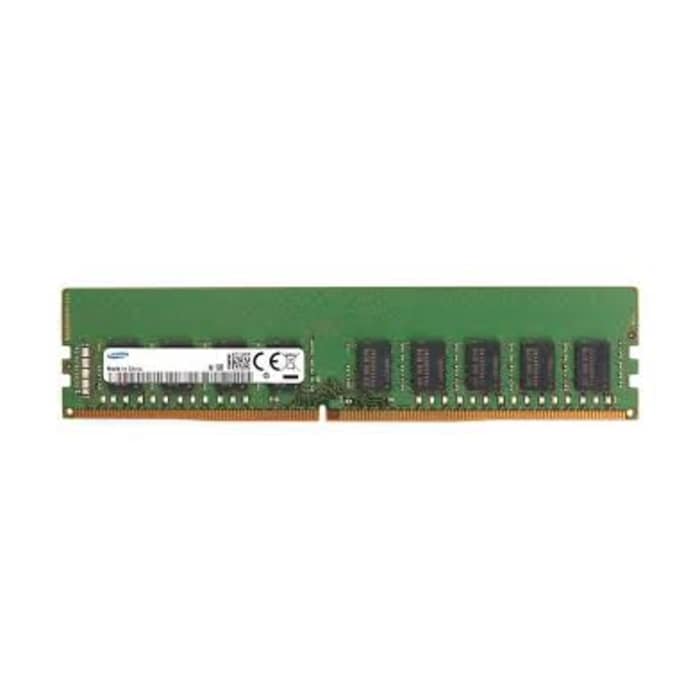
This 16GB DDR4-2666 ECC Unbuffered DIMM is purpose-built for entry-level servers, SMB NAS appliances, and professional workstations where data integrity cannot be compromised. Its dual-rank x8 organization boosts effective bandwidth via rank interleaving while the unbuffered ECC design minimizes latency and corrects single-bit errors, making it ideal for virtualization, ZFS storage, and always-on critical workloads.
1. ECC protection automatically corrects single-bit errors, safeguarding transactional databases and critical workloads from silent data corruption in always-on server environments.
2. 16GB capacity per module supports higher virtualization density, allowing more containers or VMs to run simultaneously without memory contention on a single node.
3. 2666MHz speed delivers sufficient memory bandwidth to feed multi-core server CPUs, reducing latency in data-intensive operations like in-memory caching and analytics.
4. Dual Rank x8 configuration keeps memory channels fully saturated, critical for consistent VM performance under heavy consolidation and parallel processing.
5. 1.2V low operating voltage reduces overall power draw and thermal output in dense rack deployments, directly lowering datacenter cooling costs.
For workstations and high-end desktop platforms where precision is non-negotiable, the M391A2K43BB1-CTDQY is an ECC UDIMM engineered to eliminate silent data corruption. Its error-correcting code is not just a spec; it means that during a multi-day 3D rendering or a financial simulation, a single-bit memory flip—caused by background radiation—won’t crash your project or introduce a costly calculation error. The dual-rank x8 organization lets the memory controller interleave accesses across two internal ranks, delivering measurably higher sustained bandwidth when your CPU is streaming massive textures or churning through a large in-memory dataset for scientific computing. This keeps cores fed and reduces stutter under heavy concurrency. Operating at a standard 1.2V, the module runs cooler inside a tightly packed chassis, lowering fan noise and improving long-term reliability during continuous 100% loads like video transcoding runs that last overnight. The DDR4-2666 speed with CL19 latency provides a stable, widely compatible foundation that avoids the inconsistent training issues of overclocked kits, meaning you can deploy a fleet of machines with identical performance profiles—critical for reproducible engineering workloads. This memory transforms your desktop into a dependable, high-throughput tool for work that cannot afford a second guess.
This is a server-grade ECC unbuffered DIMM designed for entry-level servers and workstations that support UDIMM ECC.
General Virtualization
For a hypervisor running multiple light to moderate VMs, install four identical 16 GB modules to achieve a balanced 64 GB capacity. Populating all available dual‑channel slots ensures symmetric interleaving and leverages the ECC error correction vital for continuous uptime. This configuration provides ample headroom for memory overcommitment while keeping VM migration latency low.
In-Memory Database
Deploy a fully populated board using four dual‑rank 16 GB DIMMs (64 GB total) to maximize rank interleaving across both channels. The dual‑rank x8 organization boosts per‑channel throughput, critical for low‑latency key‑value stores or caching layers. ECC protection also guards against silent data corruption during intensive, persistent in‑memory operations.
High‑Performance Computing
Equip every memory channel with an identical 16 GB module, typically filling four slots for 64 GB. This symmetric layout takes advantage of the dual‑rank design to reduce access conflicts and sustain steady 2666 MT/s bandwidth under parallel MPI or floating‑point heavy workloads. The resulting uniform configuration ensures predictable, stable performance for compute‑bound simulation and analytics tasks.
Rigorously tested server memory, compatible with Dell PowerEdge T140, T340, R240, HPE ProLiant DL20 Gen10, Lenovo ThinkSystem ST250.
Q: Can I mix this M391A2K43BB1-CTDQY with other memory modules of different brands or speeds?
A: Mixing modules can cause ECC errors or instability. For server reliability, always populate with identical part numbers, matching rank, voltage, and timings (DDR4-2666 CL19). Mismatched speeds will force the system to the lowest common frequency.
Q: Is this memory compatible with my system?
A: It fits platforms supporting DDR4 ECC Unbuffered UDIMMs, such as Intel Xeon E-2100/2200 series or AMD Ryzen PRO with appropriate workstation/server chipsets. Verify with the qualified vendor list from your motherboard manufacturer.
Q: What is the recommended DIMM population order for optimal performance?
A: Follow the server board’s manual; generally, populate the DIMM in the farthest slot from the CPU per channel first. With dual-rank configs, balancing across memory channels achieves optimal interleaving. One DIMM per channel is ideal for 2666MHz.
Q: Does this module support overclocking or XMP profiles?
A: No. This server-grade ECC UDIMM runs at JEDEC standard DDR4-2666 only. There are no XMP profiles; it is engineered for deterministic data integrity under constant load, not overclocking.
Q: What warranty and typical failure rate can I expect?
A: This module includes a 1-year warranty. As enterprise-class memory with error correction, annualized failure rates are extremely low, typically well below 0.1% under normal operating conditions.