











 Secure payments
Standard refund policy
Trade Assurance
Secure payments
Standard refund policy
Trade Assurance
| Product Type | Memory Module |
|---|---|
| Memory Capacity | 16 GB |
| Memory Technology | DDR4 |
| Product Voltage | 1.2 V |
| RAM Speed | 2666 MHz |
| RAM Standard | DDR4-2666/PC4-21300 |
| Error Identifying | ECC |
| Signal Type | Unbuffered |
| Column Access Strobe (CAS) | CL19 |
| Rank | Dual Rank x8 |
| Quantity of Pins | 288-pin |
| RAM Genre | UDIMM |
This 16GB DDR4-2666 ECC Unbuffered UDIMM is specifically engineered for entry-level servers and workstations that demand data integrity without the cost of registered memory. Its unbuffered ECC design provides single-bit error correction for critical applications like file servers or light virtualization workloads, while the dual-rank x8 organization enhances interleaving to improve memory bandwidth efficiency at the conservative CL19 latency.
1. Error Correcting Code (ECC) capability automatically detects and corrects single-bit memory faults, preserving transactional integrity for mission-critical small business databases and virtualization hosts that cannot tolerate silent data corruption.
2. Unbuffered signal type eliminates the register clock delay found in registered DIMMs, delivering marginally lower latency that benefits single-socket entry server responsiveness in latency-sensitive edge computing roles.
3. 16 GB capacity per module provides sufficient density to host multiple lightweight virtual machines or containers on a compact micro-ATX server board while leaving room for future memory expansion.
4. DDR4-2666 data rate supplies a balanced 21.3 GB/s per-channel throughput, efficiently handling concurrent file-sharing requests and remote desktop sessions without creating a thermal burden inside constrained chassis.
5. Dual Rank x8 organization interleaves two internal rank groups per module, sustaining higher command bus utilization and steady bandwidth delivery for hypervisor workloads that demand consistent VM memory performance.
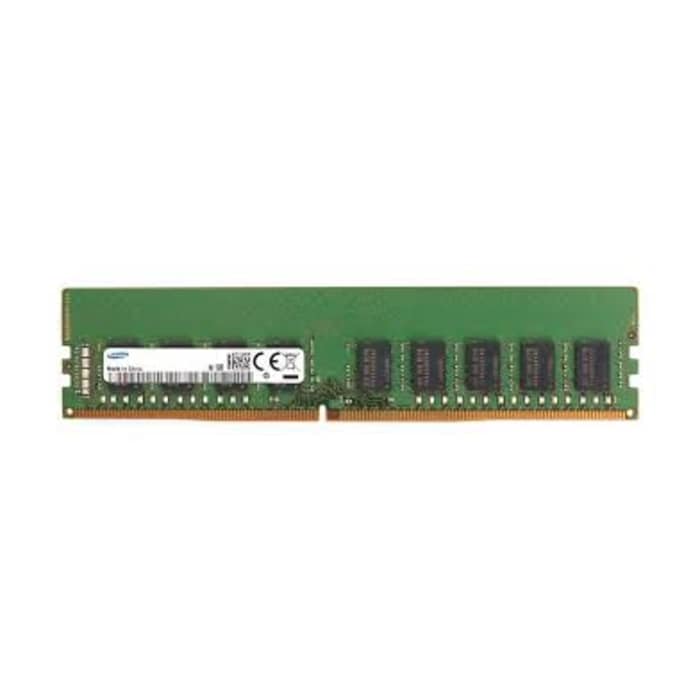
The Samsung M391A2K43BB1-CTD is a 16GB DDR4 UDIMM purpose-built for professional workstations, integrating ECC error correction, unbuffered low-latency signaling, a dual-rank x8 architecture, and a cool 1.2V profile. During overnight finite-element analysis or back-testing trading strategies, ECC silently detects and corrects single-bit errors triggered by cosmic radiation, ensuring a corrupted cell never forces you to re-run an eight-hour job. The unbuffered design speaks directly to the memory controller, shaving off the clock cycle penalty of registered modules — so your CAE solver or 3D viewport stays responsive under heavy multithreading. Dual-rank x8 bank interleaving then elevates effective bandwidth, absorbing the massive data streams of 4K video grading or BIM model rendering without frame drops. All within a 1.2V envelope that reduces thermal strain during round-the-clock operation, preserving stability and hardware longevity. For professionals who equate uptime with revenue, this memory converts technical robustness into real-world productivity.
Identified as server memory: 16GB DDR4-2666 CL19 ECC Unbuffered UDIMM (dual‑rank, 288‑pin). Capacity planning guidelines for common server workloads:
General Virtualization
For moderate VM density, deploy two 16GB modules (32GB) in a dual‑channel configuration to combine cost‑efficiency with ECC protection, comfortably supporting 5–8 typical virtual machines. For heavier workloads, populate all four DIMM slots with identical dual‑rank modules to reach 64GB, leveraging interleaving for better bandwidth.
In‑Memory Database
In‑memory databases require maximum capacity and reliability. Fill all memory channels symmetrically with four 16GB ECC UDIMMs (64GB) to eliminate bottlenecks; the dual‑rank x8 organization aids interleaving for better performance. Always respect unbuffered ECC limitations to maintain stability under sustained loads.
High‑Performance Computing
For bandwidth‑sensitive HPC, adopt a one‑DIMM‑per‑channel (1DPC) approach: install one dual‑rank 16GB module per channel (32GB total) to sustain the full 2666MT/s and lowest CL19 latency, guaranteeing maximum throughput. Avoid populating two DIMMs per channel, as unbuffered ECC memory often down‑clocks when fully loaded, sacrificing performance and increasing latency.
In every scenario, populate DIMMs in matched pairs to preserve ECC and dual‑channel interleaving.
Validated for ECC UDIMM servers: rigorously tested, compatible with Dell PowerEdge T140, Lenovo ThinkSystem ST50, HPE ProLiant ML30 Gen10.
Q: Can I mix this M391A2K43BB1-CTD with other memory modules of different brands or speeds?
A: Mixing brands or speeds is strongly discouraged for server ECC UDIMMs. Mismatched modules may cause instability, disable ECC, or lead to data corruption. Always use identical part numbers for guaranteed reliability.
Q: Is this memory compatible with my system?
A: This DDR4-2666 ECC UDIMM targets Intel Xeon E-2100/2200 series and AMD Ryzen PRO platforms that specifically support unbuffered ECC memory. Please check your motherboard’s QVL for this exact MPN.
Q: What is the recommended DIMM population order for optimal performance?
A: To enable dual-channel mode, install two identical modules in slots A2 and B2 first. For single-module setups, use slot A2. Always follow the population guidelines in your server board manual.
Q: Does this module support overclocking or XMP profiles?
A: No, this is a JEDEC-compliant, server-grade ECC UDIMM. It prioritizes data integrity and stability over speed tuning, so it does not support XMP or overclocking features.
Q: What warranty and typical failure rate can I expect?
A: This module comes with a one-year warranty. As an enterprise-class ECC UDIMM built with rigorously screened chips, the typical annualized failure rate is under 0.5% under normal server workloads.