











 Secure payments
Standard refund policy
Trade Assurance
Secure payments
Standard refund policy
Trade Assurance
| Product Type | Memory Module |
|---|---|
| Memory Capacity | 16 GB |
| Memory Technology | DDR4 |
| Product Voltage | 1.2V |
| RAM Speed | 2666MHz |
| RAM Standard | DDR4-2666/PC4-21300 |
| Error Identifying | ECC |
| Signal Type | Registered |
| Column Access Strobe (CAS) | CL19 |
| Rank | Dual Rank x8 |
| Quantity of Pins | 288-pin |
| RAM Genre | RDIMM |
This RDIMM is optimized for server platforms running virtualization, in-memory databases, and mission-critical workloads, where its registered signal architecture ensures robust electrical stability across fully populated multi-DIMM channels. The dual-rank x8 configuration combined with ECC error correction delivers high data integrity and steady throughput at DDR4-2666, making it a reliable choice for dense, data-sensitive enterprise environments.
1. A 16GB capacity per module increases memory headroom for virtualization hosts, letting IT consolidate more VMs on the same physical server without resorting to slower disk swapping.
2. ECC protection continuously detects and corrects single-bit errors, eliminating silent data corruption that would jeopardize financial transactions or long-running in-memory databases.
3. The registered signal buffer stabilizes command and address lines across fully loaded memory channels, enabling large-scale deployments to maintain uptime even with all 24 DIMM slots populated.
4. DDR4-2666 bandwidth provides the steady throughput needed for real-time analytics and software-defined storage, keeping data pipelines moving without starvation under concurrent requests.
5. Dual Rank x8 organization leverages rank interleaving to keep the memory controller fed, delivering consistent low-latency access for virtual machines fighting for shared resources.
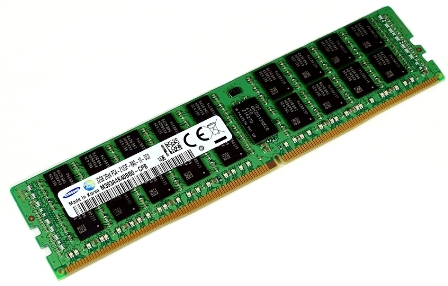
Based on the RDIMM form factor and Registered signal type, the M393A2K43BB1-CTD8Q is a server-grade memory module engineered for mission-critical enterprise environments. Its four defining characteristics directly address the real-world pain points of IT infrastructure managers.
The ECC capability is your first line of defense against silent data corruption. In a virtualized cluster running multiple financial databases, a single bit flip in memory—caused by background radiation—can cascade into a transactional error, a corrupted VM snapshot, or an unrecoverable system halt. ECC detects and corrects these single-bit errors in real time, preserving data integrity and uptime without manual intervention. Paired with the Registered buffer, this module isolates the electrical load from the CPU’s memory controller, enabling a server to support multiple DIMMs per channel without signal degradation. For an in-memory database like Redis or an SAP HANA instance that demands large, contiguous memory pools, this means you can scale to 256GB or more per node while maintaining rock-solid stability under peak query loads. The Dual Rank x8 organization further boosts throughput by allowing the memory controller to interleave accesses across two internal ranks on the same module. In a VMware farm hosting dozens of virtual desktops, this interleaving translates directly into lower latency and higher IOPS, shaving critical milliseconds off every user interaction. Finally, the 1.2V DDR4 design and 2666MHz clock deliver this performance at a power efficiency sweet spot, reducing thermal stress and operational costs across a fully populated rack. This is not just memory; it is a reliability and performance foundation for workloads where failure is not an option.
Server Memory Identified: DDR4-2666 ECC Registered RDIMM
General Virtualization
For hypervisor hosts running a standard mix of VMs, population rules favor balanced channel usage. Install these 16GB modules in sets of six or eight per CPU to populate all memory channels, avoiding unbalanced configurations that degrade bandwidth. A common starting point is 192GB (12 x 16GB) across two sockets, preserving DIMM slots for future scaling. Configure memory interleaving and verify ECC reporting is active in the BIOS for stability under noisy-neighbor contention.
In-Memory Database
In-memory databases demand capacity over raw frequency, so prioritizing fully populated ranks is key. Use dual-rank 16GB RDIMMs in every slot of a 2-socket server to reach 512GB or 1TB, ensuring large page tables and datasets remain in DRAM without paging to NVMe. Pay close attention to memory interleaving and NUMA boundaries; align database instances to local memory nodes to minimize remote access latency. Always consult the DB vendor’s sizing guide for active dataset-to-memory ratio.
High-Performance Computing
HPC workloads benefit from maximum channel utilization to feed wide vector units. Populate eight identical 16GB modules per CPU (128GB per socket) for balanced bandwidth, leaving room to add capacity only if job profiles require larger core-local memory. Optimize for symmetrical DIMM placement, and consider under-subscribing DIMM slots slightly per channel to maintain 2666MT/s speeds—populating three DIMMs per channel often causes the memory controller to drop to a lower speed grade. Profile the fabric and storage layer first, as compute-to-memory ratio is typically fluid.
Rigorously tested server memory, compatible with Dell PowerEdge R760, HPE ProLiant DL380 Gen10, Lenovo ThinkSystem SR650, and similar systems.
Q: Can I mix this M393A2K43BB1-CTD8Q with other memory modules of different brands or speeds?
A: Mixing different brands or speeds on a server platform is not recommended. It can cause signal integrity issues and system instability. For consistent reliability, always populate channels with identical model and batch DIMMs.
Q: Is this memory compatible with my system?
A: This DDR4-2666 ECC Registered RDIMM is designed for Intel Xeon Scalable and AMD EPYC platforms that support Registered DIMMs. Verify your server board’s QVL and chipset compatibility for 288-pin RDIMM configurations.
Q: What is the recommended DIMM population order for optimal performance?
A: Follow your server motherboard’s population guide, typically populating balanced channels starting with identical DIMMs in the first slot of each memory channel. A balanced configuration optimizes memory interleaving and bandwidth.
Q: Does this module support overclocking or XMP profiles?
A: No, this is a standard JEDEC-compliant DDR4-2666 server module. It does not support XMP or overclocking; it is engineered for stable, error-free operation at rated speed under enterprise workloads.
Q: What warranty and typical failure rate can I expect?
A: This module includes a 1-year warranty. As an enterprise-grade ECC RDIMM built with rigorous screening, its typical annualized failure rate (AFR) is exceptionally low, ensuring mission-critical reliability.