











 Secure payments
Standard refund policy
Trade Assurance
Secure payments
Standard refund policy
Trade Assurance
| Product Type | Memory Module |
|---|---|
| Compliance Standards | |
| Memory Capacity | 16 GB |
| Memory Technology | DDR4 |
| Product Voltage | 1.2 V |
| RAM Speed | 2933 MHz |
| RAM Standard | DDR4-2933/PC4-23400 |
| Error Identifying | ECC |
| Signal Type | Registered |
| Column Access Strobe (CAS) | CL21 |
| Rank | Single Rank x4 |
| Quantity of Pins | 288-pin |
| RAM Genre | RDIMM |
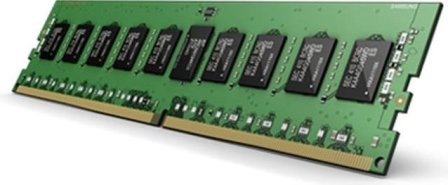
This DDR4-2933 Registered ECC DIMM with single-rank x4 organization is purpose-built for server platforms running memory-intensive workloads like virtualization and in-memory databases, where data integrity and reliability are non-negotiable. The registered signal type ensures stable command and address signaling across high-density memory channels, while the 1Rx4 configuration maximizes bank group parallelism to deliver lower effective access latency and sustained throughput under heavy load.
1. Ample module capacity enables dense memory configurations, allowing a single server to host more virtual machines and improving consolidation ratios in virtualized data centers.
2. ECC functionality provides continuous data integrity for mission-critical databases and financial applications, where silent memory errors can translate directly into revenue loss or compliance failures.
3. Registered DIMM buffering preserves signal integrity across fully populated memory channels, ensuring stable operation under maximum capacity loads essential for large-scale in-memory analytics.
4. High data transfer rate elevates memory bandwidth, significantly accelerating real-time data processing and reducing query latencies in time-sensitive enterprise workloads.
5. Single Rank layout reduces electrical loading per channel, yielding lower access latency and improved energy efficiency that contributes to slimmer power budgets in high-density server racks.
When you are running a virtualized cluster hosting dozens of business-critical VMs, a single bit-flip in memory can silently corrupt sensitive financial records or customer data. This is where the Samsung M393A2K40DB2-CVFCQ truly proves its worth. As a server-class Registered DIMM with ECC, every piece of data passing through this 16GB DDR4-2933 module is continuously validated and corrected, eliminating the risk of undetected transient errors that plague non-ECC memory. For you, that means unshakeable data integrity in always-on environments.
The Registered signal type directly addresses a persistent pain point for IT architects: scaling memory capacity without degrading stability. In a hypervisor or an in-memory database like SAP HANA, you often need to fully populate every channel. Ordinary unbuffered DIMMs would strain the memory controller and cause boot failures or erratic behavior. This module’s register buffers the command and address lines, allowing you to pack denser memory configurations while maintaining clean electrical signals. The result is rock-solid reliability even with 12 or more sticks per server.
Combine that with a DDR4-2933 speed delivering over 23 GB/s of bandwidth, and the Single Rank x4 organization optimizing bank-level parallelism, and you get consistently low-latency access for heavy transactional workloads. In practice, that means faster query responses in a Redis cluster and smoother live migration of virtual machines between nodes—transforming your infrastructure from a reactive bottleneck into a proactive business accelerator.
General Virtualization
For a balanced virtual machine host, populate at least four of these 16 GB RDIMMs (64 GB total) across two memory channels per CPU to leverage memory interleaving. Use identical modules in a 2-DIMM-per-channel (2DPC) configuration to maintain 2933 MT/s speed without throttling, while leaving slots free for future scaling.
In-Memory Database
Maximize capacity and bandwidth by installing eight identical 16 GB RDIMMs (128 GB total) evenly across all four memory channels of a single-socket server. This populates one DIMM per channel (1DPC), sustaining full 2933 MT/s frequency and low latency, which is critical for real-time in-memory processing. ECC and registered buffering ensure data integrity under heavy write loads.
High-Performance Computing (HPC)
Deploy a fully balanced configuration with sixteen 16 GB RDIMMs (256 GB total) across two sockets, populating two DIMMs per channel on each CPU for maximum aggregate bandwidth. The single-rank x4 design reduces electrical loading, helping maintain 2933 MT/s speed even at 2DPC, which directly benefits memory-bound parallel scientific simulations.
Server-grade validated: rigorously tested, compatible with Dell PowerEdge R760, HPE ProLiant DL380 Gen11, Lenovo ThinkSystem SR650, and more.
Q: Can I mix this M393A2K40DB2-CVFCQ with other memory modules of different brands or speeds?
A: Mixing is strongly discouraged. Even modules with similar specs may present subtle timing or rank differences, compromising server stability. Use identical modules to ensure full compatibility and reliability in mission-critical environments.
Q: Is this memory compatible with my system?
A: This DDR4-2933 ECC Registered DIMM is built for server platforms such as Intel Xeon Scalable and AMD EPYC. Please confirm your motherboard supports 288-pin RDIMMs and check its Qualified Vendor List for compatible parts.
Q: What is the recommended DIMM population order for optimal performance?
A: Populate identical DIMMs per channel, starting with the slot farthest from the CPU (typically blue). Follow your server vendor's memory configuration guide to achieve balanced interleaving and full memory bandwidth.
Q: Does this module support overclocking or XMP profiles?
A: No. This is a JEDEC-standard DDR4-2933 Registered module engineered for 24/7 server integrity. Overclocking and XMP profiles are not supported, as they would compromise the rock-solid stability required in enterprise deployments.
Q: What warranty and typical failure rate can I expect?
A: It includes a 1-year warranty. Built for enterprise reliability, this Samsung module undergoes rigorous testing, resulting in an extremely low annualized failure rate. Prompt replacement is provided for covered defects.