











 Secure payments
Standard refund policy
Trade Assurance
Secure payments
Standard refund policy
Trade Assurance
| Product Type | Memory Module |
|---|---|
| Compliance Standards | |
| Memory Capacity | 16 GB |
| Memory Technology | DDR4 |
| Product Voltage | 1.2 V |
| RAM Speed | 3200 MHz |
| RAM Standard | DDR4-3200/PC4-25600 |
| Error Identifying | ECC |
| Signal Type | Registered |
| Column Access Strobe (CAS) | CL22 |
| Rank | Dual Rank x8 |
| Quantity of Pins | 288-pin |
| RAM Genre | RDIMM |
This DDR4-3200 Registered ECC RDIMM, featuring a dual-rank x8 organization and CL22 latency, is engineered for enterprise servers demanding uncompromising data integrity under heavy memory loads. Its registered signal type ensures robust electrical stability across densely populated DIMM slots, making it the optimal choice for virtualization clusters, in-memory databases, and mission-critical workloads where every bit of error correction counts.
1. ECC protection detects and corrects single-bit errors in real time, safeguarding transactional integrity for databases and financial services that cannot tolerate silent data corruption.
2. Registered signal buffering stabilizes command and address buses, allowing fully loaded memory channels without compromising reliability in dense virtualization clusters.
3. High bandwidth accelerates in-memory analytics and large-scale caching, keeping latency low across hundreds of simultaneous virtual machines during peak consolidation.
4. Generous per-module capacity raises virtual machine density per node, delaying costly hardware expansion and improving total cost of ownership for multi-tenant clouds.
5. Dual-rank interleaving saturates the memory channel with parallel access, sustaining peak throughput for bandwidth-hungry enterprise workloads such as real-time stream processing.
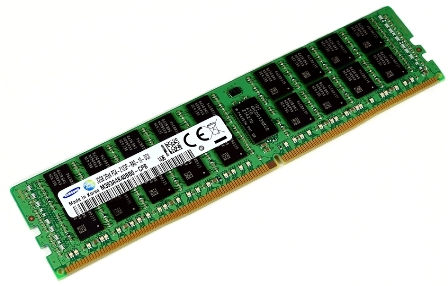
The Samsung M393A2K43EB3-CWECO is a server-grade DDR4 Registered ECC DIMM, and its four defining characteristics translate directly into uptime and throughput for your data center. In a high-density virtualization cluster, the Registered buffer stabilizes command signals across fully populated channels, allowing you to confidently scale to 256 GB or more per node without signal collapse and the intermittent reboots that plague unbuffered memory at scale. ECC guards your real-time operations at the silicon level. For an in-memory database like SAP HANA or a Redis cache handling millions of transactions, a single cosmic-ray-induced bit flip can corrupt a financial record silently — ECC detects and corrects those errors inline, turning potential data integrity disasters into non-events. The dual-rank x8 organization further boosts performance through rank interleaving, overlapping read cycles to reduce latency contention when dozens of VMs hammer storage and caching tiers simultaneously. Finally, the 3200 MT/s speed at CL22 latency ensures those database queries return faster under load, directly accelerating business decisions. In server memory, these traits are not specifications — they are the difference between a trusted appliance and a liability.
This is a DDR4-3200 registered ECC module (16GB, dual-rank x8, RDIMM), intended solely for servers. The capacity planning below focuses on three key enterprise workloads.
General Virtualization
Balanced memory population is essential. Install one identical 16GB RDIMM in every memory channel — for a typical 8-channel dual-socket system this means 8 modules (128GB total). This delivers full bandwidth, supports dozens of VMs comfortably, and enables smooth scaling by later adding a second module per channel to reach 256GB without performance penalties.
In-Memory Database
Both capacity and consistent latency matter. Start with one DIMM per channel for optimal interleaving, then scale by populating a second identically configured 16GB DIMM per channel (e.g., 16 modules for 256GB). Always use matching dual-rank RDIMMs on each channel; mixing capacities or ranks risks dropping the memory speed and degrading database response times.
High-Performance Computing (HPC)
Maximum sustained bandwidth is critical. Install one 16GB module per channel (1DPC) to keep the memory running at full 3200 MT/s. An 8-channel platform thus provides 128GB, which suits most compute-bound jobs. If larger capacity becomes necessary, prefer moving to higher-density modules rather than adding a second DIMM per channel, as 2DPC configurations often force a speed reduction that hurts HPC throughput.
Thoroughly tested, compatible with Dell PowerEdge R750, HPE ProLiant DL380 Gen10, Lenovo ThinkSystem SR650, and similar servers.
Q: Can I mix this M393A2K43EB3-CWECO with other memory modules of different brands or speeds?
A: Mixing this RDIMM with modules of different brands or speeds is not recommended for server environments. It may cause instability, reduced performance, or POST failures. Uniform configurations ensure validated reliability.
Q: Is this memory compatible with my system?
A: This DDR4-3200 ECC Registered DIMM is designed for servers based on Intel Xeon Scalable or AMD EPYC platforms that support 288-pin RDIMMs. Verify your server's qualified vendor list (QVL) for exact compatibility.
Q: What is the recommended DIMM population order for optimal performance?
A: Follow your server motherboard's population guide, typically populating identical DIMMs per channel starting with the farthest slot from the CPU. Balanced channel loading maximizes bandwidth and interleaving efficiency.
Q: Does this module support overclocking or XMP profiles?
A: No. This is a standard JEDEC-compliant RDIMM running at fixed 3200MT/s with CL22. Server memory does not support overclocking or XMP; it prioritizes stability and data integrity over variable speed.
Q: What warranty and typical failure rate can I expect?
A: This module carries a 1-year warranty. Enterprise-class RDIMMs like this Samsung unit exhibit very low annualized failure rates (AFR), typically well under 1%, under normal server operating conditions.