











 Secure payments
Standard refund policy
Trade Assurance
Secure payments
Standard refund policy
Trade Assurance
| Product Type | Memory Module |
|---|---|
| Memory Capacity | 16 GB |
| Memory Technology | DDR4 |
| Product Voltage | 1.2 V |
| RAM Speed | 3200 MHz |
| RAM Standard | DDR4-3200/PC4-25600 |
| Error Identifying | ECC |
| Signal Type | Registered |
| Column Access Strobe (CAS) | CL22 |
| Rank | Dual Rank |
| Quantity of Pins | 288-pin |
| RAM Genre | RDIMM |
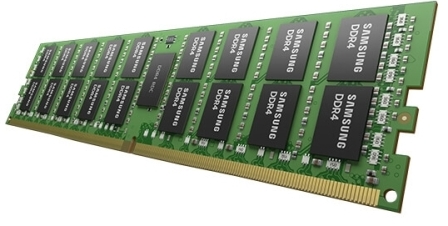
Designed as a registered server module (RDIMM) with ECC, this 16GB DDR4-3200 stick is ideally suited for enterprise platforms running virtualization, in-memory databases, or mission-critical workloads where data integrity is paramount. Its dual-rank organization and registered signaling improve signal stability and interleaving efficiency in dense server configurations, while the CL22 timing and 1.2 V operation keep performance and power efficiency balanced under sustained load.
1. On-die ECC detects and corrects single-bit errors in real time, preserving data integrity for mission-critical databases and preventing silent data corruption that could crash financial transactions or analytics workloads.
2. Registered buffering reduces electrical loading on the memory controller, enabling fully populated server boards to run with absolute signal integrity during sustained heavy virtualization loads.
3. Dual-rank interleaving pipelines concurrent accesses across internal banks, keeping channel bandwidth highly saturated and latency consistently low for dense container or VM deployments.
4. High data rate per channel accelerates in-memory processing, ensuring snappy response across dozens of virtualized tenants simultaneously querying large datasets.
5. Capacity per module provides an ideal density building block, allowing data center operators to maximize total memory footprint per rack unit while leaving slots free for future scale-out.
The Samsung M393A2K43DB3-CWEC0SM is a 16GB DDR4-3200 RDIMM engineered for server environments where reliability and scale define operational success. Its four defining attributes—ECC, Registered signals, dual-rank architecture, and strict JEDEC compliance at 1.2V—translate directly into resilience against real-world data-center pain points.
ECC error correction is non-negotiable in memory-driven databases like SAP HANA or Redis clusters: a single undetected bit flip can corrupt financial transactions or user analytics, but ECC silently scrubs these soft errors, preserving data integrity around the clock. Registered buffering stabilizes signal distribution across heavily populated motherboards; in a virtualization cluster running dozens of VMs per node, you can fully populate all 24 DIMM slots without signal degradation, maximizing memory density and avoiding costly lock-ups during live migrations. Dual-rank interleaving further amplifies bandwidth, accelerating concurrent read/write operations when a hypervisor juggles multiple tenant workloads or an in-memory analytics engine processes real-time queries. Meanwhile, the low 1.2V operating voltage reduces thermal load across rack-scale infrastructure, curbing cooling costs and improving long-term reliability. For IT architects, this means fewer silent corruptions, denser VM deployment, and faster insight generation—transforming memory from a passive component into a strategic enabler of continuously available services.
Identified as server-class memory (DDR4-3200 ECC Registered DIMM), this 16 GB module is built for reliability in multi-socket platforms. Below are capacity guidelines for common workloads.
General Virtualization
Aim for a balanced memory-to-core ratio. For a dual-socket server hosting multiple VMs, populate at least 8 identical modules (128 GB) across all channels, ideally two DIMMs per channel to maximize bandwidth. Scale to 16 modules (256 GB) for heavier consolidation.
In-Memory Database
Databases like Redis or SAP HANA require the entire dataset in memory. Install 16 or more modules (256 GB+) using all channels to keep data resident. Dual-Rank DIMMs improve rank interleaving, reducing latency for critical transactions.
High-Performance Computing
HPC workloads demand high bandwidth. Populate every channel equally with one or two DIMMs per channel. A typical node starts with 8 modules (128 GB) for computation, scaling to 16 modules (256 GB) for memory-intensive simulations, ensuring uniform access and ECC protection.
Rigorously tested, compatible with Dell PowerEdge R750, HPE ProLiant DL380 Gen10, Lenovo ThinkSystem SR650, and more.
Q: Can I mix this M393A2K43DB3-CWEC0SM with other memory modules of different brands or speeds?
A: Mixing is not recommended. RDIMMs must operate at identical speed and CAS latency for stability. Using a different brand or speed may force fallback to the lowest common JEDEC profile, risking server instability.
Q: Is this memory compatible with my system? (Intel or AMD server platform)
A: This DDR4-3200 ECC Registered DIMM is compatible with servers using Intel Xeon Scalable (2nd Gen and later) or AMD EPYC 7002/7003 series processors with DDR4 memory support. Verify the platform supports Registered DIMMs.
Q: What is the recommended DIMM population order for optimal performance?
A: For dual-socket servers, populate identical DIMMs per channel, following motherboard-specific color-coded slots. Generally, fill all blue slots first, then black, to maintain balanced memory channels and enable dual-rank interleaving.
Q: Does this module support overclocking or XMP profiles?
A: No. This server-grade Registered ECC DIMM adheres to JEDEC standard DDR4-3200 CL22. It does not support XMP or manual overclocking, as operational stability and data integrity are critical for enterprise environments.
Q: What warranty and typical failure rate can I expect?
A: This module includes a one-year warranty. It delivers enterprise-class reliability with an AFR well below 1%, thanks to rigorous screening and on-die ECC error correction designed for 24/7 server operation.