











 Secure payments
Standard refund policy
Trade Assurance
Secure payments
Standard refund policy
Trade Assurance
| Product Type | Memory Module |
|---|---|
| Compliance Standards | |
| Memory Capacity | 16 GB |
| Memory Technology | DDR4 |
| Product Voltage | 1.2 V |
| RAM Speed | 3200 MHz |
| RAM Standard | DDR4-3200/PC4-25600 |
| Error Identifying | ECC |
| Signal Type | Registered |
| Column Access Strobe (CAS) | CL22 |
| Rank | Single Rank x4 |
| Quantity of Pins | 288-pin |
| RAM Genre | RDIMM |
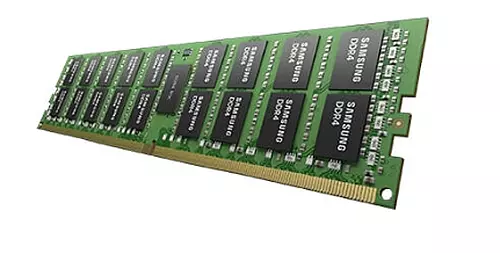
This DDR4-3200 Registered DIMM with ECC is engineered for server-class platforms, delivering robust data integrity and stability for memory-intensive workloads such as virtualization and in-memory databases. Its single-rank x4 organization and CL22 latency ensure consistent signaling and efficient memory controller loading, making it an ideal fit for dense multi-DIMM server configurations.
1. 16GB capacity per module fits dense virtualization nodes, allowing more active VMs per host without immediate DIMM replacement cycles.
2. 3200 MT/s bandwidth prevents data pipeline stalls in memory-analytics applications, keeping real-time dashboards responsive under concurrent user loads.
3. ECC protection transparently corrects single-bit faults, turning cosmic-ray-induced errors into non-events for long-running financial settlement processes.
4. Registered signal buffering stabilizes multi-DIMM channels at full speed, essential for maintaining data integrity in fully‑populated storage controllers.
5. Single Rank x4 organization cuts per‑channel electrical loading, enabling higher sustained clock rates and reduced thermal stress in dense rack‑mount deployments.
The M393A2K40DB3-CWEBQ is a 16GB DDR4-3200 Registered ECC DIMM engineered for enterprise servers. Its four critical attributes translate directly into operational resilience for your data center. ECC reliably corrects single-bit errors in real time, a non-negotiable safeguard in dense virtualization clusters where a single uncorrected flip can silently corrupt a hypervisor’s memory map and bring down dozens of production VMs. The registered buffer decouples the memory bus from the DRAM chips, maintaining rock-solid signal integrity when you fully populate every channel to feed memory-hungry workloads, such as in-memory databases or real-time analytics platforms like Redis and SAP HANA. Running at 3200MT/s, this module supplies the raw bandwidth to keep multi-core processors saturated, cutting transaction latency under heavy concurrent loads. Further, its single-rank x4 organization presents a lighter electrical burden per DIMM than dual-rank alternatives, so multiple modules per channel achieve lower command latency and deliver the consistent I/O response that software-defined storage and high-frequency trading systems demand. This combination directly prevents costly downtime, accelerates data insights, and protects the integrity of every digital transaction you process.
General Virtualization
Deploy this 16GB DDR4-3200 RDIMM in sets of eight across dual-socket servers to populate one DIMM per channel, achieving balanced memory bandwidth for mixed VM workloads. A typical configuration of 8×16GB (128GB total) supports 20–30 light to moderate VMs, while denser nodes can scale to 16×16GB (256GB) when CPU cores are fully utilized. Always install identical modules to maintain memory mirroring and sparing options where reliability is paramount.
In-Memory Database
Low-latency databases demand large, contiguous memory pools; equip a 2-socket server with 12–16 of these 16GB RDIMMs for a 192–256GB footprint ideal for Redis or Memcached clusters. Populate all memory channels evenly to maximize throughput and leverage the ECC and registered features to prevent data corruption during high-frequency writes. For heavier datasets, consider moving to 32GB or 64GB RDIMMs, but this 16GB module remains cost-effective for scale-out nodes.
High Performance Computing
HPC clusters benefit from this single-rank x4 module’s signal integrity at speed; install one DIMM per populated channel (e.g., 8 modules per node) to achieve highest clock stability during MPI-parallel tasks. The CL22 latency and 3200MT/s speed strike a sweet spot for memory-bandwidth-bound simulations, and registered buffering allows scaling to larger per-node capacities without sacrificing RAS features. For GPU-offloaded workloads, 128–256GB using these sticks keeps the CPU fed efficiently.
Rigorously tested server memory. Compatible with Dell PowerEdge R760, HPE ProLiant DL380 Gen11, Lenovo ThinkSystem SR650 V3.
Q: Can I mix this M393A2K40DB3-CWEBQ with other registered DDR4 modules of different brands or speeds?
A: Mixing brands is possible but not recommended. All modules will operate at the lowest common speed and timings. For guaranteed stability, especially in mission-critical servers, use identical modules with the same part number.
Q: Is this registered DIMM compatible with my Intel Xeon Scalable or AMD EPYC server platform?
A: This DDR4-3200 RDIMM is compatible with platforms supporting registered ECC memory at 3200 MT/s, such as Intel Xeon Scalable 3rd Gen and AMD EPYC 7002/7003 series. Verify that your specific motherboard CPU supports 16GB single rank x4 modules.
Q: What is the recommended DIMM population order for optimal performance on a server board?
A: Populate identical DIMMs per memory channel, starting with the farthest slot from the CPU. For example, in a 1 DIMM per channel configuration, fill the blue slots first. Always consult your server's manual for balanced memory interleaving and maximum throughput.
Q: Does this server memory module support overclocking or XMP profiles to exceed JEDEC specifications?
A: No. As enterprise Registered ECC memory, it strictly adheres to JEDEC DDR4-3200 (PC4-25600) with fixed CL22 timings. Overclocking and XMP are disabled to guarantee 24/7 data integrity and long-term reliability under server workloads.
Q: What warranty and typical failure rate can I expect with this 16GB DDR4 RDIMM?
A: This module carries a 1-year warranty. Enterprise-class components typically exhibit an annualized failure rate (AFR) below 0.5%. Proper cooling and operating within voltage specifications ensure an extremely low failure probability over its lifespan.