











 Secure payments
Standard refund policy
Trade Assurance
Secure payments
Standard refund policy
Trade Assurance
| Product Type | Memory Module |
|---|---|
| Memory Capacity | 16 GB |
| Memory Technology | DDR4 |
| Product Voltage | 1.2 V |
| RAM Speed | 3200 MHz |
| RAM Standard | DDR4-3200/PC4-25600 |
| Error Identifying | ECC |
| Signal Type | Registered |
| Column Access Strobe (CAS) | CL22 |
| Rank | Dual Rank x8 |
| Quantity of Pins | 288-pin |
| RAM Genre | RDIMM |
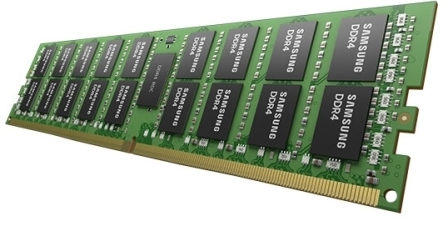
Designed for server platforms, this Samsung DDR4-3200 Registered DIMM with ECC and a dual-rank x8 organization ensures enhanced signal integrity and memory bank interleaving for consistent performance under heavy multi-DIMM configurations. It is ideally suited for virtualization, in-memory databases, and mission-critical enterprise workloads where 16GB capacity, true ECC error correction, and low CL22 latency at 1.2V deliver an optimal balance of data integrity, power efficiency, and throughput.
1. Registered buffer technology decouples the memory controller from direct DRAM loads, ensuring rock-solid signal integrity when populating all DIMM slots in dense multi-socket server platforms.
2. On-die ECC transparently corrects single-bit errors in real time, safeguarding against silent data corruption that could compromise transactional databases and long-running analytics.
3. Dual Rank organization leverages rank interleaving to saturate memory channels, delivering higher sustained bandwidth for virtualized environments with heavy VM co-location.
4. The swift data transfer rate matches the throughput demands of modern Xeon and EPYC cores, preventing bottlenecks during real-time in-memory processing and AI inference.
5. A 1.2 V operating voltage reduces thermal waste and power draw across large memory fleets, directly lowering data center cooling costs and improving overall power usage effectiveness.
The Samsung M393A2K43DB3-CWEGQ is a server-grade RDIMM engineered for data centers where resilience and continuous uptime are the only acceptable benchmarks. Its four key characteristics directly answer the harsh realities of enterprise computing. ECC correction actively scrubs and remediates single-bit flips caused by background radiation or electrical noise. In an in-memory database such as SAP HANA, an uncorrected bit error silently corrupts a live financial record; ECC is the protective layer that prevents silent data corruption from cascading through your transactions. The registered buffer then steps in to stabilize signal loads, enabling a single host to support high-density memory populations without signal degradation. For a hypervisor running dozens of virtual machines, this means you can confidently pack channels with multiple DIMMs to maximize VM density, avoiding the instability that would otherwise force expensive balancing acts. The dual-rank x8 organization further elevates performance through bank interleaving, giving the memory controller more open pages to exploit. This translates directly into higher sustained bandwidth during massive analytical table scans in database clusters or real-time streaming pipelines. Finally, the DDR4-3200 speed at a low 1.2V delivers 25.6 GB/s per channel, feeding modern multi-core CPUs efficiently while keeping thermals in check inside space-constrained 1U servers. For a Redis caching layer or a vSAN cluster, these features fuse into a single 16GB building block that delivers the data integrity, density headroom, and predictable low latency your workloads demand.
General Virtualization
For a balanced virtualized host, install 8 to 16 of these 16 GB RDIMMs (128–256 GB total) evenly across all memory channels in a dual-socket server. This configuration maintains symmetrical channel population and full memory bandwidth, supporting 30–50 typical VMs without overcommitting RAM. Use identical dual‑rank modules to avoid NUMA imbalances and keep memory latency predictable.
In-Memory Database
In‑memory databases require keeping entire datasets in RAM for microsecond response times. A dual-socket server should be fully loaded with 16 to 24 of these registered 16 GB DIMMs (256–384 GB total), populating every channel to maximize throughput. The dual‑rank, x8 organization and CL22 timing provide robust error‑corrected bandwidth, essential for Redis, SAP HANA, or Memcached deployments.
High-Performance Computing (HPC)
HPC clusters demand consistent, high‑bandwidth memory access. Populate all 16 DIMM slots on a dual‑socket board with one 16 GB dual‑rank RDIMM per channel (256 GB total) to enable full channel and rank interleaving. This Samsung dual‑rank x8 part effectively hides CAS latency, sustaining near‑peak DDR4‑3200 throughput for simulation, modeling, and parallel computation jobs.
Rigorously tested, this ECC RDIMM is compatible with Dell PowerEdge R750, HPE DL380 Gen10, Lenovo SR650 V2.
Q: Can I mix this M393A2K43DB3-CWEGQ with other memory modules of different brands or speeds?
A: Mixing is not recommended. Different speeds or brands may cause stability issues and disable ECC functionality. For reliable operation, use identical modules with the same Samsung part number and specs.
Q: Is this memory compatible with my system?
A: This 16GB DDR4-3200 RDIMM is compatible with Intel Xeon Scalable and AMD EPYC platforms supporting 288-pin Registered ECC memory. Please verify your server's qualified vendor list (QVL) for full compatibility.
Q: What is the recommended DIMM population order for optimal performance?
A: Follow your motherboard's population guide. For dual-socket systems, balance DIMMs across all memory channels with identical configurations. Typically, fill one DIMM per channel first to maximize bandwidth.
Q: Does this module support overclocking or XMP profiles?
A: No, this is a JEDEC-compliant server RDIMM operating at its native 3200MT/s. It does not support XMP or manual overclocking, as stability and data integrity are prioritized in enterprise environments.