











 Secure payments
Standard refund policy
Trade Assurance
Secure payments
Standard refund policy
Trade Assurance
| Product Type | Memory Module |
|---|---|
| Memory Capacity | 16 GB |
| Memory Technology | DDR4 |
| Product Voltage | 1.2V |
| RAM Standard | DDR4-3200/PC4-25600 |
| Error Identifying | ECC |
| Signal Type | Registered |
| Column Access Strobe (CAS) | CL22 |
| Rank | Dual Rank x8 |
| Quantity of Pins | 288-pin |
| RAM Genre | RDIMM |
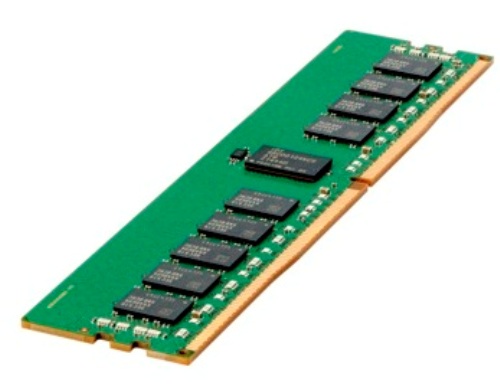
This RDIMM with ECC and registered signal type is engineered for server platforms handling virtualization, in-memory databases, and mission-critical workloads where data integrity is non-negotiable. Its dual-rank x8 configuration maximizes interleaving and bandwidth efficiency, while the DDR4-3200 CL22 timing at 1.2V delivers a solid balance of performance and power for dense multi-DIMM deployments.
1. 16GB capacity per module delivers the density needed to maximize memory slots in virtualized servers, allowing more VMs per host without sacrificing headroom for critical applications.
2. DDR4-3200 speed ensures 25.6 GB/s peak bandwidth per channel, accelerating in-memory databases and real-time analytics under heavy query loads.
3. ECC protection silently corrects single-bit errors, preventing silent data corruption that could otherwise crash long-running enterprise workloads or compromise transactional integrity.
4. Registered signal type reduces electrical loading on the memory bus, enabling fully populated multi-DIMM configurations that maintain stability in large-scale rack deployments.
5. Dual Rank x8 organization interleaves memory accesses across internal banks, sustaining higher throughput and lowering latency for consistent response times in concurrent multi-tenant services.
Engineered for enterprise servers, the Samsung M393A2K43DB2-CWECQ is a 16GB DDR4-3200 RDIMM that directly addresses the critical pain points of modern data centers. Its registered architecture buffers command signals, enabling you to densely populate server boards without the signal degradation that would crash a virtualized cluster. When dozens of virtual machines share a single host, this stability keeps every guest responsive under load. The integrated ECC continuously corrects single-bit errors, which is vital for safeguarding transactional databases and preventing silent data corruption that could ripple into financial inaccuracies or analytics anomalies. As a dual-rank x8 module, it leverages rank interleaving to overlap data access between internal banks, effectively boosting throughput for memory-bound applications such as an in-memory SAP HANA instance or a high-concurrency Redis cache. While the CL22 latency is tuned for reliability over raw speed, the 1.2V low-power design helps you scale capacity without punishing thermal budgets, reducing cooling OPEX across a fleet of hypervisors. This module transforms memory from a commodity component into a strategic advantage for workload consolidation and data integrity.
General Virtualization
For general virtualization hosts, populate at least eight 16 GB RDIMMs (128 GB total) across six or eight memory channels, using one dual‑rank module per channel where possible. This balances capacity for a moderate number of virtual machines while maintaining DDR4-3200 speed, as registered ECC memory allows stable operation at full frequency in balanced configurations.
In‑Memory Database
Maximise capacity per socket by installing sixteen or more modules to reach 256 GB and beyond, leveraging the registered dual‑rank x8 design to drive large memory footprints without signal integrity loss. Fill all channels with two DIMMs per channel if the platform supports it, accepting a potential slight frequency drop to DDR4-2933 for the sake of ultra‑low‑latency data access in in‑memory workloads.
High Performance Computing (HPC)
Prioritise memory bandwidth by installing a single 16 GB RDIMM per channel across all available channels—typically six or eight modules—to keep the memory bus at DDR4-3200. The 1.2 V operating voltage and dual‑rank construction deliver strong sustained throughput; for capacity‑sensitive HPC jobs, expand to two modules per channel but test application scaling to confirm that the marginal bandwidth reduction is acceptable.
Strictly tested, compatible with Dell PowerEdge R760, HPE ProLiant DL380 Gen10, and Lenovo ThinkSystem SR650.
Q: Can I mix this M393A2K43DB2-CWECQ with other memory modules of different brands or speeds?
A: Mixing RDIMMs with different brands or speeds is not recommended. It may cause instability or system failure. For optimal reliability, always use identical modules from the same manufacturer and batch.
Q: Is this memory compatible with my system?
A: This DDR4-3200 ECC Registered RDIMM is designed for server platforms using Intel Xeon Scalable or AMD EPYC processors. Verify your motherboard supports 288-pin RDIMMs at 1.2V and 3200MT/s.
Q: What is the recommended DIMM population order for optimal performance?
A: Populate identical modules in balanced channels per your server board manual. Typically, install in sets of four or eight to enable all memory channels and maximize bandwidth. Match rank and capacity per channel.
Q: Does this module support overclocking or XMP profiles?
A: No. This is a JEDEC-compliant registered ECC module designed for server stability. It does not support XMP or overclocking. Operating at its native 3200MT/s with standard CL22 timings is recommended.
Q: What warranty and typical failure rate can I expect?
A: This module includes a one-year warranty. Enterprise-grade RDIMMs like this Samsung unit exhibit very low annualized failure rates, typically under 0.5%, when operated within specified environmental conditions.