











 Secure payments
Standard refund policy
Trade Assurance
Secure payments
Standard refund policy
Trade Assurance
| Product Type | Memory Module |
|---|---|
| Memory Capacity | 16 GB |
| Memory Technology | DDR5 |
| Product Voltage | 1.1 V |
| RAM Speed | 4800 MHz |
| RAM Standard | DDR5-4800/PC5-38400 |
| Error Identifying | ECC |
| Signal Type | Registered |
| Column Access Strobe (CAS) | CL40 |
| Rank | Single Rank x8 |
| Quantity of Pins | 288-pin |
| RAM Genre | RDIMM |
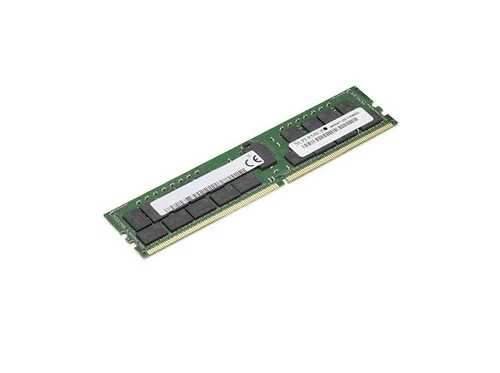
The DDR5-4800 Registered DIMM with ECC is engineered for enterprise server platforms, delivering robust data integrity and signal stability crucial for virtualization and in-memory database workloads. Its single-rank x8 configuration at CL40 ensures balanced latency and efficient memory access, while the registered architecture enables higher memory density per channel for scalable, mission-critical deployments.
1. Registered DIMM architecture buffers command and address signals, enabling reliable population of all memory channels in high-density servers that cannot tolerate signal degradation under constant transactional workloads.
2. On-die ECC corrects single-bit errors in real time, preserving data accuracy for sensitive financial computations and round-the-clock virtualized database instances where even silent corruption is unacceptable.
3. DDR5 technology delivers a generational leap in bandwidth-per-core, letting hypervisors pack more virtual machines onto the same host without memory bottlenecks during peak consolidation.
4. A 4800 megatransfer rate supplies the sustained throughput modern server processors demand, reducing tail latencies in distributed caching and real-time analytics pipelines at scale.
5. Sixteen-gigabyte module capacity provides a dense yet granular scaling unit, allowing operators to reach multi-terabyte footprints across standard dual-socket boards while leaving room for future expansion.
The M321R2GA3BB6-CQKMS is a DDR5 RDIMM purpose-built for enterprise servers. Its four key features translate directly into operational resilience and performance for critical workloads. The DDR5-4800 interface delivers 38.4 GB/s of bandwidth, eliminating memory bottlenecks in dense virtualization clusters and allowing more VMs per host without slowdowns. On-chip ECC error correction safeguards in-memory databases like SAP HANA or Redis against silent bit flips, preventing costly data corruption in financial transactions or real-time analytics. The Registered buffer technology stabilizes command and address signals across multiple DIMMs, so you can scale memory capacity confidently in multi-slot servers—essential for supporting dozens of virtual machines with uncompromising stability. The Single Rank x8 design reduces electrical loading and optimizes latency, improving query response times for latency-sensitive applications while ensuring broad platform compatibility. With a 1.1V ultra-efficient voltage, this module also helps curb data center power consumption. Together, these characteristics mean your virtualized infrastructure and memory-driven databases achieve maximum uptime and faster time-to-insight.
General Virtualization
For general virtualization hosts, balance memory capacity with cost by populating all available memory channels with one 16GB RDIMM per channel. This configuration—such as eight or twelve identical M321R2GA3BB6-CQKMS modules—delivers 128GB or 192GB total while sustaining full DDR5-4800 speed and low latency. The ECC and registered features ensure data integrity across diverse virtual machines.
In-Memory Database
In-memory databases demand both capacity and sustained throughput, so deploy multiple 16GB RDIMMs to fill every channel at one DIMM per channel (1DPC) to avoid speed reduction. Scale total memory by adding further identical modules in a second rank-per-channel configuration if capacity must exceed 256GB, accepting a slight frequency trade-off. The CL40 latency and registered signaling provide the stability required for large dataset processing.
High Performance Computing
For HPC workloads, maximize memory bandwidth by installing one Single Rank x8 RDIMM in every memory channel, keeping the system at the full 4800MT/s transfer rate. A typical dual-socket node using 16 such 16GB modules reaches 256GB of balanced, low-latency memory. ECC reliability and consistent rank alignment guarantee computational repeatability across long-running parallel jobs.
Rigorously tested DDR5 RDIMM compatible with Dell PowerEdge R760, HPE ProLiant DL380 Gen11, Lenovo ThinkSystem SR650 V3.
Q: Can I mix this M321R2GA3BB6-CQKMS with other memory modules of different brands or speeds?
A: Mixing RDIMMs of different brands or speeds is strongly discouraged. Inconsistent timings or ranks can compromise signal integrity on a registered bus, leading to system instability and memory errors.
Q: Is this memory compatible with my system?
A: This DDR5-4800 registered ECC module targets Intel Xeon Scalable (Sapphire Rapids) and AMD EPYC 9004 platforms. Verify your server board’s qualified vendor list for M321R2GA3BB6-CQKMS confirmation.
Q: What is the recommended DIMM population order for optimal performance?
A: Populate symmetric channels per your server manual. For a single-rank x8 RDIMM, typically install one DIMM per channel using the farthest slot from the CPU first to balance interleaving and bandwidth.
Q: Does this module support overclocking or XMP profiles?
A: No. This is a JEDEC-compliant registered ECC module built for stability, not overclocking. It does not feature XMP profiles and operates strictly at its rated 4800MT/s with CL40 timings.
Q: What warranty and typical failure rate can I expect?
A: This module includes a one-year warranty. Enterprise-class RDIMMs exhibit an annualized failure rate typically under 2–3% when operated within specified environmental and electrical parameters.