











 Secure payments
Standard refund policy
Trade Assurance
Secure payments
Standard refund policy
Trade Assurance
| Product Type | Memory Module |
|---|---|
| Memory Capacity | 16 GB |
| Memory Technology | DDR5 |
| Product Voltage | 1.1 V |
| RAM Speed | 4800 MHz |
| RAM Standard | DDR5-4800/PC5-38400 |
| Error Identifying | ECC |
| Signal Type | Registered |
| Column Access Strobe (CAS) | CL40 |
| Rank | Single Rank x8 |
| Quantity of Pins | 288-pin |
| RAM Genre | RDIMM |
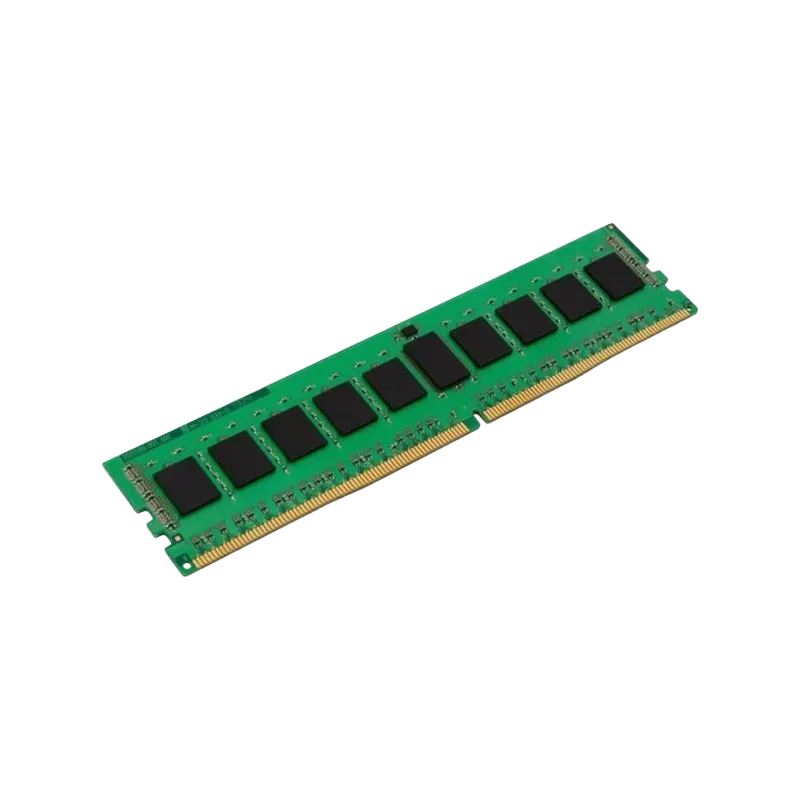
This 16GB DDR5-4800 Registered ECC RDIMM is purpose-built for server platforms handling virtualization, in-memory databases, and data-analytics workloads where uncompromising data integrity is critical. The Registered signal type reduces bus loading to maintain excellent signal stability across fully populated systems, and the efficient single-rank x8 configuration cooperates with end-to-end ECC to deliver high-bandwidth performance with active single-bit error correction.
1. DDR5 technology doubles the bank groups and prefetch depth, multiplying available memory bandwidth to keep modern multi-core server CPUs fed during heavily parallelized workloads like virtualization and large-scale analytics.
2. A sixteen-gigabyte capacity per DIMM provides the ideal granularity for maximizing memory density in dual-socket servers, supporting more virtual machines per rack without sacrificing performance.
3. Integrated ECC silently corrects single-bit upsets as they occur, safeguarding long-running enterprise applications and in-memory databases against silent data corruption.
4. Registered signal buffering decouples the memory controller from the DRAM loads, preserving signal integrity when all channels are fully populated—a must for maintaining uptime in dense server farms.
5. Operating at 4800MT/s, this module slashes memory access latency on read-intensive caching tiers, directly accelerating real-time transaction processing and business intelligence queries.
The M425R2GA3BB0-CQKOL is a server-class DDR5 RDIMM engineered for mission-critical infrastructure where every bit of data must be trusted. Its four core attributes — ECC error correction, registered signal buffering, 4800MT/s throughput, and efficient 1.1V operation — directly resolve the real pain points of data center operators. In a dense virtualization cluster hosting dozens of VMs, a single undetected bit flip can silently corrupt a financial transaction or a patient record; on-chip ECC detects and corrects these errors on the fly, safeguarding transactional integrity and preventing costly application faults. Registered clock drivers then stabilize command and address signals when you fully load all memory channels, enabling you to scale capacity without sacrificing platform stability — a non-negotiable requirement for large-scale virtualization. That same infrastructure often relies on in-memory databases such as Redis or SAP HANA to deliver real-time insights. Here, DDR5-4800 bandwidth sharply accelerates massive concurrent reads, slashing query latency under heavy loads and directly improving user experience. Finally, the low 1.1V operating voltage subtly yet powerfully curbs power draw per DIMM, easing the thermal and energy strain in crowded racks and lowering total cost of ownership. Together, these capabilities mean your memory-intensive workloads run with hardened reliability, uncompromised speed, and optimized efficiency.
General Virtualization
This 16GB DDR5-4800 RDIMM is the foundation for dense server virtualization. Deploy in multiples of eight modules across a dual-socket platform to populate all memory channels, maximizing bandwidth for numerous VMs. Aim for 128GB to 256GB per host using single-rank DIMMs, balancing capacity with low latency to avoid overcommitting memory under moderate consolidation ratios.
In-Memory Database
Low-latency ECC memory is critical for in-memory databases like Redis or SAP HANA. Configure six or eight identical 16GB modules per CPU to maintain balanced memory interleaving and deliver the high throughput required by real-time analytics. For small to mid-sized datasets, a 128GB pool ensures data fits entirely in DRAM, eliminating storage bottlenecks and supporting sub-millisecond response times.
High-Performance Computing
HPC workloads demand the bandwidth of fully populated channels. Use one 16GB DIMM per channel (typically eight per socket) to saturate memory controllers with DDR5-4800 speed, providing up to 307 GB/s per CPU. This single-rank x8 configuration minimizes electrical loading, enabling stable high-frequency operation for simulation, modeling, and large-scale computation while ECC safeguards results against silent data corruption.
Validated server memory: rigorously tested, compatible with Dell PowerEdge R760, HPE ProLiant DL380 Gen11, Lenovo ThinkSystem SR650 V3.
Q: Can I mix this M425R2GA3BB0-CQKOL with other memory modules of different brands or speeds?
A: Mixing RDIMMs of different brands or speeds risks system instability and is not recommended. For guaranteed compatibility, populate all channels with identical Samsung DDR5-4800 ECC Registered modules sharing the same rank and CAS latency.
Q: Is this memory compatible with my system?
A: This module is compatible with servers supporting DDR5 ECC Registered DIMMs. Verify your motherboard supports 288-pin DDR5 RDIMMs and the specific Intel Xeon Scalable (Sapphire Rapids) or AMD EPYC (Genoa) platform with 4800MT/s speeds.
Q: What is the recommended DIMM population order for optimal performance?
A: For optimal bandwidth, balance memory across all memory channels—typically populate identical DIMMs in 1 DIMM Per Channel (1DPC) configuration, filling slots according to your server board’s population guide for symmetrical interleaving.
Q: Does this module support overclocking or XMP profiles?
A: No. This DDR5 Registered ECC memory adheres to JEDEC standard speeds only. Overclocking and XMP profiles are not supported on server-class RDIMMs, ensuring data integrity and stability for mission-critical workloads.
Q: What warranty and typical failure rate can I expect?
A: This memory includes a one-year warranty. Enterprise-grade Samsung RDIMMs exhibit very low failure rates (typically <0.2% AFR) under spec operating conditions, backed by rigorous testing for 24/7 server environments.