











 Secure payments
Standard refund policy
Trade Assurance
Secure payments
Standard refund policy
Trade Assurance
| Product Type | Memory Module |
|---|---|
| Memory Capacity | 16 GB |
| Memory Technology | DDR5 |
| Product Voltage | 1.1 V |
| RAM Speed | 4800 MHz |
| RAM Standard | DDR5-4800/PC5-38400 |
| Error Identifying | ECC |
| Signal Type | Registered |
| Column Access Strobe (CAS) | CL40 |
| Rank | Single Rank x8 |
| Quantity of Pins | 288-pin |
| RAM Genre | RDIMM |
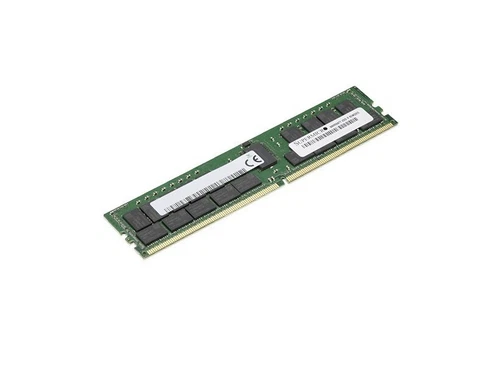
This DDR5-4800 Registered DIMM with ECC is engineered for server platforms, excelling in virtualization, in-memory databases, and mission-critical enterprise workloads that demand uncompromising data integrity. The single-rank x8 configuration and registered signal type deliver robust electrical buffering and stable 4800MT/s operation across fully populated memory channels, effectively suppressing signal distortion and silent data corruption.
1. A 16GB capacity per DIMM provides a sweet-spot density for hypervisor hosts, packing more virtual machines into each server without wasting precious memory channels.
2. DDR5 technology doubles bank groups for higher parallelism, directly accelerating massive in-memory datasets and real-time transaction processing under full load.
3. 4800MT/s transfer speed feeds bandwidth-hungry server CPUs, keeping data flowing smoothly during heavy virtualization and large-scale AI inference bursts.
4. ECC error correction eliminates silent data corruption, which is non-negotiable for financial ledgers, scientific simulations, and any workload where a single bit flip could cause costly failures.
5. Registered clock buffering stabilizes signal integrity across fully loaded channels, ensuring large-memory configurations stay reliable during continuous 24/7 operation.
Designed for enterprise servers, the Samsung M321R2GA3BB6-CQKDS is a DDR5-4800 Registered DIMM that directly addresses the critical demands of modern data centers. Its 4800MT/s speed effectively doubles the peak bandwidth of previous-generation DDR4, meaning your virtualization clusters can host significantly more VMs per node without memory bottlenecks, and in-memory databases like SAP HANA or Redis serve queries with dramatically lower latency.
The on-die ECC built into DDR5, coupled with standard module-level ECC, forms a powerful defense against bit-flip errors. For a financial transaction system or a patient database running 24/7, this means the difference between a silent data corruption going unnoticed and reliable data integrity you can stake your infrastructure on. Because it is a Registered DIMM, the module includes a register chip that buffers command and address signals, allowing a server board to support three DIMMs per channel stably while maintaining clean signal integrity. When you need to scale your virtualization host to 512GB or more, that stability is non-negotiable—sudden crashes under heavy memory load become a thing of the past. Finally, operating at just 1.1V, this module slashes power consumption per bit transferred. Across a fully populated rack of database servers, the aggregate energy savings directly reduce OpEx and thermal stress, extending hardware lifespan in dense deployments where every watt matters.
General Virtualization
For a dual-socket server, populate all memory channels symmetrically—one 16GB RDIMM per channel—to maximize bandwidth and reduce latency. With eight channels per CPU, installing sixteen modules yields 256 GB, delivering balanced capacity for a large number of virtual machines while maintaining DDR5-4800 speed.
In-Memory Database
Capacity is the primary driver; fill every available slot, accepting a slight frequency drop when using two DIMMs per channel (2DPC). A two-socket platform with eight channels each can support up to 32 of these 16 GB RDIMMs, providing 512 GB to hold entire datasets in RAM for real-time analytics engines like Redis or SAP HANA.
High-Performance Computing
Bandwidth-sensitive HPC workloads benefit from the fastest unconstrained speed. Install exactly one single‑rank 16 GB RDIMM per memory channel to keep the memory bus at 4800 MT/s. In a typical dual‑CPU node, that creates a 128–256 GB configuration with peak throughput, ideal for simulation, modeling, and numerical computation tasks.
Engineered for servers: rigourously tested DDR5 RDIMM, compatible with Dell PowerEdge R760, HPE ProLiant DL380 Gen11, Lenovo ThinkSystem SR650 V3, and Supermicro SYS-620P-TR.
Q: Can I mix this M321R2GA3BB6-CQKDS with other memory modules of different brands or speeds?
A: Mixing RDIMMs of different brands or speeds is strongly discouraged in server environments. It can cause instability, force down-clocking, and jeopardize 24/7 mission-critical reliability. Always use identical, platform-validated modules for guaranteed performance.
Q: Is this memory compatible with my Intel Xeon or AMD EPYC server platform?
A: This DDR5-4800 ECC Registered DIMM is built for current Intel Xeon Scalable (Sapphire Rapids) and AMD EPYC 9004 (Genoa) platforms. Please consult your server board’s Qualified Vendor List to confirm support and optimal configuration.
Q: What is the recommended DIMM population order for optimal performance?
A: Follow your server’s manual: typically, populate balanced channels with identical DIMMs, using the farthest slots from each CPU first. This ensures maximum memory interleaving, bandwidth, and reliable multi-channel operation across all populated banks.
Q: Does this module support overclocking or XMP profiles?
A: No. As an enterprise RDIMM operating at JEDEC standard DDR5-4800, this module prioritizes signal integrity and error correction. Overclocking or XMP profiles are not supported; it is optimized for constant, reliable 24/7 operation.
Q: Can this RDIMM be used in a standard desktop PC or laptop?
A: No. Registered ECC DIMMs require a server-class chipset and CPU. They are physically and electrically incompatible with consumer desktops and laptops, which accept only UDIMM or SO-DIMM memory modules.