











 Secure payments
Standard refund policy
Trade Assurance
Secure payments
Standard refund policy
Trade Assurance
| Product Type | Memory Module |
|---|---|
| Memory Capacity | 16 GB |
| Memory Technology | DDR5 |
| Product Voltage | 1.1 V |
| RAM Speed | 5600 MHz |
| RAM Standard | DDR5-5600/PC5-44800 |
| Error Identifying | ECC |
| Signal Type | Registered |
| Column Access Strobe (CAS) | CL46 |
| Rank | Dual Rank |
| Quantity of Pins | 288-pin |
| RAM Genre | RDIMM |
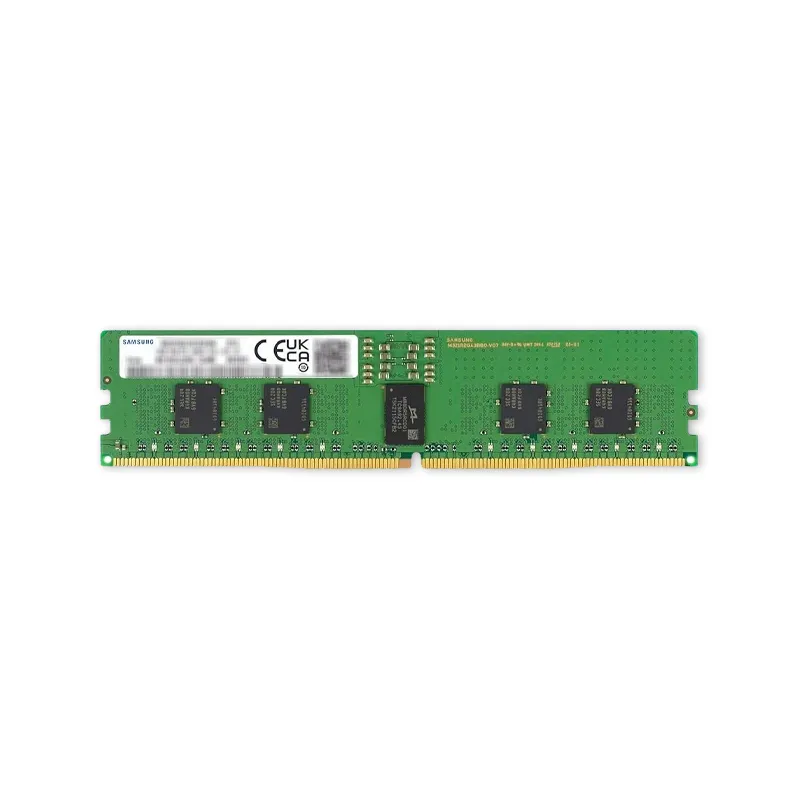
This 16GB DDR5-5600 Registered ECC RDIMM is purpose-built for enterprise servers and workstations, delivering the data integrity and reliability required for virtualization, in-memory databases, and transactional workloads. Its dual-rank design enhances throughput through rank interleaving, while the registered signal architecture maintains signal stability and supports high-density memory configurations without compromising ECC protection.
1. DDR5 memory technology doubles bank groups and enhances on‑die ECC, dramatically boosting throughput per channel to keep densely‑packed server CPUs fed with data under sustained load.
2. ECC protection silently corrects single‑bit errors and detects multi‑bit failures, preserving data integrity for mission‑critical transactional applications and long‑running compute jobs.
3. Registered clock buffering isolates the memory controller from electrical loading, enabling stable operation across fully‑populated DIMM slots in large‑scale multi‑socket platforms.
4. Dual Rank interleaving overlaps command execution across internal banks, effectively saturating the memory channel and delivering consistent bandwidth for heavily consolidated virtual machines.
5. High transfer rate shortens data access windows, accelerating in‑memory databases and real‑time analytics without adding latency‑sensitive bottlenecks.
The Samsung M321R2GA3PB0-CWMKH is a server-grade DDR5 Registered DIMM engineered for relentless data integrity and scale. In a virtualized cluster hosting dozens of VMs, a single undetected bit-flip can corrupt a hypervisor and cascade into multi-tenant outages. This module’s ECC function actively scrubs such errors, turning a silent service killer into a non-event, while the Registered clock driver buffers command and address signals so your platform can populate all channels with 16 GB dual-rank modules and still hit 5600 MT/s without signal collapse. That dual-rank architecture interleaves memory banks for measurably lower latency under concurrent access, which becomes a direct performance multiplier for an in-memory database like Redis. As your dataset outgrows L3 cache, rank interleaving sustains high throughput per watt because the 1.1 V DDR5 interface delivers 44.8 GB/s of bandwidth at nearly 20 percent better energy efficiency than its DDR4 predecessors. Density, speed, signal stability, and error containment do not remain specification bullets here; they determine whether your real-time analytics finish in seconds or stall on memory contention, and whether your nightly batch runs complete cleanly or trigger cryptic data corruption that erodes trust. For anyone building a virtualization farm or database engine room, this RDIMM converts raw parameters into business continuity.
General Virtualization
For a typical hypervisor host running mixed VMs, populate at least four 16GB RDIMMs across balanced memory channels to enable quad-channel interleaving, yielding 64GB total. This provides sufficient capacity to allocate 4–8GB per VM for moderate density while registered ECC ensures data integrity. Avoid single-DIMM configurations, as they cripple bandwidth and NUMA efficiency under concurrent workloads.
In-Memory Database
In-memory databases like Redis or SAP HANA demand both high capacity and fault tolerance. Deploy eight 16GB modules (128GB total) in a two-DIMM-per-channel configuration, keeping ranks dual per channel for optimal latency. The registered ECC is essential here to prevent silent data corruption. For production, mirror the setup across a second identical node for high availability.
High-Performance Computing
HPC jobs benefit from maximum memory bandwidth. Install a full set of eight 16GB DDR5-5600 RDIMMs, one per channel, to exploit all memory controllers on a dual-socket platform. This 128GB configuration uses dual-rank DIMMs for superior bank-level parallelism, critical for tightly coupled parallel tasks. Tune BIOS to lock speed at 5600 MT/s and disable power-saving modes to avoid latency penalties during long-running simulations.
Rigorously tested, compatible with Dell PowerEdge R760, HPE ProLiant DL380 Gen11, Lenovo ThinkSystem SR650 V3, etc.
Q: Can I mix this M321R2GA3PB0-CWMKH with other memory modules of different brands or speeds?
A: Mixing is not recommended for registered ECC modules. This Samsung RDIMM adheres to strict JEDEC DDR5-5600 timings. Combining with dissimilar ranks, speeds, or vendors may cause system instability or prevent boot.
Q: Is this memory compatible with my system?
A: This module is designed for servers supporting DDR5 Registered DIMMs, including AMD EPYC 7003/9004 and Intel Xeon Scalable platforms. Please verify your motherboard's QVL list for M321R2GA3PB0-CWMKH compatibility.
Q: What is the recommended DIMM population order for optimal performance?
A: For balanced memory interleaving, populate identical modules in accordance with your server board's manual. Typically, install dual-rank DIMMs first in blue slots per channel, spreading across all populated memory controllers.
Q: Does this module support overclocking or XMP profiles?
A: No. As a JEDEC-compliant server RDIMM, this DDR5-5600 module runs at fixed JEDEC timings (CL46). It does not support overclocking, XMP, or EXPO profiles, prioritizing data integrity and operational stability.
Q: What warranty and typical failure rate can I expect?
A: This Samsung module is covered by a 1-year warranty. Enterprise-grade RDIMMs exhibit very low annualized failure rates under specified conditions, ensuring reliable 24/7 operation when properly cooled and not overclocked.