











 Secure payments
Standard refund policy
Trade Assurance
Secure payments
Standard refund policy
Trade Assurance
| Product Type | Memory Module |
|---|---|
| Memory Capacity | 16 GB |
| Memory Technology | DDR5 |
| Product Voltage | 1.1 V |
| RAM Speed | 5600 MHz |
| RAM Standard | DDR5-5600/PC5-44800 |
| Error Identifying | ECC |
| Signal Type | Registered |
| Column Access Strobe (CAS) | CL46 |
| Rank | Dual Rank |
| Quantity of Pins | 288-pin |
| RAM Genre | RDIMM |
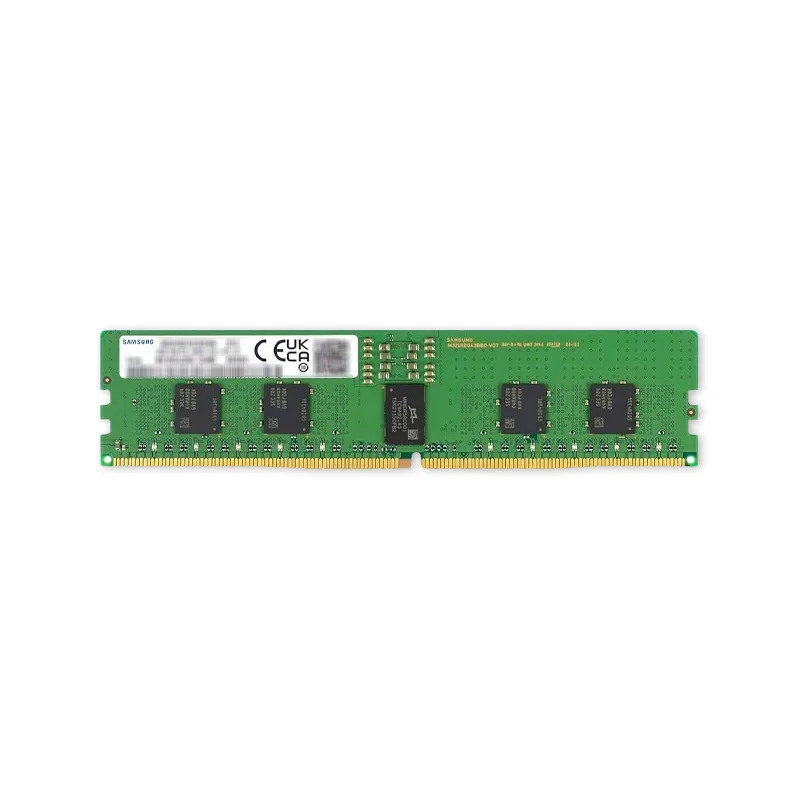
This DDR5-5600 Registered ECC RDIMM is engineered for enterprise server platforms handling memory-intensive workloads such as virtualization and in-memory databases, where its Dual Rank configuration boosts interleaved bandwidth and the integrated ECC engine guarantees end‑to‑end data integrity. The Registered signal architecture drives stable operation across densely populated 288‑pin channels at a low 1.1 V, delivering the perfect balance of performance, capacity scalability, and reliability for mission‑critical deployments.
1. DDR5 technology doubles the burst length and increases bank groups, providing the sustained throughput modern servers demand when hosting dozens of virtual machines on a single node.
2. 5600MT/s data rate raises the bandwidth ceiling per memory channel, which directly accelerates in-memory analytics and large-scale transactional databases under peak load.
3. On-die ECC corrects single-bit errors at the chip level, hardening against silent data corruption in environments where continuous data integrity is non-negotiable.
4. Registered clock driver buffers command and address signals, allowing a fully populated multi-DIMM configuration without signal degradation in dense rack servers.
5. Dual rank organization interleaves memory accesses across two internal ranks, maximizing channel utilization and smoothing out latency spikes during concurrent live migrations and heavy I/O workloads.
Built for the data center, the Samsung M321R2GA3PB0-CWMJH is a server-grade DDR5 RDIMM, and its four core characteristics directly address the realities of mission‑critical infrastructure. In a dense virtualization cluster hosting dozens of VMs, the registered (buffered) architecture stabilizes signal integrity, letting you populate all memory channels without the instability that would cripple a lesser module; that means you consolidate more workloads per host without risking crashes. Its dual‑rank design then interleaves accesses to supply each VM with consistently low‑latency data, preventing the micro‑stutters that frustrate users on shared platforms. When those same servers power an in‑memory database like SAP HANA or Redis, the 5600 MT/s DDR5 bandwidth feeds real‑time analytics at speed, while integrated ECC silently corrects single‑bit errors before they become corrupted transactions—an absolute necessity where a flipped bit could mean a financial miscalculation or a compliance violation. Together, these features translate into unshakeable uptime, predictable performance under multi‑tenant pressure, and data fidelity that lets IT teams trust every query result without second‑guessing the hardware.
General Virtualization
For basic consolidation, install four of these 16GB RDIMMs (64GB total) across balanced memory channels to handle moderate VM counts. Scale to eight modules (128GB) for heavier density, filling all channels in a typical single-socket server to sustain both capacity and memory bandwidth under mixed workloads.
In-Memory Database
Large in-memory datasets demand maximum capacity. Populate all DIMM slots with identical 16GB modules—often 16 or more—to reach 256GB or higher while maintaining reliable registered ECC protection. Stick to balanced channel population to preserve throughput, as data integrity and low latency are critical for real-time analytics.
High-Performance Computing (HPC)
Memory bandwidth often outweighs total capacity. Adopt a one dual-rank DIMM per channel (1DPC) configuration to maintain the full DDR5-5600 speed, as filling two DIMMs per channel may force a downclock. A dual-socket node with 16 of these 16GB modules (128GB per socket) delivers consistent, high-bandwidth performance for simulation and modeling codes.
This rigorously tested 16GB DDR5 RDIMM is compatible with Dell R760, HPE DL380 Gen11, Lenovo SR650 V3.
Q: Can I mix this M321R2GA3PB0-CWMJH with other memory modules of different brands or speeds?
A: Mixing RDIMMs of different brands or speeds is not recommended. It may cause instability or prevent booting. For reliable server operation, identical modules with the same rank, CAS, and speed are strongly advised.
Q: Is this memory compatible with my Intel Xeon or AMD EPYC server platform?
A: This DDR5-5600 registered DIMM is designed for server platforms supporting 16Gb-based DRAM and 1.1V operation. Verify your server board supports 288-pin RDIMMs and the specific Xeon Scalable or EPYC processor generation.
Q: What is the recommended DIMM population order for optimal performance?
A: Populate identical RDIMMs per channel, starting with the slot farthest from the CPU. For dual-rank modules, fill one DIMM per channel first to maximize bandwidth, then add a second matching module per channel.
Q: Does this module support overclocking or XMP profiles?
A: No. This is a JEDEC-compliant registered server memory module operating at fixed 5600MT/s with CL46. It does not support XMP, EXPO, or any form of user-level overclocking for data integrity and stability.
Q: What warranty and typical failure rate can I expect?
A: This module includes a 1-year warranty. Enterprise-grade RDIMMs typically exhibit an annualized failure rate (AFR) below 0.5%, ensuring high reliability under continuous server workloads when operated within specifications.