











 Secure payments
Standard refund policy
Trade Assurance
Secure payments
Standard refund policy
Trade Assurance
| Product Type | Memory Module |
|---|---|
| Memory Capacity | 16 GB |
| Memory Technology | DDR5 |
| Product Voltage | 1.1 V |
| RAM Speed | 5600 MHz |
| RAM Standard | DDR5-5600/PC5-44800 |
| Error Identifying | ECC |
| Signal Type | Registered |
| Column Access Strobe (CAS) | CL46 |
| Rank | Dual Rank |
| Quantity of Pins | 288-pin |
| RAM Genre | RDIMM |
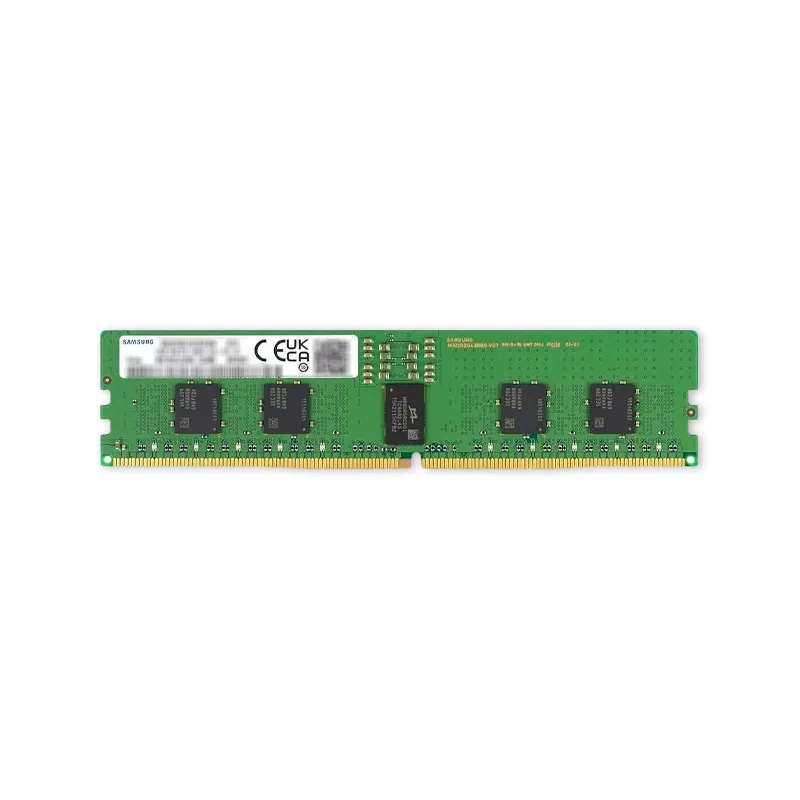
Designed for enterprise server platforms, this 16 GB DDR5-5600 Registered DIMM with ECC delivers critical data integrity for virtualization and in-memory database workloads. Its dual-rank configuration maximizes memory interleaving for higher throughput, while the registered signal type ensures stable operation in densely populated 288-pin server boards.
1. On-the-fly error correction prevents silent data corruption, safeguarding financial transactions and database integrity in mission-critical servers.
2. The register buffer stabilizes signal integrity across high-density memory configurations, enabling seamless scaling to terabyte-scale RAM for large-scale virtualization.
3. Dual rank interleaving maximizes per-channel bandwidth utilization, ensuring consistent low-latency data access under heavy multi-tenant workloads.
4. 5600 MT/s DDR5 throughput accelerates real-time analytics and in-memory caching, reducing query response times for data-intensive applications.
5. Operating at just 1.1V, this module drastically cuts per-DIMM power draw, lowering overall energy costs in thousands-strong server deployments.
Designed for mission-critical server environments, the M321R2GA3PB0-CWMCH DDR5-5600 Registered ECC RDIMM translates its technical specifications directly into operational resilience where downtime is not an option. Its ECC functionality continuously detects and corrects single-bit memory errors, preventing silent data corruption in transactional databases that could otherwise cascade into financial inaccuracies or analytic discrepancies. The Registered signal buffer enables stable operation across densely populated memory channels, meaning you can confidently scale to higher capacities for large virtualization clusters without signal degradation causing random crashes during peak VM migrations. Behind the scenes, the dual-rank organization leverages bank interleaving to overlap read and write cycles, effectively increasing the command rate bandwidth. In an in-memory database like Redis or SAP HANA, this translates to noticeably faster response under heavy concurrent query loads, accelerating real-time decision-making. Finally, the native 5600MT/s DDR5 interface provides the raw throughput to feed today’s multi-core server CPUs, ensuring your hosted desktops and containerized workloads never starve for data, even during simultaneous boot storms or nightly batch processing.
General Virtualization
For general virtualization hosts running multiple VMs, balance capacity and cost by populating all memory channels with 16 GB dual‑rank RDIMMs. A typical dual‑socket server with 8 memory channels achieves 128 GB using eight modules—enough for moderate consolidation. Dual‑rank DIMMs improve bandwidth through rank interleaving without exceeding one DIMM per channel, maintaining the full 5600 MT/s speed.
In-Memory Database
In‑memory databases like SAP HANA or Redis demand large, reliable memory footprints. Deploying 16 GB registered ECC DIMMs across all available slots scales capacity while ECC protects data integrity. For heavy workloads, configure two DIMMs per channel (2DPC) to reach 256 GB or more; expect a slight speed reduction to 5200 MT/s but gain the necessary headroom for large datasets.
High-Performance Computing
HPC applications prioritize bandwidth and low latency. Populate every memory channel with one 16 GB dual‑rank RDIMM (1DPC) to maximize bandwidth at the native 5600 MT/s speed. A 128‑GB configuration (eight modules) suits most simulation and modeling tasks, while keeping latency low. Avoid 2DPC configurations unless absolute capacity outweighs the bandwidth trade‑off.
Server memory rigorously tested and validated for Dell PowerEdge R760, HPE ProLiant DL380 Gen11, Lenovo ThinkSystem SR650 V3.
Q: Can I mix this M321R2GA3PB0-CWMCH with other memory modules of different brands or speeds?
A: Mixing is not recommended for server environments. Mismatched RDIMMs can cause stability issues, reduced performance, or POST failures. Always use identical modules with the same speed, rank, and ECC configuration.
Q: Is this memory compatible with my server system?
A: This DDR5-5600 RDIMM is designed for AMD EPYC 9004 series and 4th/5th Gen Intel Xeon Scalable platforms. Verify your motherboard’s QVL and BIOS revision to ensure correct support for 16GB Registered ECC modules.
Q: What is the recommended DIMM population order for optimal performance?
A: Populate identical modules per channel starting with the farthest slot from the CPU. For dual-socket servers, balance memory equally across both processors. Consult your server's manual for the exact slot numbering to maximize interleaving.
Q: Does this module support overclocking or XMP profiles?
A: No. As an enterprise DDR5 Registered ECC module operating at JEDEC standard CL46, it does not support overclocking or XMP. Stability and error correction are prioritized over frequency adjustments in server environments.
Q: What warranty and typical failure rate can I expect?
A: This module is covered by a one-year warranty. Enterprise-class RDIMMs typically have a very low annualized failure rate, often below 0.5%, when operated within specified temperature and voltage conditions in validated servers.