











 Secure payments
Standard refund policy
Trade Assurance
Secure payments
Standard refund policy
Trade Assurance
| Model | M393B2G70CB0-CMA |
|---|---|
| Product Type | Memory Module |
| Compliance Standards | EU RoHS,FCC |
| Memory Capacity | 16 GB |
| Memory Technology | DDR3 |
| Product Voltage | 1.5V |
| RAM Speed | 1866MHz |
| RAM Standard | DDR3-1866/PC3-14900 |
| Error Identifying | ECC |
| Signal Type | Registered |
| Column Access Strobe (CAS) | CL13 |
| Rank | Dual Rank x4 |
| Quantity of Pins | 240-pin |
| RAM Genre | RDIMM |
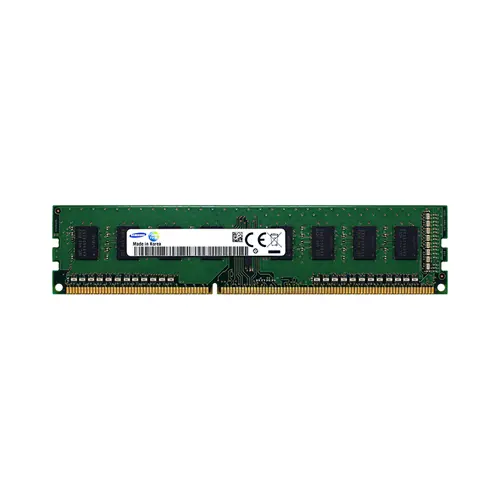
This Samsung 16GB DDR3-1866 Registered ECC module (M393B2G70CB0-CMA) is engineered for dual-socket servers and enterprise platforms requiring rock-solid data integrity under heavy memory population. Its Dual Rank x4 organization with CL13 latency and registered signaling delivers superior signal stability and bandwidth efficiency, making it ideal for virtualization clusters, in-memory databases, and mission-critical workloads where ECC error correction is non-negotiable.
1. ECC protection detects and corrects single-bit memory errors, safeguarding transactional databases and long-running compute jobs from silent data corruption.
2. Registered signal buffering stabilizes high-capacity memory configurations, essential for scaling up to multi-terabyte servers without compromising signal integrity.
3. Dual Rank x4 organization maximizes interleaving potential, sustaining higher bandwidth utilization and lower latency under the concurrent requests of dense virtualization.
4. 16GB per module density balances cost and capacity, allowing a typical dual-socket server to host a rich mix of VMs without exhausting DIMM slots prematurely.
5. 1866MHz data rate delivers responsive throughput for memory-bound analytics, accelerating real-time data crunching in big data clusters.
The Samsung M393B2G70CB0-CMA is a 16GB DDR3-1866 Registered ECC DIMM purpose-built for enterprise servers and workstations where data integrity and uptime are non-negotiable. In a virtualized cluster running dozens of mission-critical VMs, its ECC protection actively catches and corrects single-bit memory errors caused by cosmic radiation or silicon degradation—silently preventing silent data corruption that could crash financial transactions or corrupt a hypervisor’s memory state. The Registered signal buffer decouples the memory controller from the DRAM bus, allowing the system to support up to 24 DIMMs per server without signal degradation; this directly translates to higher VM density and room to grow your in-memory database footprint without sacrificing stability. Meanwhile, the module’s Dual Rank x4 organization interleaves internal banks to deliver superior bandwidth during concurrent read/write operations—vital when an in-memory analytics platform like SAP HANA scans billions of rows, or when multiple VMs compete for memory throughput. Paired with a 1866MT/s clock and a tight CL13 CAS latency, this RDIMM reduces the response time of read-intensive workloads such as Redis caching clusters, ensuring consistent low-latency performance even under heavy multi-tenant pressure. In the real world, these four attributes mean the difference between a resilient, predictable data center and one plagued by phantom errors, sluggish workloads, and costly scaling limitations.
This Samsung M393B2G70CB0-CMA is a 16GB DDR3-1866 Registered ECC RDIMM — a server-grade module built for stability in multi-socket systems. Below are capacity planning recommendations for common data-center workloads.
General Virtualization
Populate six to eight modules per dual-socket host (96–128 GB total) to comfortably run 20–30 mixed-role VMs. Distribute DIMMs evenly across all memory channels to maximize interleaving and bandwidth. In heavily loaded clusters, scale to 192 GB using twelve 16 GB DIMMs, always matching ranks and speeds per channel.
In-Memory Database
Maximize capacity within a single node while preserving low latency. Use sixteen or more identical 16 GB RDIMMs for a total of 256 GB or higher, populating all channels with balanced dual-rank modules. Configure the database engine to lock pages in memory, and disable NUMA node interleaving unless the working set spans multiple sockets.
High Performance Computing
Bandwidth is paramount. Populate every memory channel with at least one 16 GB DIMM, ideally reaching 128–256 GB per node with a symmetrical layout. Choose a 2 DIMMs-per-channel configuration where the platform supports it, and align process pinning to the memory locality to keep MPI ranks close to their allocated DIMM banks.
Rigorously tested, compatible with Dell PowerEdge R720, HP ProLiant DL380p Gen8, IBM x3650 M4.
Q: Can I mix this M393B2G70CB0-CMA module with other memory brands or speeds?
A: We do not recommend mixing different brands or speeds. This registered ECC module requires identical ranks and timings; mixing may cause POST failures or system instability in server environments.
Q: Is this memory compatible with my Intel Xeon E5 or AMD Opteron server platform?
A: It is compatible with systems that support DDR3-1866 registered ECC RDIMMs, such as Intel Romley (C600 series) and AMD G34 platforms. Please verify your motherboard’s memory QVL.
Q: What is the recommended DIMM population order for optimal performance?
A: Populate identical modules per channel, starting with the blue slots (first channel). For dual-rank x4 RDIMMs, follow your server manual’s balanced configuration to utilize interleaving and achieve rated 1866 MT/s.
Q: Does this module support overclocking or XMP profiles?
A: No. This is a JEDEC-compliant DDR3 registered ECC module. It does not support XMP, overclocking, or non-standard voltage adjustments. It operates reliably at 1866 MHz with CL13 timings.
Q: What warranty and typical failure rate can I expect with this module?
A: It includes a one-year warranty. As an enterprise-grade Samsung RDIMM, it delivers excellent reliability with an extremely low annualized failure rate (AFR) under stated environmental specifications.