











 Secure payments
Standard refund policy
Trade Assurance
Secure payments
Standard refund policy
Trade Assurance
| Model | M393B2G70QH0-CMAQ9 |
|---|---|
| Product Type | Memory Module |
| Compliance Standards | EU RoHS,FCC |
| Memory Capacity | 16 GB |
| Memory Technology | DDR3 |
| Product Voltage | 1.5V |
| RAM Speed | 1866MHz |
| RAM Standard | DDR3-1866/PC3-14900 |
| Error Identifying | ECC |
| Signal Type | Registered |
| Column Access Strobe (CAS) | CL13 |
| Rank | Dual Rank x4 |
| Quantity of Pins | 240-pin |
| RAM Genre | RDIMM |
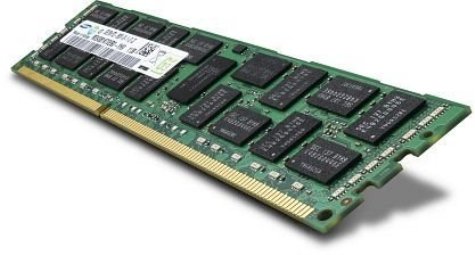
Designed for server environments, this Samsung M393B2G70QH0-CMAQ9 is a 16GB DDR3-1866 Registered DIMM with ECC, ideally suited for virtualization, in-memory databases, and data-integrity-critical workloads. Its dual-rank x4 organization enhances memory interleaving efficiency for sustained throughput, while the registered signal type minimizes bus loading to ensure stable operation across fully populated server banks.
1. Each 16GB RDIMM doubles memory footprint per slot, enabling higher VM density and smoother scaling of in-memory databases on consolidation servers.
2. ECC protection proactively corrects transient memory faults, safeguarding financial transactions and scientific computations from silent data corruption.
3. Registered buffer technology isolates the memory controller from heavy loads, sustaining stable 24/7 operation even when all DIMM slots are populated in a mission-critical server.
4. Dual Rank x4 design keeps the memory bus saturated through bank interleaving, delivering consistent latency and throughput for virtualized environments under mixed workload bursts.
5. 1866 MT/s transfer rate fuels a 14.9 GB/s memory pipe per channel, accelerating real-time analytics and large-scale caching for enterprise applications.
Based on its specifications, the M393B2G70QH0-CMAQ9 is unmistakably a server-grade RDIMM. Its four defining characteristics become vitally important when you move beyond the spec sheet and into the data center.
The ECC technology directly safeguards your transactional integrity. In a dense virtualization cluster hosting dozens of VMs, a single undetected bit flip from cosmic radiation can silently corrupt a financial record or hypervisor state, leading to unpredictable crashes. ECC actively corrects these errors, transforming a catastrophic risk into a routine, survivable event. Meanwhile, the Registered signal buffer alleviates the electrical loading on the CPU’s memory controller as you populate all channels with high-capacity DIMMs. For an in-memory database like Redis or SAP HANA storing terabytes of hot data, this means you can reliably scale to massive capacities without sacrificing stability or fearing intermittent signal failure under sustained load. The dual-rank x4 organization then interleaves access across internal banks, significantly boosting bandwidth during the heavy concurrent reads that characterize real-time analytics platforms. Paired with the 1866MHz speed and CL13 latency, it delivers a predictable, balanced throughput that prevents bottlenecks in time-sensitive decision engines, ensuring your queries return consistent results before revenue is lost.
General Virtualization
Equip a typical dual-socket server with at least four M393B2G70QH0-CMAQ9 RDIMMs (64 GB total), distributing them evenly across memory channels to balance capacity and throughput. This setup supplies ample headroom for multiple virtual machines while preserving ECC protection. For dense consolidation, scale to 96 GB (6 modules) or 128 GB (8 modules) to avoid memory pressure.
In-Memory Database
Maximize resident data size by populating all available DIMM slots with these 16 GB Registered DIMMs—ideally 16 modules (256 GB) in a dual-socket platform. The dual‑rank x4 design and ECC maintain data integrity and low‑latency access under intense transactional loads, keeping the entire working set in memory.
High-Performance Computing
For bandwidth‑sensitive HPC jobs, install one DIMM per memory channel (e.g., 8 × 16 GB = 128 GB per node) to sustain the full 1866 MHz frequency without rank‑speed penalties. This pattern delivers consistent high throughput for simulations and large‑scale data processing. If capacity becomes the bottleneck, populate two DIMMs per channel (256 GB); be aware that the memory speed may drop to 1600 MHz depending on platform constraints.
Rigorously tested for server compatibility: Dell PowerEdge R720, R620, HP DL380p Gen8, Lenovo RD630, and more.
Q: Can I mix this M393B2G70QH0-CMAQ9 with other memory modules of different brands or speeds?
A: Mixing is not recommended for server environments. To ensure signal integrity and stability, populate all channels with identical Samsung RDIMMs of the same speed, rank, and CL13 timing.
Q: Is this memory compatible with my server platform?
A: This DDR3-1866 ECC Registered DIMM is designed for Intel Xeon E5-2600 v1/v2 or AMD Opteron 6300 series platforms with 240-pin slots. Confirm that your board supports 2Rx4 RDIMMs and 1.5V operation.
Q: What is the recommended DIMM population order for optimal performance?
A: For dual-socket servers, balance capacity across memory channels. Typically populate identical DIMMs per channel, starting with the slot farthest from the CPU. Always follow your motherboard's population guide for 2DPC configurations.
Q: Does this module support overclocking or XMP profiles?
A: No. This is a JEDEC-compliant enterprise server module with fixed 1866MHz CL13 timing. It does not support XMP or overclocking to maintain 24/7 data integrity and ECC reliability.
Q: What warranty and typical failure rate can I expect?
A: This Samsung module includes a 1-year warranty. Enterprise-grade DDR3 RDIMMs exhibit an annualized failure rate (AFR) below 0.5% under normal operating conditions, ensuring long-term mission-critical reliability.