











 Secure payments
Standard refund policy
Trade Assurance
Secure payments
Standard refund policy
Trade Assurance
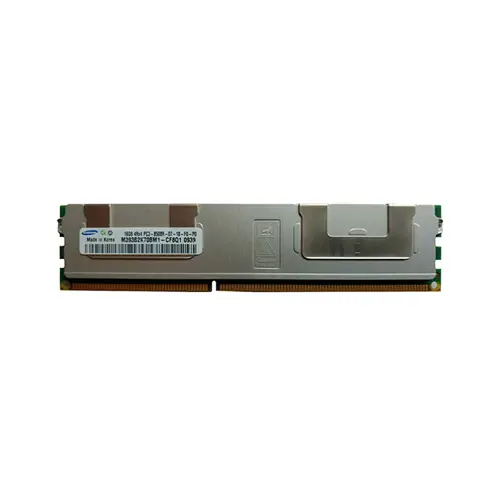
| Model | M393B2K70BM1-CF8Q1 |
|---|---|
| Product Type | Memory Module |
| Compliance Standards | EU RoHS,FCC |
| Memory Capacity | 16 GB |
| Memory Technology | DDR3 |
| Product Voltage | 1.5V |
| RAM Speed | 1066MHz |
| RAM Standard | DDR3-1066/PC3-8500 |
| Error Identifying | ECC |
| Signal Type | Registered |
| Column Access Strobe (CAS) | CL7 |
| Rank | Quad Rank x4 |
| Quantity of Pins | 240-pin |
| RAM Genre | RDIMM |
With its Registered ECC DDR3 architecture and quad-rank x4 configuration, this 16GB RDIMM is purpose-built for legacy server platforms where data integrity and high memory density per channel are critical. The module’s CL7 latency and 1.5V operation deliver stable, error-corrected performance ideal for memory-intensive virtualization and database workloads on dual-socket systems.
1. 16GB per module delivers the memory capacity headroom needed to consolidate more virtual machines on a single server, directly boosting workload density in virtualized data centers.
2. ECC protection actively detects and corrects single-bit memory errors, preserving long-term data accuracy and reducing system crashes in mission-critical financial and database applications.
3. Registered signal buffering stabilizes address and command paths, enabling fully loaded memory channels without compromising signal integrity under heavy enterprise workloads.
4. Quad Rank x4 organization packs four ranks of DRAM into one RDIMM, maximizing total system memory in dense server nodes where DIMM slots are limited.
5. CL7 low-latency timing shrinks the delay before data retrieval, accelerating response times for latency-sensitive transaction processing and in-memory caching.
The M393B2K70BM1-CF8Q1 is a 16GB DDR3-1066 Registered DIMM purpose-built for server environments, where stability and data integrity are not negotiable. Its ECC technology actively detects and corrects single-bit memory errors caused by background radiation—an absolute necessity when a flipped bit in a virtualization cluster could corrupt a hypervisor page and silently crash dozens of virtual machines. The Registered signal buffer isolates the memory chips from the CPU’s memory controller, enabling you to populate all 24 DIMM slots per server without signal degradation; this transforms a virtualization host into a dense, reliable resource pool capable of running hundreds of VMs simultaneously. For in-memory databases like Redis or SAP HANA, the module’s Quad Rank x4 organization, combined with CL7 latency, leverages rank interleaving to boost effective bandwidth while delivering predictable low-latency access. What this means for you is straightforward: a 16GB footprint per stick lets you build cost-effective, large-capacity memory reservoirs that sustain high-throughput transactional workloads with zero tolerance for silent data corruption, keeping your database queries fast and your services always on.
Server Memory Capacity Planning for M393B2K70BM1-CF8Q1 (16GB DDR3-1066 RDIMM ECC)
This module is a registered ECC DDR3 DIMM, designed exclusively for server platforms. Its Quad Rank x4 organization and 1.5V operation reflect a maturity suited for capacity-focused legacy systems. Below are configuration guidelines for three typical server workloads.
General Virtualization
Virtualized environments running multiple VMs are memory-capacity driven. Equip dual-socket servers with twelve of these 16GB modules to reach 192GB per host, enabling comfortable overcommit ratios for mid-density private clouds. Populate all channels symmetrically to maintain balanced memory bandwidth and avoid NUMA penalties.
In-Memory Database
For Redis or SAP HANA-style workloads requiring large, low-latency datasets, prioritize maximum capacity over speed. Fully populate all 24 DIMM slots of a 4-socket server to achieve the 384GB ceiling. Use identical Quad Rank modules throughout and disable sparing features to expose the entire memory pool to the database engine.
High Performance Computing
HPC workloads sensitive to main memory bandwidth benefit from population rules that optimize rank interleaving. Deploy identical Quad Rank DIMMs in sets of four per channel group, achieving rank multiplication for peak streaming throughput. Limit total module count to avoid memory speed drops below 1066 MT/s that occur when fully loading all banks with quad-rank parts.
Rigorously tested server RDIMM; compatible with Dell PowerEdge R710, HP ProLiant DL380 G7, and IBM System x3650 M3.
Q: Can I mix this M393B2K70BM1-CF8Q1 with other memory modules of different brands or speeds?
A: Mixing is not recommended for server RDIMMs. Different brands or speeds can cause stability issues and ECC errors. Always use identical modules to ensure reliable, validated performance in multi-slot configurations.
Q: Is this memory compatible with my Intel Xeon E5-2600 v2 server platform?
A: This DDR3-1066 Registered ECC RDIMM is designed for server platforms like Intel Xeon E5-2600 v2. Verify your board supports quad-rank x4 RDIMMs at 1.5V and 240-pin. Consult your server's qualified vendor list for full compatibility.
Q: What is the recommended DIMM population order for optimal performance with this module?
A: Follow your server board's memory population guidelines. Typically, populate identical quad-rank DIMMs starting from the farthest slot per channel. Balanced configuration across all memory channels ensures optimal interleaving and throughput.
Q: Does this module support overclocking or XMP profiles?
A: No. This is an enterprise server RDIMM running at JEDEC-standard DDR3-1066 with ECC. It does not support XMP or overclocking. It offers maximum stability and data integrity at its rated speed and timings.
Q: What warranty and typical failure rate can I expect for the M393B2K70BM1-CF8Q1?
A: This module comes with a 1-year warranty. Server-grade RDIMMs exhibit very low annualized failure rates, typically below 0.5%, when operated within specified voltage and thermal limits.