











 Secure payments
Standard refund policy
Trade Assurance
Secure payments
Standard refund policy
Trade Assurance
| Model | M393B2K70CM0-CF804 |
|---|---|
| Product Type | Memory Module |
| Compliance Standards | EU RoHS,FCC |
| Memory Capacity | 16 GB |
| Memory Technology | DDR3 |
| Product Voltage | 1.5V |
| RAM Speed | 1066MHz |
| RAM Standard | DDR3-1066/PC3-8500 |
| Error Identifying | ECC |
| Signal Type | Registered |
| Column Access Strobe (CAS) | CL7 |
| Rank | Quad Rank x4 |
| Quantity of Pins | 240-pin |
| RAM Genre | RDIMM |
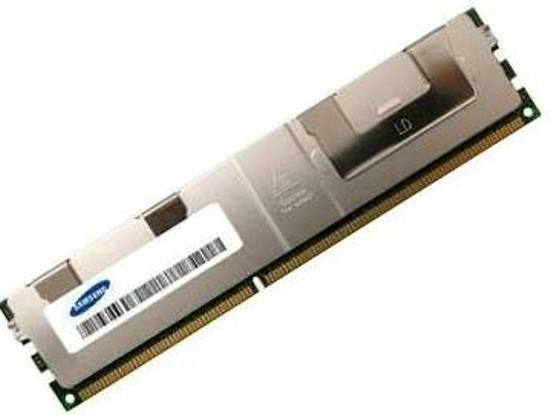
Designed specifically for server platforms, this Samsung 16GB DDR3-1066 RDIMM (M393B2K70CM0-CF804) leverages Registered ECC technology to guarantee data integrity in mission-critical environments such as virtualization clusters and in-memory databases. Its Quad Rank x4 configuration maximizes memory density per channel while the CL7 latency ensures responsive data access under heavy, sustained loads.
1. 16GB capacity per module maximizes memory density in server nodes, allowing more virtual machines to run concurrently on the same physical host without sacrificing performance.
2. ECC protection detects and corrects single-bit memory errors in real time, preventing silent data corruption that could crash critical enterprise workloads or financial transactions.
3. Registered signal buffering stabilizes command and address lines across large memory populations, essential for maintaining reliability in fully populated 24-slot server boards under 24/7 operation.
4. Quad Rank x4 organization populates all DRAM ranks to keep data buses highly utilized, sustaining consistent bandwidth even under deeply queued virtualization and database requests.
5. CL7 low latency at 1066MHz sharpens response times for cache-sensitive server applications, cutting microseconds from query processing in high-frequency trading or in-memory analytics.
The Samsung M393B2K70CM0-CF804 is an RDIMM engineered for servers, where uptime and data integrity are non-negotiable. Its ECC technology actively detects and corrects single-bit memory errors caused by cosmic radiation or electrical noise—an absolute necessity in financial transaction databases where a silent bit flip could corrupt a ledger entry or in a virtualized cluster where one corrupted page can crash dozens of guest machines. The registered signal type places a buffer between the memory controller and the DRAM chips, stabilizing electrical loads so you can populate all 24 DIMM slots without signal degradation; this is critical when scaling an in-memory database like SAP HANA that demands massive, reliable capacity. With a Quad Rank x4 organization on a single 16GB module, it delivers dense memory interleaving, increasing the number of concurrent row operations and boosting bandwidth for heavy virtualization workloads where multiple VMs compete for memory access. That CL7 latency at 1066MHz keeps response times tight under the constant context switches of a hypervisor. Finally, strict compliance with EU RoHS and FCC standards ensures this module is deployed without regulatory friction in data centers worldwide, safeguarding your supply chain and environmental compliance posture.
General Virtualization
For a general virtualization host, populate channels symmetrically to maximize memory bandwidth. Install at least six identical 16GB RDIMMs (96GB total) across three channels per CPU to balance capacity and cost, enabling smooth consolidation of dozens of light to medium VMs.
In-Memory Database
In-memory databases demand both large capacity and high reliability. Deploy a fully populated configuration—typically 12 or 24 of these quad-rank 16GB modules per dual-socket server (192GB or 384GB total)—to hold entire datasets in RAM while leveraging ECC protection against data corruption.
HPC (High Performance Computing)
HPC workloads favor bandwidth over raw capacity. Use one RDIMM per channel on all available memory channels (e.g., 8 or 12 modules per node) to achieve maximum memory throughput. The 1.5V operation and CL7 latency help maintain stable, predictable performance under sustained parallel computing loads.
Rigorously tested and validated for Dell R720, HP DL380p Gen8, IBM x3650 M4 server platforms.
Q: Can I mix this M393B2K70CM0-CF804 with other memory modules of different brands or speeds?
A: Not recommended. This Registered ECC DIMM with quad-rank x4 organization may conflict with unbuffered or dissimilar rank configurations, causing system instability. Always use identical modules for validated server reliability.
Q: Is this memory compatible with my system? Which Intel or AMD platforms are supported?
A: It's compatible with dual-socket Intel Xeon 5500/5600 series and AMD Opteron 6100 platforms that support DDR3 Registered ECC. Please verify the server board's qualified vendor list for quad-rank x4 16GB RDIMM support.
Q: What is the recommended DIMM population order for optimal performance with this quad-rank module?
A: Populate identical kits per channel, following the server manual's slot numbering. Due to quad-rank loading, systems often require reduced bus speeds when all channels are filled, typically limiting to two DIMMs per channel.
Q: Does this module support overclocking or XMP profiles?
A: No. As an enterprise Registered ECC DDR3 module running JEDEC standard 1066MHz with CL7, it prioritizes data integrity and stability over overclocking. XMP profiles are not supported.
Q: What warranty and typical failure rate can I expect?
A: This module includes a 1-year warranty. Built with enterprise-grade components and rigorous testing, the typical annualized failure rate is very low, around 0.1–0.3%, ensuring long-term mission-critical reliability.