











 Secure payments
Standard refund policy
Trade Assurance
Secure payments
Standard refund policy
Trade Assurance
| Product Type | Memory Module |
|---|---|
| Memory Capacity | 16 GB |
| Memory Technology | DDR3 |
| Product Voltage | 1.5V |
| RAM Speed | 1066MHz |
| RAM Standard | DDR3-1066/PC3-8500 |
| Error Identifying | ECC |
| Signal Type | Registered |
| Column Access Strobe (CAS) | CL7 |
| Rank | Quad Rank x4 |
| Quantity of Pins | 240-pin |
| RAM Genre | RDIMM |
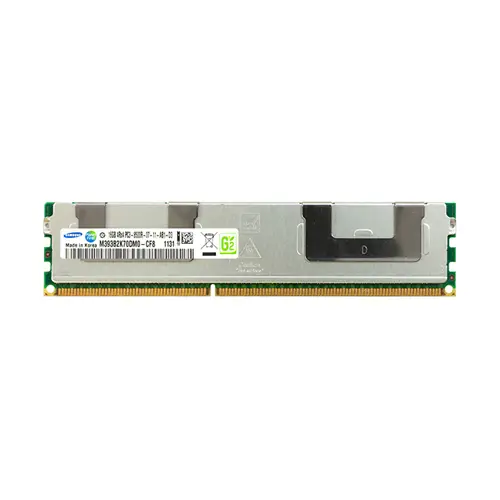
Designed for legacy server platforms, this 16GB DDR3-1066 RDIMM features quad-rank x4 organization for high-density memory configurations and registered signal buffering to maintain stability in fully populated racks. Its ECC protection and low CL7 latency make it well-suited for virtualization hosts and memory-intensive database workloads where data integrity is critical.
1. ECC memory silently detects and corrects single-bit errors, preventing silent data corruption that could crash financial databases or compromise scientific computations.
2. Registered signal buffering decouples memory chips from the bus, maintaining signal integrity across fully loaded server boards for unshakable 24/7 operation.
3. Quad Rank x4 organization fully drives four memory ranks per module, keeping throughput saturated even under heavy virtualization where multiple VMs contend for bandwidth.
4. Sixteen gigabyte capacity per stick maximizes virtual machine density, allowing a single physical server to host more tenants without costly expansion.
5. The 1066 MHz clock speed delivers a steady 8.5 GB/s throughput per channel, offering a proven balance of performance and power for legacy enterprise workloads that require absolute stability.
In enterprise environments where every computational error carries financial risk, the Samsung M393B2K70DM0-CF8Q8B RDIMM turns electrical uncertainty into transaction-grade reliability. With ECC protection, it detects and corrects single-bit memory errors silently caused by background radiation or cosmic particles—corruption that would otherwise crash a virtual machine hypervisor or poison an in-memory database like SAP HANA. In a dense virtualization cluster running dozens of guests per node, the registered signal buffer electrically isolates the memory bus from the CPU, allowing stable operation with a full quad-rank x4 configuration even when all sixteen DIMM slots are populated. This means you can safely allocate 512 GB of memory to a single host without seeing memory training failures or intermittent reboots. When an online transaction processing engine stores millions of rows in memory, the CL7 latency on the 1066 MHz bus keeps cache misses short, preserving consistent response times under peak OLTP load. For your data center, this module translates directly to fewer silent data corruptions, higher virtual machine density, and sustained throughput in memory-hungry analytics pipelines—protecting uptime and your service-level agreements.
Memory Type Assessment
Based on the given specifications — ECC, Registered, 240-pin RDIMM, DDR3-1066 — this is definitively a server-class memory module. Capacity planning must leverage its reliability features for enterprise workloads.
General Virtualization
Virtual hosts thrive on ample, error-corrected RAM for VM density. Populate all available channels symmetrically with multiple 16 GB RDIMMs, aiming for 64–256 GB depending on the hypervisor’s VM count. A balanced population (e.g., six identical modules) ensures consistent performance and prevents memory bottlenecks during live migrations.
In-Memory Database
In-memory databases like Redis or SAP HANA demand maximum capacity and absolute data integrity. Deploy these modules in a fully populated configuration, prioritizing total capacity over speed — 256 GB or more is typical. The ECC and registered buffer minimize soft errors and signal degradation under heavy, persistent load, safeguarding transactional data.
High-Performance Computing (HPC)
HPC clusters require both capacity and reliable throughput. Install modules across all memory channels per node to maximize bandwidth, using identical 16 GB RDIMMs for load-balanced memory interleaving. While 1066 MHz is modest by modern standards, the Quad Rank x4 organization aids rank interleaving, slightly improving effective access rates for parallel computational tasks.
Rigorously tested RDIMM. Compatible with Dell PowerEdge R710, R720, HP ProLiant DL380 G7, and similar servers.
Q: Can I mix this M393B2K70DM0-CF8Q8B with other memory modules of different brands or speeds?
A: Mixing is not recommended for server environments. For guaranteed stability, use identical Samsung part numbers. Different brands, speeds, or ranks may cause POST failures or signal integrity issues in registered ECC configurations.
Q: Is this memory compatible with my system?
A: This DDR3-1066 registered ECC RDIMM is designed for server platforms such as Intel Xeon 5600/5500 series and AMD Opteron 6100/6200 series. Confirm your board supports quad-rank 16GB modules at 1.5V.
Q: What is the recommended DIMM population order for optimal performance?
A: Follow your server vendor’s population guide. Typically, populate identical quad-rank DIMMs in the first slot of each memory channel, farthest from the CPU, to maintain balanced interleaving and maximize memory bandwidth.
Q: Does this module support overclocking or XMP profiles?
A: No, this is a JEDEC-compliant server module. It does not support overclocking or XMP profiles. Enterprise memory prioritizes data integrity and 24/7 stability over frequency tuning.
Q: What warranty and typical failure rate can I expect?
A: This module includes a 1-year warranty. Samsung enterprise DRAM maintains an extremely low annualized failure rate (typically below 0.1%), delivering reliable performance for mission-critical workloads.