











 Secure payments
Standard refund policy
Trade Assurance
Secure payments
Standard refund policy
Trade Assurance
| Model | M393A2G40DB0-CPB-C |
|---|---|
| Product Type | Memory Module |
| Compliance Standards | EU RoHS,FCC |
| Memory Capacity | 16 GB |
| Memory Technology | DDR4 |
| Product Voltage | 1.2V |
| RAM Speed | 2133MHz |
| RAM Standard | DDR4-2133/PC4-17000 |
| Error Identifying | ECC |
| Signal Type | Registered |
| Column Access Strobe (CAS) | CL15 |
| Rank | Dual Rank x4 |
| Quantity of Pins | 288-pin |
| RAM Genre | RDIMM |
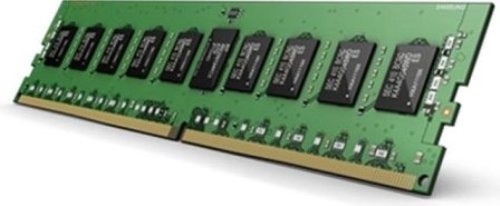
This Samsung M393A2G40DB0-CPB-C is a server-grade DDR4-2133 Registered DIMM with ECC, purpose-built for enterprise platforms running virtualization, in-memory databases, and mission-critical workloads where data integrity is non-negotiable. Its dual-rank x4 organization and CL15 latency optimize memory bandwidth and bank-level parallelism, while the registered signal type ensures robust signal integrity in high-density 288-pin configurations, making it ideal for consistent, error-free operation under sustained load.
1. ECC protection detects and corrects single-bit memory errors in real time, preventing silent data corruption that could crash critical financial or database workloads.
2. Registered signal buffering stabilizes high-density memory configurations, allowing servers to scale to hundreds of gigabytes without compromising command integrity.
3. Dual Rank x4 organization interleaves memory accesses across banks, sustaining peak bandwidth utilization for virtualization hosts running dozens of concurrent VMs.
4. 16 GB per module delivers the ideal capacity granularity for dense datacenter deployments, maximizing total memory per node without overprovisioning cost.
5. 1.2 V low-power operation cuts per-DIMM energy consumption significantly, directly lowering cooling overhead in multi-rack server environments.
The M393A2G40DB0-CPB-C is a 16GB DDR4-2133 Registered DIMM built for enterprise servers. Its four defining traits—ECC error correction, registered buffer, dual-rank x4 architecture, and 1.2V operation—directly address critical pain points. In virtualization farms, ECC silently fixes single-bit flips caused by background radiation; without it, a corrupted bit in a hypervisor page or guest kernel can trigger system crashes or silent data corruption. The registered buffer re-drives address and command signals, letting you populate all 24 DIMM slots on a dual-socket host with stable, high-capacity memory—essential for consolidating hundreds of virtual machines. The dual-rank design interleaves data across two sets of DRAM pages, raising sustained bandwidth for in-memory databases like SAP HANA or Redis. When handling high-throughput transactions, this boosts query-per-second rates and cuts tail latency. Finally, 1.2V operation slashes energy consumption by roughly 20%, trimming power and cooling bills at scale. This directly yields higher uptime, responsive applications, and lower TCO.
General Virtualization
For a balanced virtualized environment hosting 20–30 VMs, populate two 16 GB RDIMMs per channel for a total of 64 GB across four channels (4 x 16 GB). This dual-rank, registered ECC configuration ensures reliable memory isolation and sufficient capacity for hypervisor overhead plus moderate workloads. Use identical modules to maintain NUMA node symmetry in dual-socket servers.
In-Memory Database
Deploy a fully populated memory architecture using 8 x 16 GB modules (128 GB total) to maximise capacity and bandwidth for datasets exceeding 100 GB. The DDR4-2133 RDIMMs with ECC guard against bit errors during high-speed transactional processing. Evenly distribute modules across all memory channels to sustain the low-latency throughput required by Redis or SAP HANA instances.
High-Performance Computing
Optimise for bandwidth-sensitive parallel workloads by installing 8 or 16 identical 16 GB RDIMMs (128–256 GB) in a balanced, all-channel interleaved layout. The dual-rank, registered design delivers stable memory bandwidth under sustained floating-point loads. Pair with a CPU supporting multiple DDR4 channels to avoid bottlenecks in CFD, molecular dynamics, or seismic processing tasks.
Rigorously tested server memory compatible with Dell PowerEdge R740, HPE ProLiant DL380 Gen10, Lenovo ThinkSystem SR650, and more.
Q: Can I mix this M393A2G40DB0-CPB-C with other memory modules of different brands or speeds?
A: Mixing is not recommended for server environments. Mismatched brands, speeds, or ranks can cause signal integrity issues and system instability with registered ECC memory. Always use identical modules.
Q: Is this memory compatible with my Intel Xeon or AMD EPYC server platform?
A: This DDR4-2133 RDIMM is compatible with systems supporting registered ECC DDR4, such as Intel Xeon E5-2600 v3/v4 and many first-generation EPYC platforms. Verify your board’s QVL and 288-pin support.
Q: What is the recommended DIMM population order for optimal performance?
A: Follow your server motherboard’s manual, typically populating identical DIMMs per channel starting from the farthest slot from the CPU. Balanced loading across channels maximizes throughput and interleaving.
Q: Does this module support overclocking or XMP profiles?
A: No. This is a standard JEDEC-compliant registered server DIMM built for 24/7 stability. Overclocking and XMP are not supported; the module runs at its fixed 2133MHz, CL15 specification.
Q: What warranty and typical failure rate can I expect?
A: This module includes a 1-year warranty. Manufactured to enterprise-grade standards, typical annualized failure rate (AFR) is extremely low, well below 0.5% under specified operating conditions.