











 Secure payments
Standard refund policy
Trade Assurance
Secure payments
Standard refund policy
Trade Assurance
| Product Type | Memory Module |
|---|---|
| Compliance Standards | |
| Memory Capacity | 16 GB |
| Memory Technology | DDR3 |
| Product Voltage | 1.35 V |
| RAM Speed | 1066 MHz |
| RAM Standard | DDR3-1066/PC3-8500 |
| Error Identifying | ECC |
| Signal Type | Registered |
| Column Access Strobe (CAS) | CL7 |
| Rank | Quad Rank x4 |
| Quantity of Pins | 240-pin |
| RAM Genre | RDIMM |
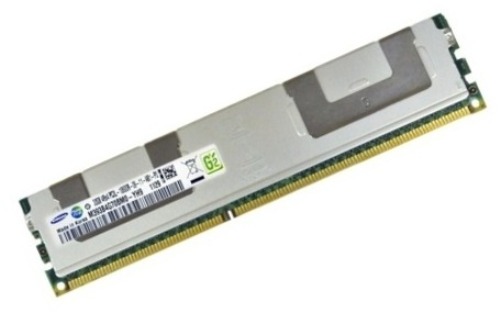
This DDR3-1066 Registered ECC RDIMM is engineered for legacy server platforms where data integrity and stability are critical, making it ideal for memory-intensive workloads like virtualization and in-memory databases. Its Quad Rank x4 organization maximizes capacity density per channel, while the CL7 latency and registered signal buffering ensure reliable operation under heavy, sustained loads.
1. ECC protection silently corrects single-bit errors, preserving data integrity in mission-critical database and virtualization workloads.
2. Registered signal buffering ensures rock-solid electrical stability when scaling to large memory configurations in multi-socket servers.
3. 16GB capacity per module enables dense memory footprints for hosting more virtual machines without sacrificing performance.
4. Operating at just 1.35V significantly reduces power consumption and cooling overhead in large-scale datacenter deployments.
5. Quad Rank x4 organization maximizes bank-level parallelism, sustaining high bandwidth under heavy concurrent access typical of multi-tenant environments.
In the data center, the Samsung M393B2K70CM0-YF8 RDIMM is purpose‑built for mission‑critical workloads, and its four design pillars directly address your real‑world challenges. The ECC error correction is your frontline defense against silent data corruption; in a memory‑resident database like SAP HANA, a single bit flip can cascade into a faulty transaction, but ECC catches and corrects it immediately, preserving financial accuracy. Registered buffering stabilizes signal integrity when you fully populate a server with multiple DIMMs, letting you confidently scale a virtualization cluster to dozens of VMs without the instability or boot failures that plague unbuffered modules. The quad‑rank x4 organization packs 16 GB on one stick while still respecting channel loading limits, so you can maximize footprint‑per‑server and run more containers on a single physical node. Finally, the 1.35 V low‑voltage operation drives down power consumption and thermal output across a rack full of servers; over a three‑year lifecycle, that translates directly into lower electricity bills and reduced cooling strain, all while sustaining 1066 MT/s with CL7 latency for predictable, efficient performance where every watt and every transaction counts.
Server Memory Identified
This is a DDR3-1066 Registered ECC RDIMM (Quad Rank x4, 1.35V), designed for legacy server platforms requiring high reliability and multi-rank support.
General Virtualization
Deploy 8 to 12 modules per host to achieve 128–192 GB total, balancing guest density and memory bandwidth. With quad-rank DIMMs, populate only two per channel to avoid severe frequency drops, and enable memory interleaving for consistent VM performance under moderate overcommitment.
In-Memory Database
Maximise capacity by fully populating 12–18 slots to reach 192–288 GB, keeping frequently accessed datasets in RAM. Pair with a low-latency CAS 7 setting, but limit population to two quad-rank DIMMs per channel to preserve 1066 MT/s speed and prevent transaction time spikes during large cache warm-ups.
High-Performance Computing
Install 6 modules (96 GB) in a half-populated 3-channel configuration to sustain full 1066 MT/s on all ranks. This reduces memory access bottlenecks in MPI-based workloads that spawn many threads per node, while the registered ECC logic safeguards long-running simulations from silent data corruption.
Rigorously tested, compatible with Dell PowerEdge R710, HP DL380 G7, IBM x3650 M3, and similar servers.
Q: Can I mix this M393B2K70CM0-YF8 with other memory modules of different brands or speeds?
A: Mixing Registered ECC modules of different brands or speeds is not recommended. It can cause signal integrity issues and force all modules to operate at the lowest common speed, risking system instability. Use identical part numbers for best results.
Q: Is this memory compatible with my system? (Server platforms)
A: This DDR3-1066 ECC Registered RDIMM is designed for servers supporting quad-rank x4, 1.35V low-voltage modules. Verify compatibility with your Intel or AMD server motherboard's QVL, ensuring support for 240-pin Registered DIMMs and ECC functionality.
Q: What is the recommended DIMM population order for optimal performance?
A: Follow your server motherboard's population guide. Typically, populate identical blue or black slots first per channel to balance ranks across memory controllers, enabling interleaving. Quad-rank modules like this require careful placement to avoid loading limits.
Q: Does this module support overclocking or XMP profiles?
A: No. Server-grade Registered ECC memory strictly adheres to JEDEC standards for data integrity. It does not support overclocking or XMP profiles, prioritizing reliability and error correction over clock speed adjustments in mission-critical environments.
Q: What warranty and typical failure rate can I expect?
A: The module includes a one-year warranty. As an enterprise-class RDIMM built with Samsung DRAM, it exhibits a very low annualized failure rate (typically under 0.5%), ensuring exceptional reliability for 24/7 server operations.