











 Secure payments
Standard refund policy
Trade Assurance
Secure payments
Standard refund policy
Trade Assurance
| Model | M393B2G70QH0-YK0Q9 |
|---|---|
| Product Type | Memory Module |
| Compliance Standards | EU RoHS,FCC |
| Memory Capacity | 16 GB |
| Memory Technology | DDR3 |
| Product Voltage | 1.35V |
| RAM Speed | 1600MHz |
| RAM Standard | DDR3-1600/PC3-12800 |
| Error Identifying | ECC |
| Signal Type | Registered |
| Column Access Strobe (CAS) | CL11 |
| Rank | Dual Rank x4 |
| Quantity of Pins | 240-pin |
| RAM Genre | RDIMM |
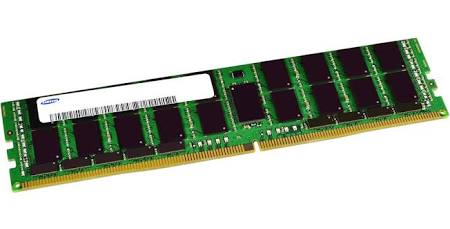
This is a server-class DDR3 Registered ECC memory module designed for enterprise environments where data integrity is critical, such as virtualization hosts, memory-resident databases, and financial transaction systems. Its dual-rank x4 configuration maximizes interleaving performance for sustained throughput, while the 1.35V low-voltage operation and ECC error correction deliver improved energy efficiency and robust protection against single-bit memory errors.
1. ECC memory corrects single-bit errors and detects multi-bit corruption, critical for preventing silent data corruption in transactional databases and long-running enterprise workloads.
2. Registered DIMM buffers clock and command signals, preserving signal integrity across fully populated server boards to support maximum memory capacity in high-density virtualization nodes.
3. Dual Rank x4 organization enables rank interleaving that saturates DDR3 channels, sustaining consistent bandwidth when dozens of VMs contend for shared memory resources.
4. A 16GB module density allows IT architects to provision ample RAM per socket without sacrificing DIMM slot availability, directly boosting virtual machine consolidation ratios.
5. Low 1.35V operation reduces power draw per DIMM, which scales into meaningful datacenter energy savings and lowers thermal stress on surrounding components in dense rack environments.
Designed for the data center, the M393B2G70QH0-YK0Q9 is a 16GB DDR3 Registered DIMM engineered to eliminate the silent threats that undermine server uptime. Its ECC technology continuously detects and corrects single-bit memory errors, a critical safeguard when you are running in-memory databases like SAP HANA or Redis, where even one flipped bit due to background radiation can corrupt a live financial transaction or session state. The registered architecture buffers the command and address lines, stabilizing signal integrity so you can fully populate all memory channels across a virtualization cluster without random boot failures or performance degradation under heavy consolidation ratios. Because it operates at 1.35V instead of the legacy 1.5V, this module significantly reduces the aggregate power draw and cooling load inside your rack, stretching every watt in a high-density deployment. The dual-rank x4 configuration further accelerates database response by enabling fast interleaved accesses, maximizing the throughput of each 1600MHz clock cycle when hundreds of virtual machines simultaneously query shared storage. For the infrastructure owner, that combination translates directly into longer node reliability, fewer emergency maintenance windows, and consistent quality of service under load.
General Virtualization
For a typical hypervisor host running multiple VMs, density is key. Populate your dual-socket server with at least eight of these 16GB RDIMMs (128GB total), using one DIMM per channel to balance capacity and memory speed. This configuration supports moderate consolidation ratios for web servers, domain controllers, and light database workloads without overcommitting resources.
In-Memory Database
Latency-sensitive in-memory databases like Redis or SAP HANA benefit from maximum channel utilization. Install 12 identical M393B2G70QH0 modules (192GB) across the server’s channels, leveraging the Dual Rank x4 organization for higher bank-level parallelism. Enable 1.35V operation to reduce thermal stress during sustained 100% load, ensuring ECC guards against silent data corruption.
High-Performance Computing
HPC workloads demand bandwidth over sheer capacity. Deploy 16 modules (256GB) in a fully balanced configuration, one per channel, to achieve peak DDR3-1600 memory bandwidth. The registered ECC design and CL11 timings provide the stability required for multi-day simulation runs, where a single uncorrectable error would invalidate results. Consider leaving a few slots free if your cluster scheduler relies on local scratch space rather than large resident datasets.
Rigorously tested server memory. Compatible with Dell PowerEdge R620, R720, HP ProLiant DL380p Gen8, and similar DDR3 ECC RDIMM systems.
Q: Can I mix this M393B2G70QH0-YK0Q9 with other memory modules of different brands or speeds?
A: Mixing is not recommended. For server stability, use identical modules with the same rank, speed, and latency. Mismatched DIMMs may force the system to downclock or cause ECC errors.
Q: Is this memory compatible with my system?
A: This RDIMM is compatible with DDR3 servers supporting Registered ECC memory at 1600MT/s. Verify your Intel Xeon E5/E7 v2 or AMD Opteron platform accepts 240-pin 1.35V RDIMMs.
Q: What is the recommended DIMM population order for optimal performance?
A: Populate identical DIMMs per channel starting from the farthest slot from the CPU. Follow your server board’s memory population guide to balance loads across memory channels for optimal bandwidth.
Q: Does this module support overclocking or XMP profiles?
A: No. This is a JEDEC-compliant server RDIMM without XMP. It operates at fixed 1600MHz/CL11. Overclocking is not supported and would compromise ECC integrity and platform stability.
Q: What warranty and typical failure rate can I expect?
A: The module includes a one-year warranty. Engineered with high-grade components, it exhibits a very low annualized failure rate typical of enterprise-class Samsung RDIMMs under spec conditions.