











 Secure payments
Standard refund policy
Trade Assurance
Secure payments
Standard refund policy
Trade Assurance
| Model | M312L2923FH3-CB3E0 |
|---|---|
| Product Type | Memory Module |
| Compliance Standards | EU RoHS,FCC |
| Memory Capacity | 1 GB |
| Memory Technology | DDR |
| Product Voltage | 2.5V |
| RAM Speed | 333MHz |
| RAM Standard | DDR-333/PC-2700 |
| Error Identifying | ECC |
| Signal Type | Registered |
| Column Access Strobe (CAS) | CL2.5 |
| Rank | Dual Rank x8 |
| Quantity of Pins | 184-pin |
| RAM Genre | RDIMM |
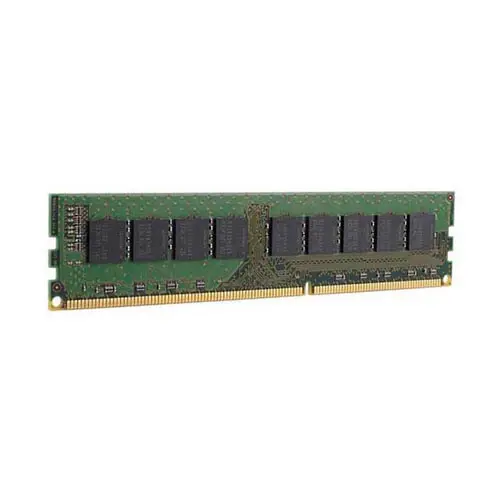
This is a legacy server-grade DDR Registered ECC DIMM, purpose-built for aging single- or dual-processor platforms where data integrity and system stability under sustained loads are critical. The combination of ECC error correction, Registered signaling, and a Dual Rank x8 organization delivers reliable performance for memory-centric workloads like small-scale virtualization and database caching on Socket 478/604-era servers, with CL2.5 latency keeping access times low for its 333MHz clock.
1. ECC detection and correction prevents silent data corruption, ensuring uninterrupted integrity for mission-critical database and financial transactions.
2. Registered signal buffering maintains command and address stability, allowing dense multi-DIMM configurations essential for high virtualization density.
3. Dual Rank x8 organization enables rank interleaving that saturates memory channels, increasing aggregate throughput under heavy concurrent workloads.
4. A low Column Access Strobe latency speeds up read cycles, reducing processor stall time and improving response in latency-sensitive enterprise applications.
5. The module’s throughput class delivers consistent bandwidth for legacy-tier server roles, sustaining steady I/O performance in always-on service environments.
The M312L2923FH3-CB3E0 is immediately recognizable as a server-grade RDIMM, and its four defining characteristics translate directly into relentless uptime and predictable performance for mission‑critical infrastructure. When you host a virtualized cluster running multiple database instances on a single physical host, the ECC capability silently corrects single‑bit memory errors before they can corrupt transactional records or destabilize the hypervisor. That means no silent data corruption in your financial logs and no unexpected VM crashes during peak business hours. The registered buffer architecture then steps in to guarantee signal integrity even when every DIMM slot is populated, letting you scale memory capacity without sacrificing stability across your blade servers. Inside a Redis or memcached in‑memory database, the dual‑rank x8 organization enables rank interleaving, overlapping access cycles so that the server can serve more queries per second while the CAS Latency of 2.5 keeps response times tightly predictable under burst loads. For you, this silicon is not about clock speed alone; it is about preserving the consistency of your data, extending the life of your legacy DDR platforms, and ensuring that your virtualized workloads stay resilient enough to meet SLAs that your business depends on.
This is a server-class DDR-333 Registered ECC DIMM. The capacity planning below addresses typical legacy server workloads.
General Virtualization
For light virtualization on older hosts, populate all available DIMM slots to maximize total capacity. With 1 GB modules, a dual-socket system with eight slots yields 8 GB, enough to run several small VMs. Always install identical DIMMs in pairs to enable dual-channel interleaving and preserve ECC reliability.
In-Memory Database
In-memory databases demand large capacity, so the 1 GB density is a major constraint. Plan to fill every slot (e.g., twelve modules for 12 GB) and dedicate the volume to caching small, hot datasets. For production workloads, migrating to higher-density registered DIMMs or a modern platform is strongly recommended.
High-Performance Computing
HPC applications benefit from ECC integrity and balanced configurations. Distribute registered DIMMs evenly across all memory channels per processor to maximize sustained bandwidth. Even with 1 GB sticks, uniform population eliminates bottlenecks. Given DDR-333 speed limits, prioritize capacity over frequency and install the maximum supported number of modules to accommodate larger working sets.
Rigorously tested, compatible with Dell PowerEdge 1850, HP ProLiant DL360 G4, IBM xSeries 346 servers.
Q: Can I mix this M312L2923FH3-CB3E0 with other memory modules of different brands or speeds?
A: Mixing is strongly discouraged for registered server memory. Dissimilar modules may force the system to downclock to the lowest common speed or cause stability issues, potentially compromising data integrity in critical server workloads.
Q: Is this memory compatible with my server system?
A: This 184-pin DDR-333 RDIMM is designed for legacy server platforms with Intel E7500/E7520 or equivalent AMD 8000-series chipsets. Please verify your motherboard supports Registered ECC DDR and a 2.5V memory voltage specification.
Q: What is the recommended DIMM population order for optimal performance?
A: For dual-channel server boards, populate identical modules in corresponding bank slots first, typically following the manufacturer's guide. Start with the slots furthest from the CPU per bank to maintain balanced memory interleaving and proper ECC function.
Q: Does this module support overclocking or XMP profiles?
A: No. This is a JEDEC-compliant registered server memory module. It operates strictly at its rated DDR-333 specification and does not support overclocking, XMP, or any non-standard frequency profiles to ensure maximum data reliability.
Q: What warranty and typical failure rate can I expect?
A: This module carries a one-year warranty. As an enterprise-grade RDIMM with ECC, it exhibits an extremely low annualized failure rate under normal operating conditions, consistent with high-reliability server memory standards.