











 Secure payments
Standard refund policy
Trade Assurance
Secure payments
Standard refund policy
Trade Assurance
| Model | M393T2950CZ3-CCC |
|---|---|
| Product Type | Memory Module |
| Compliance Standards | EU RoHS,FCC |
| Memory Capacity | 1 GB |
| Memory Technology | DDR2 |
| Product Voltage | 1.8V |
| RAM Speed | 400MHz |
| RAM Standard | DDR2-400/PC2-3200 |
| Error Identifying | ECC |
| Signal Type | Registered |
| Column Access Strobe (CAS) | CL3 |
| Rank | Single Rank x4 |
| Quantity of Pins | 240-pin |
| RAM Genre | RDIMM |
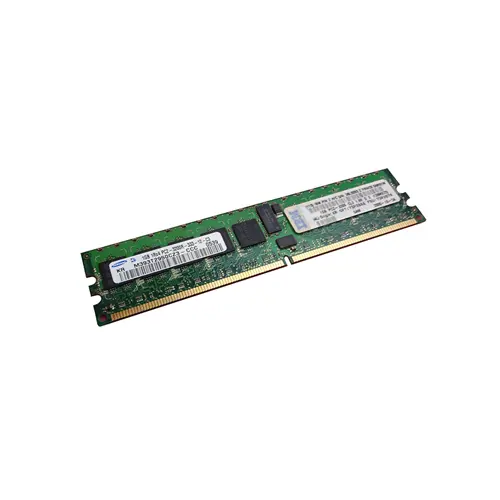
This Samsung M393T2950CZ3-CCC is a legacy server-grade DDR2-400 Registered ECC RDIMM, tailored specifically for older enterprise platforms requiring data integrity in memory-intensive roles such as virtualization hosts or small-scale database servers. Its Registered signal type and Single Rank x4 organization with ECC ensure stable quad-rank-capable operation and single-bit error correction, while the low CL3 latency at 400 MHz delivers deterministic access times critical for synchronous workloads on aging dual-socket systems.
1. ECC protection silently corrects single-bit errors and detects multi-bit faults, preserving data integrity in transactional databases and preventing costly server downtime.
2. Registered signal buffering reduces the electrical load on the memory controller, enabling higher DIMM counts per channel to maximize virtualization density without sacrificing signal stability.
3. PC2-3200 bandwidth delivers a reliable 3.2 GB/s per channel, sustaining steady throughput for entry-level file serving and light web application workloads.
4. CL3 low column access latency accelerates cache-line fetches, improving response times under latency-sensitive read-heavy operations such as financial order matching.
5. Single Rank x4 organization minimizes bus loading per module, allowing four-rank configurations to run at full speed and enhancing memory scalability for dense server deployments.
Based on the Registered DIMM form factor, ECC functionality, and 240-pin design, the M393T2950CZ3-CCC is unmistakably a server-class memory module engineered for legacy enterprise infrastructure. Its four defining characteristics directly address the pain points of IT administrators who still rely on hardened DDR2 platforms for mission-critical workloads.
ECC error correction is the non-negotiable foundation. In a financial transaction database or a virtualized cluster running multiple tenants, a single undetected bit flip induced by background radiation can silently corrupt records or crash an entire guest operating system. This module catches and corrects such errors in real time, preserving data integrity where every calculation matters. The registered buffer is equally vital. When populating a virtualization host with numerous DIMMs to maximize memory capacity, the buffer stabilizes signal loading on the memory bus, preventing electrical noise and timing degradation that would lead to intermittent failures during peak VM migration or heavy database query storms. The single-rank x4 organization, combined with a CL3 latency at 400 MHz, delivers predictable access patterns. For an in-memory cache like a Redis instance, that means the CPU wastes fewer cycles waiting on cache line fetches, sustaining low p99 latency even as the dataset scales. Collectively, these features translate into fewer silent alerts at 3 a.m., consistent throughput in aging but still profitable server fleets, and the confidence to run legacy enterprise software without costly forklift upgrades.
General Virtualization
In general virtualization, memory is the primary resource bottleneck per host. Using these 1 GB registered ECC DIMMs, you must populate every available slot to maximize capacity—an 8-socket board yields only 8 GB, which limits you to a handful of lightweight VMs. Plan for a minimum of 4–8 identical modules to maintain interleaved performance, and if your platform supports 4 GB DDR2 RDIMMs, prioritize upgrading to improve consolidation ratios.
In-Memory Database
In-memory databases require both raw capacity and absolute data integrity, making ECC essential. However, the 1 GB module size severely restricts dataset footprint; you may need 16 or more DIMMs fully populating a multi-channel platform to reach 16–32 GB. Always configure memory in balanced groups across all memory controllers for uniform latency, and verify that your working set completely fits in RAM to avoid disk contention that negates in-memory benefits.
High-Performance Computing (HPC)
HPC workloads benefit from both memory bandwidth and capacity. With these single‑rank X4 RDIMMs, install matched sets equal to the number of memory channels (e.g., four or eight identical modules) to enable full interleaving and maximum throughput. The 1 GB granularity limits total memory to a range suitable for light modeling or test‑bed clusters. For sustained HPC jobs, aggregate all available slots and consider a platform refresh, as the 400 MHz speed and small capacity fall short of modern compute demands.
Rigorously tested server DDR2-400 ECC RDIMM, compatible with Dell PE 2850/1850, HP DL360 G4, IBM x346, etc.
Q: Can I mix this M393T2950CZ3-CCC with other memory modules of different brands or speeds?
A: Mixing modules is not recommended. Registered DDR2 ECC platforms require exact matching of speed, rank, and CAS latency to ensure signal integrity and reliable system operation. Inconsistent parameters may cause instability.
Q: Is this memory compatible with my system?
A: This 240-pin DDR2-400 RDIMM is designed for servers using Intel 5000/5100/5400 series or equivalent AMD platforms that support registered ECC DDR2 memory at 1.8V. Verify your board's qualified vendor list for compatibility.
Q: What is the recommended DIMM population order for optimal performance?
A: Optimal population depends on your server's memory riser design. Typically, install identical single-rank x4 RDIMMs per channel in ascending slot order, following the platform manual to maintain balanced interleaving and data bus efficiency.
Q: Does this module support overclocking or XMP profiles?
A: No, this is a server-grade RDIMM with fixed JEDEC-standard timings. ECC and registered buffers are optimized for stability, not overclocking. XMP profiles are unsupported; it runs strictly at DDR2-400 CL3.
Q: What warranty and typical failure rate can I expect?
A: This module comes with a one-year warranty. Enterprise-class DDR2 ECC RDIMMs exhibit very low annualized failure rates, typically below 0.2% under normal operating conditions, ensuring high reliability for mission-critical workloads.