











 Secure payments
Standard refund policy
Trade Assurance
Secure payments
Standard refund policy
Trade Assurance
| Model | M393T2950BZ0-CCC |
|---|---|
| Product Type | Memory Module |
| Compliance Standards | EU RoHS,FCC |
| Memory Capacity | 1 GB |
| Memory Technology | DDR2 |
| Product Voltage | 1.8V |
| RAM Speed | 400MHz |
| RAM Standard | DDR2-400/PC2-3200 |
| Error Identifying | ECC |
| Signal Type | Registered |
| Column Access Strobe (CAS) | CL3 |
| Rank | Single Rank x4 |
| Quantity of Pins | 240-pin |
| RAM Genre | RDIMM |
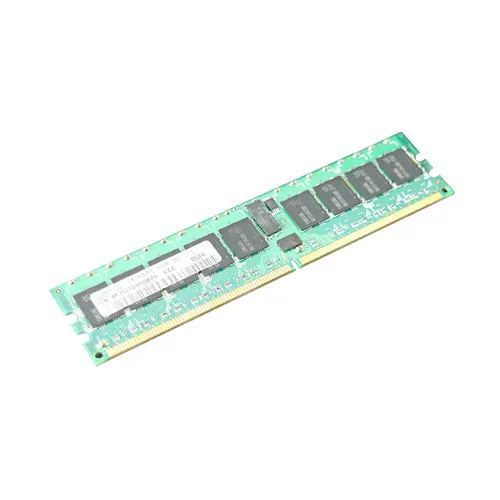
This 1GB DDR2-400 Registered ECC module (M393T2950BZ0-CCC) is a server-class RDIMM tailored for legacy enterprise platforms running virtualization, in-memory databases, or other mission-critical workloads that demand uncompromising data integrity. Its registered signal architecture ensures stable multi-module operation in high-density memory configurations, while the single-rank x4 design and ECC actively correct single-bit errors to maximize system uptime.
1. ECC protection detects and corrects single-bit memory errors, preventing silent data corruption in mission-critical server workloads.
2. Registered buffer reduces electrical load on the memory controller, enabling stable operation when fully populating server DIMM slots.
3. 1GB capacity fits lightweight legacy applications or dedicated management controllers, keeping cost and power consumption low in auxiliary roles.
4. PC2-3200 bandwidth of up to 3.2 GB/s meets the throughput demands of basic file-serving and web-hosting tasks without bottleneck.
5. Single-rank x4 organization delivers low latency access patterns, improving response times for small, frequently accessed datasets.
When deploying mission-critical virtualization clusters or in-memory databases, the M393T2950BZ0-CCC RDIMM is engineered to eliminate the hidden risks that can cripple enterprise workloads. Its ECC technology continuously detects and corrects single-bit memory errors, which in a dense virtualized environment could silently corrupt a hypervisor’s state or flip a financial transaction inside an in-memory cache—turning a minor cosmic-ray event into hours of costly forensic investigation. The registered buffer architecture decouples the memory controller from the DRAM load, allowing you to populate all DIMM slots without signal degradation; this directly translates into confidently scaling a database server to 64 GB or more, ensuring that an entire Redis or SAP HANA dataset resides in stable, low-latency memory rather than thrashing slow storage. Built as a single‑rank x4 module with a CL3 latency at 400 MHz, this DIMM pushes data in short, predictable bursts that reduce contention on the memory bus. In a virtual desktop infrastructure host juggling dozens of VMs, that consistent access pattern prevents the stutter that users feel as “lag,” while in a write‑heavy OLTP application, every saved cycle compounds into faster commit times. The 1.8 V operating voltage and 240‑pin footprint keep thermal and power envelopes in check across fully loaded 1U and 2U servers, so cooling costs stay low even as your memory‑driven services scale.
This is a server-class DDR2-400 Registered ECC DIMM with a capacity of 1 GB. Designed for legacy platforms, its low density demands careful slot population to extract maximum value from each workload profile.
General Virtualization
Install these modules in every available slot—commonly 8 identical RDIMMs to reach 8 GB. Populate channels symmetrically to maintain interleaving and avoid memory-bus bottlenecks. This minimal capacity can only support a handful of lightweight, legacy virtual machines with trimmed overhead.
In-Memory Database
Fill all DIMM slots with the same 1 GB ECC registered modules, typically 8×1 GB. The registered architecture and uniform rank help sustain reliable signaling and multi-bit error protection under steady load. The resulting 8 GB severely limits dataset size, making this approach viable only for very small caching or lookup-table workloads.
High-Performance Computing
For bandwidth-sensitive applications, install modules in symmetrical pairs across channels: for example, start with one matched pair per channel (4×1 GB) in a dual-channel server to enable interleaved access at the full 400 MHz. When capacity is also required, populate all slots with identical RDIMMs (8×1 GB) to preserve balanced dual-channel throughput while maximizing the available memory footprint.
Rigorously tested server DDR2 Registered ECC module, compatible with Dell PowerEdge 2800/2850/6800 and HP ProLiant DL380 G4.
Q: Can I mix this M393T2950BZ0-CCC with other memory modules of different brands or speeds?
A: Mixing is not recommended. Registered DDR2 modules require identical ranks, timings, and organization for stable ECC operation. Mismatched speeds will downclock to the slowest module, often causing instability.
Q: Is this memory compatible with my server?
A: This 1GB DDR2-400 Registered ECC DIMM suits older servers using Intel 5000/5100/5400 series chipsets or AMD Socket F platforms. Verify your board supports 240-pin RDIMMs and 1.8V ECC memory.
Q: What is the recommended DIMM population order for optimal performance?
A: Populate identical DIMMs per channel, starting with the slot farthest from the CPU. For dual-channel platforms, install pairs of matching single-rank modules in corresponding slots to enable interleaving.
Q: Does this module support overclocking or XMP profiles?
A: No. As a server-grade Registered ECC module, it adheres strictly to JEDEC DDR2-400/PC2-3200 standards. ECC and registered logic prevent overclocking and do not support XMP profiles.
Q: What warranty and typical failure rate can I expect?
A: This module carries a 1-year warranty. Enterprise DDR2 RDIMMs are highly reliable with an annualized failure rate typically below 0.5% under proper airflow and validated server environments.