











 Secure payments
Standard refund policy
Trade Assurance
Secure payments
Standard refund policy
Trade Assurance
| Product Type | Memory Module |
|---|---|
| Compliance Standards | |
| Memory Capacity | 1 GB |
| Memory Technology | DDR2 |
| Product Voltage | 1.8V |
| RAM Speed | 667MHz |
| RAM Standard | DDR2-667/PC2-5300 |
| Error Identifying | ECC |
| Signal Type | Fully Buffered |
| Column Access Strobe (CAS) | CL5 |
| Rank | Dual Rank x8 |
| Quantity of Pins | 240-pin |
| RAM Genre | FB-DIMM |
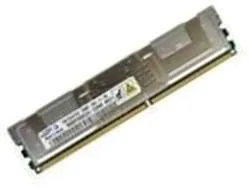
This DDR2-667 FB-DIMM with ECC is a legacy server memory module designed for fully buffered platforms requiring high data integrity, making it suitable for older virtualization hosts or memory-resident database systems where stability is paramount. Its Fully Buffered signal architecture and dual-rank x8 organization enhance signal integrity and capacity scalability, while ECC protection and CL5 latency ensure reliable error correction without compromising deterministic performance.
1. Fully Buffered architecture maintains robust signal quality across cascaded modules, allowing dense memory configurations for large-scale virtualization hosts without signal degradation.
2. ECC error detection and correction eliminates single-bit data corruption silently, preserving financial transaction accuracy in continuous 24/7 operation.
3. Dual Rank x8 organization interleaves internal banks to boost sustained throughput, keeping virtual machine response times consistent under heavy consolidation.
4. A peak bandwidth of 5.3 GB/s per channel handles moderate server workloads such as file sharing and directory services with ample headroom.
5. CL5 access latency reduces processor wait cycles, sharpening query performance in latency-intolerant database and analytics engines.
For server environments, stability and data integrity are not negotiable. The M395T2953CZ4-CE6D0 is a DDR2-667 Fully Buffered DIMM equipped with ECC, making it purpose-built for legacy enterprise platforms where uptime is everything. Its ECC technology actively detects and corrects single-bit memory errors, which can be caused by background radiation. In a memory database like an in-memory financial transaction engine, such bit flips silently corrupt calculations, but ECC ensures every data point remains precise and trustworthy, directly protecting revenue and reputation. The Fully Buffered architecture uses an Advanced Memory Buffer to redrive signals to each module, a critical feature when populating all slots in a virtualized cluster. Without this buffering, high-density setups suffer signal degradation and system crashes under heavy host loads. This FB-DIMM delivers crisp signal integrity, allowing IT managers to maximize RAM capacity for multiple virtual machines without sacrificing stability. Furthermore, the Dual Rank x8 construction organizes the module into two independently accessible ranks. This enables rank interleaving, where the memory controller can initiate a read on one rank while the other completes a refresh, effectively masking latency and increasing throughput. For a heavily loaded virtualization host running dozens of VMs, this translates into noticeably faster context switching and smoother operation under concurrent workloads. Combined with a CL5 latency at 667MHz on a dependable 1.8V power envelope, this module balances thermal restraint with data robustness, giving data center operators the confidence to extend the life of critical infrastructure without compromising on error resilience or performance.
Identified as server memory (FB-DIMM, ECC). Capacity planning guidelines for these 1 GB DDR2-667 modules:
General Virtualization
For legacy hosts, populate memory channels with matched pairs of the 1 GB FB-DIMMs to activate interleaving and ECC. An 8‑slot configuration delivers 8 GB, sufficient for several lightweight VMs, and you can enable mirroring on critical workloads. Always balance modules across channels to preserve symmetric bandwidth.
In-Memory Database
Maximise slot usage to meet the appetite of in‑memory stores like a small Redis instance. Fully populating a 16‑DIMM riser server yields 16 GB—adequate for modest caching but not large datasets. Use identical dual‑rank modules across all channels to maintain uniform latency and stable signaling.
High-Performance Computing
Equip each compute node with a module in every memory branch, typically 16 DIMMs for 16 GB per node. Coupled with MPI, many such nodes collectively handle parallel, memory‑lean workloads. Because FB‑DIMMs draw notable power, verify that cooling and airflow can sustain dense, fully populated chassis.
Rigorously tested server memory: Dell PowerEdge 2950, HP ProLiant DL380 G5, IBM System x3550.
Q: Can I mix this M395T2953CZ4-CE6D0 with other memory modules of different brands or speeds?
A: Mixing is strongly discouraged. FB-DIMMs require identical specs for stable AMB handshaking. Mismatched ranks or speeds can cause ECC errors, timing conflicts, and system boot failures in server environments.
Q: Is this memory compatible with my server system?
A: It is compatible with Intel 5000/5400 series chipset servers that support fully buffered DDR2. Verify your board uses 240-pin FB-DIMM slots. Not compatible with AMD platforms or standard unbuffered desktop boards.
Q: What is the recommended DIMM population order for optimal performance?
A: Follow the server board manual: populate identical DIMMs per channel starting with slot 1. For dual-rank x8 FB-DIMMs, install in matched pairs across channels (e.g., A1/B1) for balanced interleaving and maximum throughput.
Q: Does this module support overclocking or XMP profiles?
A: No. This is a JEDEC-standard DDR2-667 ECC FB-DIMM operating at 1.8V. Overclocking and XMP are not supported; any deviation from rated specs compromises signal integrity and system stability in server use.
Q: What warranty and typical failure rate can I expect?
A: It includes a 1-year warranty. Built with enterprise-grade DRAM, the typical Annualized Failure Rate (AFR) is below 0.5% under compliant operating conditions, ensuring dependable 24/7 server operation.