











 Secure payments
Standard refund policy
Trade Assurance
Secure payments
Standard refund policy
Trade Assurance
| Model | M393T2950EZA-CE6Q0 |
|---|---|
| Product Type | Memory Module |
| Compliance Standards | EU RoHS,FCC |
| Memory Capacity | 1 GB |
| Memory Technology | DDR2 |
| Product Voltage | 1.8V |
| RAM Speed | 667MHz |
| RAM Standard | DDR2-667/PC2-5300 |
| Error Identifying | ECC |
| Signal Type | Registered |
| Column Access Strobe (CAS) | CL5 |
| Rank | Single Rank x4 |
| Quantity of Pins | 240-pin |
| RAM Genre | RDIMM |
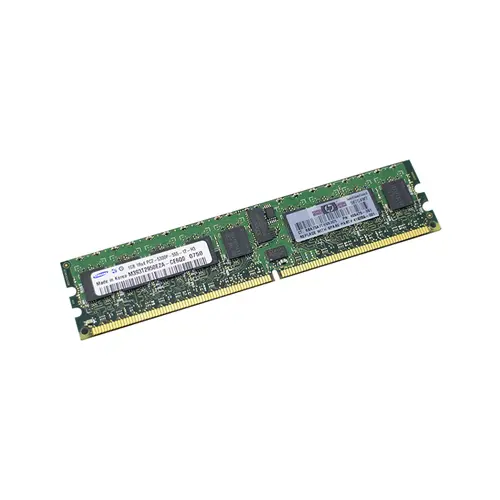
Designed for legacy server platforms requiring high data integrity, this Samsung 1GB DDR2-667 Registered ECC RDIMM is ideally suited for memory-sensitive workloads such as virtualization and entry-level database caching in aging enterprise infrastructure. Its single-rank x4 configuration minimizes electrical loading on the memory bus, while the registered signal type and ECC ensure stable operation and single-bit error correction in multi-DIMM configurations.
1. ECC detection and correction eliminates single-bit errors in real time, preserving data integrity for long-running enterprise database workloads.
2. Registered signal buffering stabilizes command and address lines, allowing server platforms to populate more DIMMs per channel and maximize virtualization density.
3. Single Rank x4 organization strengthens advanced error resilience like Chipkill, delivering comprehensive protection against memory faults in mission-critical analytics.
4. The 667 MHz clock speed yields 5.3 GB/s peak bandwidth, sustaining smooth request handling for concurrent connections on web and application servers.
5. CAS 5 latency accelerates read access to active memory rows, shaving critical microseconds off transaction processing in high-throughput financial services.
The M393T2950EZA-CE6Q0 is a server-class DDR2-667 Registered DIMM built for legacy infrastructure where uptime and data fidelity are non-negotiable. Its four critical characteristics—ECC error correction, registered buffering, a single-rank x4 organization, and CL5 latency—directly resolve real operational pain points. In a virtualized cluster, ECC protection silently corrects single-bit memory errors caused by background radiation, preventing the kind of silent data corruption that quietly propagates through your storage stack and crashes multiple guest machines simultaneously. The registered signal buffer decouples the memory bus from the CPU, allowing a host to populate all 24 DIMM slots without jeopardizing 667 MHz stability; this means you can safely provision dense memory pools for dozens of virtual machines, ensuring smooth live migration and failover. For an in-memory database such as a real-time caching engine, the single-rank x4 architecture minimizes electrical load on the memory controller, which improves signal integrity and enables consistent bandwidth. The x4 DRAM configuration also supports advanced error recovery modes, safeguarding transactional data while the single rank avoids rank-interleaving penalties, delivering predictable low-latency access. Paired with a CL5 access time, this module accelerates cache fetches and reduces query latency, transforming critical database operations into instantaneous decisions rather than bottlenecks.
General Virtualization
Install at least four identical M393T2950EZA-CE6Q0 modules (4 GB total) in paired slots to enable dual‑channel interleaving and boost memory throughput. For heavier multi‑VM workloads, populate all eight DIMM slots (8 GB) to maximize the hypervisor’s memory footprint. The ECC and registered architecture protects guest operations during sustained uptime.
In‑Memory Database
Deploy six or eight modules (6–8 GB) spread evenly across all memory channels to achieve the lowest latency and highest transactional reliability. If the server supports memory mirroring, configure two identical sets for full redundancy, as ECC alone cannot recover from multi‑bit faults. Single‑rank x4 DIMMs at CL5 provide deterministic response times critical for real‑time datasets.
High Performance Computing
Fill every memory channel with matched modules—typically eight 1 GB RDIMMs (8 GB total)—to deliver symmetrical bandwidth under parallel computing workloads. Uniform single‑rank, registered modules ensure consistent electrical loading per channel, minimizing data‑access stalls. This balanced layout sustains the memory‑intensive throughput required by tightly coupled HPC jobs.
Server-grade DDR2 RDIMM, rigorously tested, compatible with Dell PowerEdge 2950/1950/2900, HP ProLiant DL380 G5/DL360 G5, IBM System x3650.
Q: Can I mix this M393T2950EZA-CE6Q0 with other memory modules of different brands or speeds?
A: Mixing different brands or speeds with this registered ECC module is strongly discouraged. It can cause signal integrity issues and system instability. For optimal reliability, only populate identical Samsung M393T2950EZA-CE6Q0 modules in your server.
Q: Is this memory compatible with my server system?
A: This is a DDR2-667 Registered ECC RDIMM. It is compatible with legacy server platforms supporting 240-pin DDR2 technology, such as those based on Intel 5000-series chipsets or older AMD Opteron systems. Always verify against your server's hardware qualification list.
Q: What is the recommended DIMM population order for optimal performance?
A: Follow your server board's manual for balanced memory configuration. Generally, populate identical DIMMs per channel, starting with the slot farthest from the CPU, to enable dual-channel interleaving and achieve maximum throughput from the memory subsystem.
Q: Does this module support overclocking or XMP profiles?
A: No. This is a server-grade Registered ECC module designed for stringent JEDEC specifications. It does not support XMP or overclocking, as its primary focus is absolute data integrity and 24/7 operational stability in mission-critical environments.
Q: What warranty and typical failure rate can I expect?
A: This module comes with a 1-year warranty. Server-class memory like this exhibits an extremely low annualized failure rate (AFR) thanks to rigorous binning and ECC, which automatically corrects single-bit errors to prevent silent data corruption.