











 Secure payments
Standard refund policy
Trade Assurance
Secure payments
Standard refund policy
Trade Assurance
| Model | M395T2953CZ4-CE60 |
|---|---|
| Product Type | Memory Module |
| Compliance Standards | EU RoHS,FCC |
| Memory Capacity | 1 GB |
| Memory Technology | DDR2 |
| Product Voltage | 1.8V |
| RAM Speed | 667MHz |
| RAM Standard | DDR2-667/PC2-5300 |
| Error Identifying | ECC |
| Signal Type | Fully Buffered |
| Column Access Strobe (CAS) | CL5 |
| Rank | Dual Rank x8 |
| Quantity of Pins | 240-pin |
| RAM Genre | FB-DIMM |
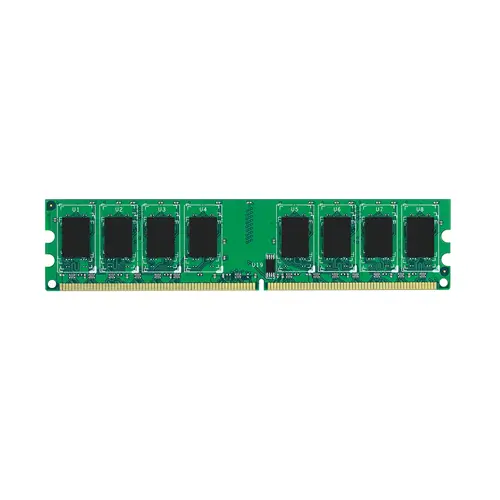
Built specifically for legacy server platforms, this FB-DIMM module utilizes Fully Buffered architecture and ECC to deliver robust signal integrity and data protection for mission-critical workloads such as memory-resident databases and virtualization. Its dual-rank x8 organization and CL5 latency effectively maximize capacity per channel while maintaining reliable, sustained throughput in multi-socket configurations.
1. The Fully Buffered architecture isolates DRAM loading from the memory bus, preserving signal integrity at scale and making it ideal for memory-dense server deployments hosting critical databases.
2. ECC protection detects and corrects single-bit errors on the fly, preventing silent data corruption that could compromise financial or transactional workloads in always-on environments.
3. Dual Rank x8 organization interleaves accesses across internal banks, maximizing channel throughput and helping sustain predictable virtual machine responsiveness during consolidation.
4. Clocking at 667MHz provides 5.3GB/s of bandwidth per channel, keeping up with concurrent requests from multi-threaded enterprise applications without introducing memory bottlenecks.
5. The 1GB capacity offers a granular expansion step, letting administrators fine-tune memory provisioning for legacy servers while avoiding wasted resources in light-duty virtualization hosts.
The M395T2953CZ4-CE60 is a server-grade Fully Buffered DIMM, purpose-built for enterprise environments where data integrity and uptime are non-negotiable. Its ECC technology actively corrects single-bit memory errors in real time. In a virtualized cluster hosting dozens of VMs, an undetected bit flip can silently corrupt a transaction database or bring down critical instances, directly translating to revenue loss. The Fully Buffered architecture serializes data and command signals, enabling you to populate all 240-pin slots without signal degradation. This is essential when scaling memory to hundreds of gigabytes for an in-memory database like Redis, where every microsecond of latency impacts query throughput. The dual-rank x8 organization interleaves internal banks, overlapping read and write operations to deliver noticeably higher sustained bandwidth under concurrent access patterns—vital when multiple VMs hammer the storage stack simultaneously. Operating at DDR2-667 with a CL5 latency and 1.8V supply, the module balances responsive performance with predictable thermal load, keeping server racks cool and stable throughout 24/7 operation without throttling.
This module is server-class DDR2-667 Fully Buffered DIMM (FB-DIMM) with ECC, offering only 1GB per stick. For legacy server platforms, capacity planning must focus on extracting maximum value from severely constrained memory resources.
General Virtualization
Populate all available DIMM slots with identical 1GB FB-DIMMs to hit the platform’s maximum capacity—typically 16GB or 32GB across dual sockets. Activate ECC and memory interleaving for stability. Allocate memory to virtual machines conservatively, strictly avoiding overcommitment, and provision only essential services on such limited hardware.
In-Memory Database
In-memory databases require large, contiguous RAM pools. Install matched 1GB modules in every channel, following the board’s population order, to build the largest possible capacity. Even fully populated, the total rarely exceeds 32GB, making this configuration suitable only for small test datasets or lightweight caching. For production, scale horizontally with multiple nodes.
High-Performance Computing
Achieve peak bandwidth by populating all FBD channels symmetrically. Use balanced configurations of these dual-rank DIMMs across branches to exploit the buffered architecture’s throughput. Be aware that 1GB per slot severely limits per-node capacity; modern HPC jobs will quickly saturate memory. Reserve this setup for compute-bound tasks that fit within the constrained memory footprint.
Rigorously tested server memory; compatible with Dell PowerEdge 2950, HP ProLiant DL380 G5, and IBM x3650.
Q: Can I mix this M395T2953CZ4-CE60 with other memory modules of different brands or speeds?
A: Mixing FB-DIMMs of different brands or speeds is strongly discouraged. It may cause clock synchronization issues and system instability. For reliable ECC operation, identical module specifications are required across all channels.
Q: Is this memory compatible with my system?
A: This is a fully buffered DDR2 ECC module intended for server platforms. Verify your board supports 240-pin FB-DIMMs, typically on Intel 5000/5100/5400 series or equivalent AMD chipsets with an appropriate memory controller.
Q: What is the recommended DIMM population order for optimal performance?
A: Consult your server board manual. Generally, populate identical FB-DIMMs in matched sets, starting with the slots farthest from the CPU per channel. All channels should be balanced to leverage interleaving and full bandwidth.
Q: Does this module support overclocking or XMP profiles?
A: No. This module uses JEDEC-standard DDR2-667 with ECC and fully buffered architecture. Overclocking or XMP is unsupported and would compromise data integrity, potentially causing critical server errors.
Q: What warranty and typical failure rate can I expect?
A: This module includes a one-year warranty. FB-DIMM technology provides robust RAS; actual failure rate is very low under proper operating conditions, with adequate thermal management being the key factor for longevity.