











 Secure payments
Standard refund policy
Trade Assurance
Secure payments
Standard refund policy
Trade Assurance
| Product Type | Memory Module |
|---|---|
| Compliance Standards | EU RoHS,FCC |
| Memory Capacity | 1 GB |
| Memory Technology | DDR2 |
| RAM Speed | 667 |
| RAM Standard | DDR2-667/PC2-5300 |
| Error Identifying | Non-ECC |
| Signal Type | Unbuffered |
| Column Access Strobe (CAS) | CL5 |
| Rank | Dual Rank x8 |
| Quantity of Pins | 200-pin |
| RAM Genre | SoDIMM |
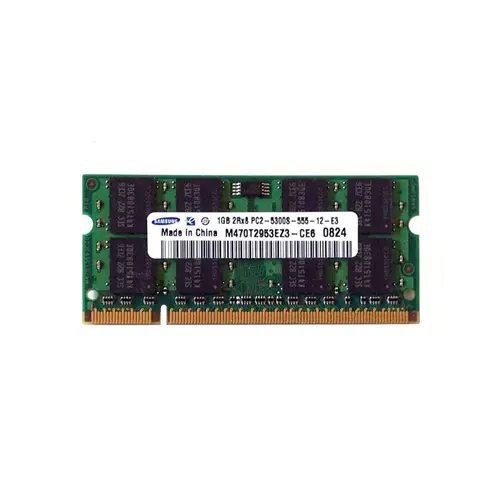
This is a legacy DDR2-667 SoDIMM designed for notebook platforms, ideal for upgrading older mobile workstations or consumer laptops to improve multitasking responsiveness. Its dual-rank x8 configuration and CL5 latency enhance memory access efficiency, while the unbuffered, non-ECC design ensures low power consumption and straightforward plug-and-play compatibility with 200-pin sockets.
1. SoDIMM form factor guarantees a direct, screw-free installation into compact laptop memory bays, making upgrades effortless even for users with no technical background.
2. Single-gigabyte capacity revitalizes aging notebooks by providing enough room for lightweight Linux distros or essential office tools without constant disk swapping.
3. DDR2 technology operates at lower voltage than its first-generation predecessor, helping to conserve battery life and reduce excess heat in fanless portable designs.
4. 667 MHz data rate sustains smooth streaming and document handling on older mobile chipsets, preventing stutter during day-to-day productivity workflows.
5. CL5 memory latency shrinks the delay between data requests and delivery, yielding a noticeably snappier interface when multitasking on restored classic laptops.
Judging by the 200-pin SODIMM form factor, unbuffered non-ECC architecture, and DDR2-667 specification, this is a laptop memory module designed to breathe new life into aging notebooks. For IT professionals maintaining legacy mobile workstations or everyday users upgrading a cherished thin-and-light, four characteristics directly translate into tangible benefits.
First, the Non‑ECC Unbuffered design guarantees seamless plug-and-play compatibility with consumer and business-class notebooks, eliminating the boot failures that often plague mismatched server memory. Second, the DDR2-667 speed with a CL5 latency strikes a crucial balance: it delivers enough bandwidth to keep Windows or lightweight Linux environments responsive during multitasking, meaning your field service technician’s mapping software and spreadsheets won’t stutter. Third, the compact SoDIMM physical format is precisely what allows an ultraportable to accept a memory upgrade without clearance issues; it slips easily into the cramped chassis of a 12-inch Latitude or ThinkPad X-series. Fourth, the Dual Rank x8 organization enables memory interleaving, which boosts the effective throughput within the 1GB capacity, allowing simultaneous handling of email, invoicing, and database lookups on a mobile workstation without dramatic slowdowns. RoHS and FCC compliance further assure you’re installing a module that meets global environmental and electromagnetic standards, keeping your fleet reliable and regulation‑ready.
Given the 1 GB DDR2-667 non-ECC unbuffered 200‑pin SoDIMM, this module is designed for notebook upgrades. Capacity planning recommendations for three typical laptop scenarios are provided below.
Laptop Upgrade
Add a second identical 1 GB module to create a 2 GB dual‑channel configuration. This doubles capacity and delivers a noticeable improvement in multitasking and operating system responsiveness for legacy Windows environments. Match the exact part number (M470T2953EZ3‑CE6) to ensure seamless compatibility.
Mobile Workstation
Populate both SODIMM slots with these 1 GB modules for a total of 2 GB, the maximum achievable with this component. The dual‑rank x8 organization enhances memory interleaving, offering modest gains for entry‑level CAD, large spreadsheets, or photo editing. While a 2 GB ceiling limits modern professional workloads, this configuration provides a stable, error‑free foundation for legacy business applications.
Ultrabook Power Saving
For an ultra‑portable targeting maximum battery life, install a single 1 GB SoDIMM and leave the second slot empty. Operating one module reduces the overall active DRAM power draw compared to a pair, directly extending runtime during light productivity tasks. Since the DDR2 standard operates at 1.8 V and lacks a low‑voltage variant, minimizing the number of powered chips is the most effective energy‑saving strategy.
Rigorously tested, guaranteed compatible with laptops like Dell Latitude D630, Lenovo ThinkPad T61, HP Compaq 6710b.
Q: Can I mix this M470T2953EZ3-CE6 with other memory modules of different brands or speeds?
A: Mixing is possible but not recommended. The system will downclock to the slowest module, and mismatched brands or ranks may cause instability in older DDR2 notebooks.
Q: Is this memory compatible with my system?
A: It fits notebooks with a 200-pin DDR2 SoDIMM slot. Verify your laptop supports PC2-5300 DDR2-667 non-ECC unbuffered memory and a maximum of 1GB per slot for guaranteed compatibility.
Q: What is the recommended DIMM population order for optimal performance?
A: For dual-slot notebooks, install this 1GB module in the primary slot. Pairing identical dual-rank modules enables dual‑channel, but single‑channel operation with this single module is also fully supported.
Q: Does this module support overclocking or XMP profiles?
A: No. This is a JEDEC‑compliant SoDIMM for stable operation at DDR2‑667 CL5. It does not include XMP nor support voltage or frequency overclocking in notebook platforms.
Q: What warranty and typical failure rate can I expect?
A: This module includes a one-year warranty. Typical annualized failure rates for such DDR2 SoDIMMs are very low, well under 1%, provided the system’s power and thermal conditions are normal.