











 Secure payments
Standard refund policy
Trade Assurance
Secure payments
Standard refund policy
Trade Assurance
| Product Type | Memory Module |
|---|---|
| Compliance Standards | EU RoHS,FCC |
| Memory Capacity | 1 GB |
| Memory Technology | DDR2 |
| RAM Speed | 667MHz |
| RAM Standard | DDR2-667/PC2-5300 |
| Error Identifying | Non-ECC |
| Signal Type | Unbuffered |
| Column Access Strobe (CAS) | CL5 |
| Rank | Single Rank x8 |
| Quantity of Pins | 240-pin |
| RAM Genre | UDIMM |
This DDR2-667 UDIMM is a non-ECC, unbuffered desktop memory module optimized for legacy productivity systems and basic content creation, where its single-rank x8 configuration ensures broad compatibility and stable signal integrity on older motherboard chipsets. The CL5 column access strobe latency provides tight timing for responsive data access, making it a reliable upgrade to extend the life of aging Windows XP or early Vista-era workstations.
1. The DDR2 technology offers a reliable foundation for legacy desktop systems, ensuring full compatibility with older motherboards and a cost-effective path to breathing new life into aging rigs.
2. A 667 MHz clock speed delivers sufficient bandwidth for smooth multitasking in vintage gaming setups, preventing audio stutter and frame dips when running classic titles alongside background applications.
3. CL5 latency contributes to snappy system responsiveness, reducing the delay between a CPU request and data delivery to give retro gaming and everyday computing a perceptible crispness.
4. The 1 GB capacity provides just enough headroom for lightweight operating systems and classic software suites, keeping memory resources balanced for responsive content consumption and basic photo editing.
5. Single Rank x8 organization minimizes electrical load on the memory controller, improving compatibility with older chipsets and offering a modest boost in overclocking headroom for enthusiasts chasing stable top-end frequencies.
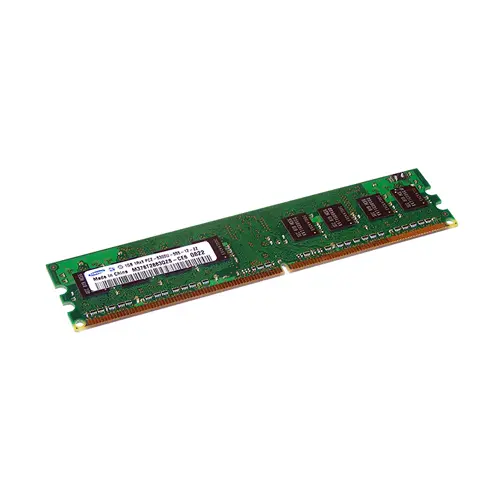
The Samsung M378T2863QZS-CE6 is a 1GB DDR2-667 UDIMM, purpose-built for legacy desktop systems where stability and cost-effective revivals matter more than raw throughput. Its Non-ECC, Unbuffered architecture strips away the register and error-correction overhead that server memory demands, meaning lower latency and full compatibility with consumer-grade chipsets. When you are upgrading an aging office fleet still running Windows XP‑era workloads or breathing life into a home‑theatre PC, that pure signal path translates directly into snappier UI response and fewer POST failures.
The CL5 timing at 667 MHz sits at a sweet spot for DDR2 platforms. In a small‑business environment where an old tower juggles QuickBooks, email, and a lightweight CRM, the tighter column‑access delay reduces the micro‑stutter that plagues memory‑starved systems. For the home‑user transforming a dusty desktop into a dedicated media server, the Single‑Rank x8 organization ensures the module draws less current and places a lighter load on the memory controller compared to older dual‑rank sticks. That means it is far more likely to play nicely with the four‑slot boards from that generation, avoiding dropped channels. Finally, the 240‑pin UDIMM form factor and EU RoHS compliance guarantee a safe, drop‑in fit in standard ATX and micro‑ATX builds. What you get is not just a stick of RAM, but a predictable, worry‑free upgrade that directly solves the sluggish multitasking and random freezes that prompt users to abandon otherwise solid hardware.
Gaming Build
For DDR2-based gaming rigs, dual-channel operation is critical to reduce memory bottlenecks. With these 1GB UDIMMs, install at least two identical modules (2×1GB) in paired slots for 2GB total, enabling 128-bit interleaving. To run later titles comfortably, populate all four DIMM slots with four 1GB modules (4GB total) in a matched dual-channel kit, though 32-bit OS limits may apply.
Content Creation
Video editing and 3D rendering thrive on capacity. Using the 1GB DDR2 sticks, fill all available slots—typically four—to reach 4GB. This ceiling, while modest by modern standards, serves retro editing suites; always pair identical modules in dual-channel configurations to maintain stability. For heavier projects, consider a maximum-capacity 8GB setup with higher-density DIMMs if the platform supports it.
General Productivity
For everyday office work, web browsing, and multitasking, a single 1GB module offers bare-minimum functionality. A cost-optimized configuration uses two modules (2×1GB) in dual-channel mode, providing 2GB and noticeably smoother responsiveness. This leaves two open slots for future upgrades while keeping power consumption and expenditure low.
Rigorously tested DDR2 UDIMM, compatible with desktops/laptops like Dell OptiPlex 745, HP dc7700, ThinkPad T60.
Q: Can I mix this M378T2863QZS-CE6 with other memory modules of different brands or speeds?
A: Mixing is possible but not advised. The memory controller will default to the slowest module's speed and latencies, potentially compromising stability and performance. Identical modules are strongly recommended.
Q: Is this memory compatible with my system?
A: This 240-pin DDR2-667 UDIMM suits desktop motherboards with DDR2 support. Confirm your chipset accepts non-ECC, unbuffered memory and a 1 GB single-rank x8 module per slot.
Q: What is the recommended DIMM population order for optimal performance?
A: Refer to your motherboard manual. Generally, install identical modules in the same-colored slots (e.g., DIMM1 and DIMM3) first to enable dual-channel mode and maximize throughput.
Q: Does this module support overclocking or XMP profiles?
A: No. This JEDEC-compliant DDR2 module lacks XMP support. It runs at 667MHz with CL5. Minimal manual frequency adjustments may be attempted but are not validated or guaranteed.
Q: What warranty and typical failure rate can I expect?
A: It carries a one-year warranty. The typical annualized failure rate is below 0.5%, reflecting robust manufacturing standards for dependable, long-term desktop use.