











 Secure payments
Standard refund policy
Trade Assurance
Secure payments
Standard refund policy
Trade Assurance
| Product Type | Memory Module |
|---|---|
| Compliance Standards | EU RoHS,FCC |
| Memory Capacity | 1 GB |
| Memory Technology | DDR2 |
| RAM Speed | 667 |
| RAM Standard | DDR2-667/PC2-5300 |
| Error Identifying | Non-ECC |
| Signal Type | Unbuffered |
| Column Access Strobe (CAS) | CL5 |
| Rank | Dual Rank x8 |
| Quantity of Pins | 200-pin |
| RAM Genre | SoDIMM |
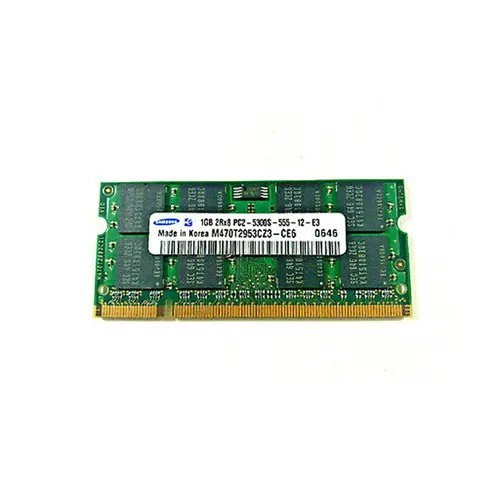
This DDR2-667 SO-DIMM is a dual-rank x8 unbuffered Non-ECC notebook memory module, ideal for upgrading older mobile workstations and laptops where plug-and-play compatibility and low power consumption are critical. Its CL5 latency and dual-rank organization improve data access efficiency, delivering snappier multitasking in systems still relying on DDR2 platforms.
1. DDR2 memory technology reduces the core operating voltage to 1.8V, which directly lowers power consumption and helps keep notebook temperatures cooler during unplugged productivity.
2. A 1GB module fits perfectly as a cost-effective capacity lift for aging laptops, restoring comfortable multitasking freedom for web browsing and office applications.
3. 667 MHz data rate sustains smooth media playback and responsive system feel, matching the typical workload of mobile users without draining battery life.
4. CL5 low column access latency speeds up data delivery to the mobile processor, delivering crisper application launches and reduced waiting time on the go.
5. Dual Rank x8 arrangement enables efficient memory interleaving inside the compact SoDIMM footprint, improving overall system fluidity during everyday portable use.
The Samsung M470T2953CZ3-CE6 is a 1 GB DDR2‑667 SODIMM purpose‑built to revitalise aging notebooks. As a non‑ECC, unbuffered module, it dispenses with server‑grade error correction to trim power draw and controller overhead — a direct answer to the two biggest mobile pain points: battery endurance and heat buildup inside cramped chassis. Its 200‑pin small‑outline form factor slots straight into everything from ultra‑portable business clamshells to mobile workstations like a ThinkPad T60 or Dell Latitude D620, making field upgrades tool‑free. Running at PC2‑5300 with a tight CAS latency of 5, this dual‑rank x8 module leverages bank interleaving to overlap data requests, delivering snappier application launches and smoother multitasking when you are juggling a CRM, spreadsheets, and a dozen browser tabs on a legacy OS. For a service technician updating a thin‑and‑light for on‑site diagnostics, the dual‑rank architecture balances capacity with bandwidth, preventing the stop‑start stutter that cripples productivity. It is not about chasing benchmark numbers — it is about giving a reliable second life to hardware that still handles essential daily work, with RoHS compliance ensuring responsible, plug‑and‑play refreshes across corporate fleets.
Laptop Upgrade
For aging notebooks still relying on DDR2 SO-DIMMs, upgrading from a single 1 GB stick to a matched pair is the most cost-effective refresh. Install two identical 1 GB or 2 GB modules to enable symmetric dual-channel operation, which measurably improves integrated graphics performance and system responsiveness under Windows 7/10. Always verify the chipset’s maximum supported capacity—many DDR2-era platforms top out at 4 GB.
Mobile Workstation
DDR2-based mobile workstations are extremely rare, but where they exist (e.g., late-2000s ThinkPad W series), maximum capacity is essential for CAD or engineering software. Populate both SO-DIMM slots with the highest density 4 GB DDR2-667 modules the chipset allows, accepting that dual-rank x8 configurations may downclock slightly for stability. Prioritize reliable, JEDEC-compliant Unbuffered Non-ECC memory to avoid data corruption in compute-heavy sessions.
Ultrabook Power Saving
Although Ultrabooks typically use later DDR3L or LPDDR standards, if a thin-and-light notebook employs DDR2 SO-DIMMs, low-voltage variants (1.8 V standard) were never widespread. Focus instead on modules with conservative CL5 timings that reduce power spikes. Running a single higher-capacity module can save a fraction of a watt versus two sticks, prolonging battery life marginally while keeping the second slot free for a future capacity boost.
Rigorously tested, compatible with laptops: Dell Latitude D630, ThinkPad T61, HP Compaq 6910p.
Q: Can I mix this M470T2953CZ3-CE6 with other memory modules of different brands or speeds?
A: Mixing different brands or speeds is not recommended, as it often causes stability issues in notebooks. For reliable operation, install identical DDR2-667 SO-DIMM modules with matching CAS latency and dual-rank organization.
Q: Is this memory compatible with my system?
A: This DDR2-667 SO-DIMM fits notebooks with 200-pin sockets and chipsets like Intel 945GM/965GM. Verify your laptop supports DDR2, 1GB capacity, and dual-rank x8 organization. Consult your model's specifications before purchase.
Q: What is the recommended DIMM population order for optimal performance?
A: Install matching modules in pairs to enable dual-channel mode if your notebook has two slots. For single-slot systems, this module can be used alone. Always match capacity and speed for best results.
Q: Does this module support overclocking or XMP profiles?
A: No. As a standard JEDEC-compliant DDR2 notebook memory, it does not support overclocking or XMP. It operates at fixed 667 MHz with CL5 timings for stability in legacy mobile platforms.
Q: What warranty and typical failure rate can I expect?
A: This module comes with a 1-year warranty. It undergoes rigorous testing to ensure low annualized failure rates, delivering reliable performance in compatible notebook systems under normal use.