











 Secure payments
Standard refund policy
Trade Assurance
Secure payments
Standard refund policy
Trade Assurance
| Product Type | Memory Module |
|---|---|
| Compliance Standards | EU RoHS,FCC |
| Memory Capacity | 1 GB |
| Memory Technology | DDR2 |
| RAM Speed | 800MHz |
| RAM Standard | DDR2-800/PC2-6400 |
| Error Identifying | Non-ECC |
| Signal Type | Unbuffered |
| Column Access Strobe (CAS) | CL6 |
| Rank | Single Rank x8 |
| Quantity of Pins | 240-pin |
| RAM Genre | UDIMM |
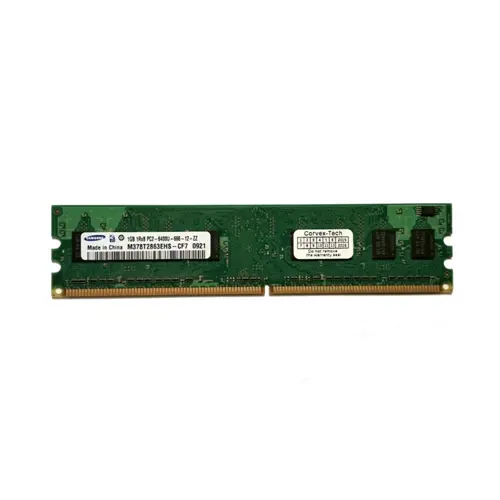
This is a standard desktop memory module, best suited for enhancing responsiveness in legacy DDR2-based systems used for office productivity and light content creation. Its single-rank x8 organization and low CAS latency of 6 cycles at 800MHz minimize access delays, ensuring stable and efficient data handling in unbuffered, non-ECC configurations.
1. 1GB capacity keeps essential applications and light browser multitasking fluid on classic desktops, avoiding the lag spikes that kill productivity during everyday office workflows.
2. DDR2 technology doubles the prefetch depth of its predecessor, delivering a tangible bandwidth lift that accelerates photo batch processing in vintage content-creation suites.
3. 800MHz operating speed supplies 6.4GB/s of peak throughput, directly reducing texture pop-in and stutter when revisiting older open-world games.
4. CL6 timing tightens the column access delay, granting snappier command response that gives competitive retro gamers a split-second advantage in fast-paced titles.
5. Single Rank x8 configuration lowers the electrical load on the memory controller, widening headroom for stable frequency pushes during enthusiast overclocking sessions.
Designed as a desktop UDIMM, the Samsung M378T2863EHS-CF7 brings targeted performance to aging but still capable systems. Its DDR2-800 speed and PC2-6400 bandwidth deliver a peak transfer rate of 6.4 GB/s, which means when you are running a classic 3A title or multitasking with dozens of browser tabs, the module pushes data to the CPU fast enough to prevent the micro-stutters that ruin immersion. The CL6 latency is another real-world advantage: during timeline scrubbing in video rendering or rapid scene transitions in a game, a lower Column Access Strobe delay ensures that requested data is served with minimal waiting, keeping frame pacing consistent and the editing viewport responsive. This is a single-rank x8 module, a configuration that is often friendlier to older memory controllers, enabling stable operation at rated speed without forcing you to downclock when populating multiple slots—critical for breathing life into a legacy workstation. Finally, the unbuffered, Non-ECC architecture eliminates the slight overhead of error correction, shaving off every possible nanosecond of access time for pure performance. For a desktop builder upgrading an old platform to handle demanding retro gaming or a budget video editing rig, this module translates directly into snappier load times, smoother playback, and the confidence that the system will remain stable under sustained workloads, all while meeting EU RoHS and FCC compliance standards.
Gaming Build
For a legacy DDR2 gaming system, install a matched pair of 1GB UDIMMs to activate dual‑channel mode, boosting bandwidth and frame consistency. Mainboards of this era typically limit memory to 4–8GB, so populate four slots with 2GB modules if available; 16GB or 32GB kits require a platform upgrade to DDR4/DDR5.
Content Creation
DDR2 platforms top out around 8GB, far below the 64GB ideal for video editing or 3D rendering. If you must work on such hardware, fill all DIMM slots with the largest supported modules (e.g., 4×2GB) and use fast scratch disks to mitigate capacity constraints. For professional workloads, migrate to a DDR4/DDR5 system that can accommodate high‑density 64GB+ configurations.
General Productivity
A budget‑friendly multi‑tasking setup uses two identical 1GB DDR2‑800 sticks in dual‑channel form, delivering responsive office and web performance. Where cost is paramount, a single 1GB module can run essential applications, though 2×2GB is a noticeable step up for modern Windows operating systems. Always pair identical capacities and ranks to ensure stable, unbuffered operation.
Strictly tested for seamless operation in desktops such as Dell OptiPlex 755, HP dc7800, Lenovo M57.
Q: Can I mix this M378T2863EHS-CF7 with other memory modules of different brands or speeds?
A: Mixing with dissimilar DDR2 modules may cause instability. The system will default to the slowest speed and loosest timings. For optimal reliability, use identical DDR2-800 CL6 UDIMMs from the same vendor.
Q: Is this memory compatible with my system?
A: This 240-pin UDIMM is compatible with desktop motherboards using Intel 965/G31/P45 or AMD 690G/780G chipsets that support DDR2-800. Verify your board supports 1GB single-rank modules.
Q: What is the recommended DIMM population order for optimal performance?
A: For dual-channel configurations, install matched pairs in slots of the same color (e.g., DIMM 1 and 3). Always populate the primary channel first as per the motherboard manual for best signal integrity.
Q: Does this module support overclocking or XMP profiles?
A: No, this module operates at JEDEC-standard DDR2-800 CL6 and does not include XMP profiles. Manual overclocking is not officially supported and may void the warranty, risking system stability.
Q: What warranty and typical failure rate can I expect?
A: A one-year warranty backs this module. It meets EU RoHS and FCC standards for high reliability, with a typical annualized failure rate well below 1% under normal operating conditions.